
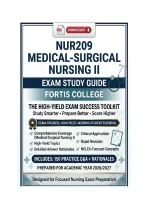
,NUR209 Medical-Surgical Nursing II Exam
Study Guide & 150 Practice Questions Fortis
College 2026/2027
1. A client with acute decompensated heart failure has bilateral crackles, 3+ pitting edema, and
a BNP of 1,200 pg/mL. The nurse anticipates that the priority medication to reduce preload will
be:
A. An oral beta-blocker given at the highest dose.
B. A calcium-channel blocker for afterload reduction only.
C. An intravenous loop diuretic to promote rapid diuresis.
D. Sublingual nitroglycerin every 5 minutes indefinitely.
Correct Answer: C. An intravenous loop diuretic to promote rapid diuresis.
Rationale: Loop diuretics rapidly reduce circulating volume and preload, relieving pulmonary
congestion. Afterload reduction and beta-blockade are important but secondary in acute fluid
overload.
2. A client receiving continuous IV heparin for a pulmonary embolism has an aPTT of 120
seconds (control 28–35 seconds). The nurse's priority action is to:
,A. Increase the infusion rate by 25%.
B. Stop the heparin infusion and notify the provider of the critical value.
C. Administer subcutaneous enoxaparin concurrently.
D. Document the result and recheck in 8 hours without intervention.
Correct Answer: B. Stop the heparin infusion and notify the provider of the critical value.
Rationale: An aPTT significantly above the therapeutic range indicates excessive anticoagulation
and bleeding risk. The infusion is held and the provider notified for rate adjustment.
3. A client with chronic atrial fibrillation is prescribed warfarin. The nurse reinforces teaching
that the client should:
A. Double the next dose if one dose is missed.
B. Take daily aspirin in addition to warfarin for extra protection.
C. Stop the drug 24 hours before any dental procedure without consulting the provider.
D. Maintain a consistent intake of vitamin K-rich foods and report any unusual bleeding or
bruising.
, Correct Answer: D. Maintain a consistent intake of vitamin K-rich foods and report any unusual
bleeding or bruising.
Rationale: Consistent vitamin K intake stabilizes INR. Clients must report bleeding and never
adjust doses or add antiplatelet agents without provider guidance.
4. A postoperative client develops sudden dyspnea, chest pain, and a feeling of impending
doom. SpO₂ drops to 87% on room air. The nurse's immediate priority is to:
A. Ambulate the client to improve circulation.
B. Place the client in high Fowler's position, apply oxygen, and activate the rapid-response team.
C. Encourage deep breathing and relaxation only.
D. Administer a PRN oral anxiolytic and reassess in 30 minutes.
Correct Answer: B. Place the client in high Fowler's position, apply oxygen, and activate the
rapid-response team.
Rationale: These signs suggest possible pulmonary embolism. Supporting oxygenation and
obtaining emergency assistance are the priorities.
Study Guide & 150 Practice Questions Fortis
College 2026/2027
1. A client with acute decompensated heart failure has bilateral crackles, 3+ pitting edema, and
a BNP of 1,200 pg/mL. The nurse anticipates that the priority medication to reduce preload will
be:
A. An oral beta-blocker given at the highest dose.
B. A calcium-channel blocker for afterload reduction only.
C. An intravenous loop diuretic to promote rapid diuresis.
D. Sublingual nitroglycerin every 5 minutes indefinitely.
Correct Answer: C. An intravenous loop diuretic to promote rapid diuresis.
Rationale: Loop diuretics rapidly reduce circulating volume and preload, relieving pulmonary
congestion. Afterload reduction and beta-blockade are important but secondary in acute fluid
overload.
2. A client receiving continuous IV heparin for a pulmonary embolism has an aPTT of 120
seconds (control 28–35 seconds). The nurse's priority action is to:
,A. Increase the infusion rate by 25%.
B. Stop the heparin infusion and notify the provider of the critical value.
C. Administer subcutaneous enoxaparin concurrently.
D. Document the result and recheck in 8 hours without intervention.
Correct Answer: B. Stop the heparin infusion and notify the provider of the critical value.
Rationale: An aPTT significantly above the therapeutic range indicates excessive anticoagulation
and bleeding risk. The infusion is held and the provider notified for rate adjustment.
3. A client with chronic atrial fibrillation is prescribed warfarin. The nurse reinforces teaching
that the client should:
A. Double the next dose if one dose is missed.
B. Take daily aspirin in addition to warfarin for extra protection.
C. Stop the drug 24 hours before any dental procedure without consulting the provider.
D. Maintain a consistent intake of vitamin K-rich foods and report any unusual bleeding or
bruising.
, Correct Answer: D. Maintain a consistent intake of vitamin K-rich foods and report any unusual
bleeding or bruising.
Rationale: Consistent vitamin K intake stabilizes INR. Clients must report bleeding and never
adjust doses or add antiplatelet agents without provider guidance.
4. A postoperative client develops sudden dyspnea, chest pain, and a feeling of impending
doom. SpO₂ drops to 87% on room air. The nurse's immediate priority is to:
A. Ambulate the client to improve circulation.
B. Place the client in high Fowler's position, apply oxygen, and activate the rapid-response team.
C. Encourage deep breathing and relaxation only.
D. Administer a PRN oral anxiolytic and reassess in 30 minutes.
Correct Answer: B. Place the client in high Fowler's position, apply oxygen, and activate the
rapid-response team.
Rationale: These signs suggest possible pulmonary embolism. Supporting oxygenation and
obtaining emergency assistance are the priorities.


