
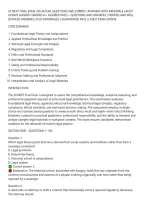
JD NEXT FINAL EXAM 200 ACTUAL QUESTIONS AND CORRECT ANSWERS WITH RATIONALE LATEST
UPDATE ALREADY GRADED A+ ASSURED PASS] – QUESTIONS AND ANSWERS | VERIFIED AND WELL
DETAILED ANSWERS | PLUS RATIONALES | GUARANTEED PASS | LATEST EXAM UPDATE
CORE DOMAINS
1. Foundational Legal Theory and Jurisprudence
2. Applied Professional Knowledge and Practice
3. Technical Legal Concepts and Analysis
4. Regulatory and Legal Compliance
5. Ethics and Professional Standards
6. Real-World Workplace Scenarios
7. Safety and Professional Responsibility
8. Critical Thinking and Problem-Solving
9. Decision-Making and Professional Judgment
10. Interpretation and Analysis of Legal Materials
INTRODUCTION
The JD NEXT Final Exam is designed to assess the comprehensive knowledge, analytical reasoning, and
professional judgment required of entry-level legal practitioners. This examination evaluates
foundational legal theory, applied professional knowledge, technical legal concepts, regulatory
compliance, ethical standards, and real-world decision-making. The assessment employs multiple-
choice and scenario-based questions to measure both direct recall and higher-order critical thinking.
Emphasis is placed on practical application, professional responsibility, and the ability to interpret and
analyze complex legal materials in workplace contexts. This exam ensures candidates demonstrate
readiness for the demands of modern legal practice.
SECTION ONE – QUESTIONS 1–100
Question 1
Which legal theory posits that law is derived from social customs and traditions rather than from a
sovereign command?
A. Legal positivism
B. Natural law theory
C. Historical school of jurisprudence
D. Legal realism
🟢 Correct answer: C
🔴 Explanation: The historical school, associated with Savigny, holds that law originates from the
common consciousness and customs of a people, evolving organically over time rather than being
imposed by a sovereign.
Question 2
A client asks an attorney to draft a contract that intentionally omits a required regulatory disclosure.
The attorney should:
,A. Draft the contract as requested because the client is the decision-maker.
B. Refuse to omit the disclosure and explain the legal and ethical obligations.
C. Draft the contract but note the omission in a separate memo.
D. Refer the client to another attorney without explanation.
🟢 Correct answer: B
🔴 Explanation: An attorney must comply with ethical rules and regulatory requirements. Knowingly
drafting a contract that omits a required disclosure could violate professional conduct rules and assist
in illegal conduct.
Question 3
Which of the following is the primary purpose of the discovery phase in civil litigation?
A. To determine the outcome of the case by a jury.
B. To compel settlement between the parties.
C. To obtain and exchange relevant information before trial.
D. To dismiss frivolous claims.
🟢 Correct answer: C
🔴 Explanation: Discovery allows parties to obtain evidence, narrow issues, and prepare for trial by
exchanging relevant information and documents.
Question 4
Under the principle of stare decisis, a lower court is generally bound by:
A. Decisions of courts in other jurisdictions with similar facts.
B. Decisions of higher courts within the same jurisdiction.
C. Advisory opinions issued by regulatory agencies.
D. Dissenting opinions from the same court.
🟢 Correct answer: B
🔴 Explanation: Stare decisis requires lower courts to follow the precedents set by higher courts in the
same jurisdiction to ensure consistency and predictability.
Question 5
An attorney discovers that a paralegal inadvertently included privileged information in a document
sent to opposing counsel. The attorney should:
A. Ignore the disclosure because it was accidental.
B. Immediately notify opposing counsel and take reasonable steps to retrieve the information.
C. Withdraw from representation to avoid liability.
D. Destroy all related documents.
🟢 Correct answer: B
🔴 Explanation: Upon discovering inadvertent disclosure of privileged information, the attorney must
take reasonable steps to rectify the error, including notifying the receiving party, to preserve the
privilege.
Question 6
Which of the following best describes the concept of "consideration" in contract law?
A. A promise to do something in the future.
B. Something of value exchanged between parties to form a contract.
C. A written acknowledgment of a debt.
D. A moral obligation to perform.
,🟢 Correct answer: B
🔴 Explanation: Consideration is a bargained-for exchange of something of value (a benefit or
detriment) that is necessary for a contract to be enforceable.
Question 7
A corporation's board of directors is considering a merger that would benefit the CEO personally but
harm shareholders. Under the business judgment rule, the board's decision will likely be:
A. Protected if made in good faith and with reasonable care.
B. Protected regardless of conflicts of interest.
C. Invalidated automatically due to the CEO's conflict.
D. Reviewed de novo by the court.
🟢 Correct answer: A
🔴 Explanation: The business judgment rule protects directors from liability if they act in good faith,
with reasonable care, and without conflicts of interest. A personal benefit to the CEO may breach the
duty of loyalty.
Question 8
Which constitutional amendment protects against unreasonable searches and seizures?
A. First Amendment
B. Fourth Amendment
C. Fifth Amendment
D. Sixth Amendment
🟢 Correct answer: B
🔴 Explanation: The Fourth Amendment to the U.S. Constitution protects individuals from
unreasonable searches and seizures by the government.
Question 9
In a negligence action, which element requires proof that the defendant's breach caused the plaintiff's
injury?
A. Duty
B. Breach
C. Causation
D. Damages
🟢 Correct answer: C
🔴 Explanation: Causation (both actual and proximate) links the defendant's breach to the plaintiff's
harm. Duty and breach establish the standard of care, while damages are the resulting loss.
Question 10
A judge is asked to recuse herself because she previously represented a party in a related matter. The
standard for recusal is:
A. Whether the judge has personal knowledge of disputed facts.
B. Whether the judge's impartiality might reasonably be questioned.
C. Whether the judge has a financial interest in the outcome.
D. Whether the judge has expressed a political opinion.
🟢 Correct answer: B
🔴 Explanation: The standard for recusal is whether a reasonable person with knowledge of the facts
would question the judge's impartiality, ensuring public confidence in the judiciary.
, Question 11
Which of the following is an example of a peremptory challenge in jury selection?
A. Dismissing a juror for cause due to bias.
B. Dismissing a juror without stating a reason, subject to constitutional limits.
C. Dismissing a juror because they are related to a party.
D. Dismissing a juror who cannot speak English.
🟢 Correct answer: B
🔴 Explanation: Peremptory challenges allow attorneys to dismiss jurors without cause, but cannot be
used to discriminate based on race, ethnicity, or sex.
Question 12
A real estate developer wants to build on a property that contains a protected wetland. Which federal
law primarily regulates this activity?
A. Clean Air Act
B. Clean Water Act
C. Endangered Species Act
D. National Environmental Policy Act
🟢 Correct answer: B
🔴 Explanation: The Clean Water Act regulates the discharge of pollutants into waters of the United
States, including wetlands, and requires permits for certain activities.
Question 13
An attorney is representing a client in a criminal case. The client confesses to the attorney but wants to
testify falsely. The attorney should:
A. Allow the client to testify falsely to protect confidentiality.
B. Withdraw from representation if the client insists on committing perjury.
C. Inform the judge immediately of the client's intent.
D. Testify on behalf of the client with the false statement.
🟢 Correct answer: B
🔴 Explanation: An attorney cannot knowingly present false evidence. If the client insists on testifying
falsely, the attorney must seek to withdraw or take other remedial measures under professional
conduct rules.
Question 14
Which of the following is a key requirement for a valid will under the Statute of Frauds?
A. It must be notarized.
B. It must be signed by the testator and witnessed by two individuals.
C. It must be filed with the probate court during the testator's lifetime.
D. It must be written in legal terminology.
🟢 Correct answer: B
🔴 Explanation: Most jurisdictions require a will to be in writing, signed by the testator, and witnessed
by a certain number of competent witnesses (often two) to be valid.
Question 15
A company's employee handbook states that employment is "at-will." This means:
A. Employees can only be terminated for cause.
B. Either party can terminate the employment relationship at any time, with or without cause.
UPDATE ALREADY GRADED A+ ASSURED PASS] – QUESTIONS AND ANSWERS | VERIFIED AND WELL
DETAILED ANSWERS | PLUS RATIONALES | GUARANTEED PASS | LATEST EXAM UPDATE
CORE DOMAINS
1. Foundational Legal Theory and Jurisprudence
2. Applied Professional Knowledge and Practice
3. Technical Legal Concepts and Analysis
4. Regulatory and Legal Compliance
5. Ethics and Professional Standards
6. Real-World Workplace Scenarios
7. Safety and Professional Responsibility
8. Critical Thinking and Problem-Solving
9. Decision-Making and Professional Judgment
10. Interpretation and Analysis of Legal Materials
INTRODUCTION
The JD NEXT Final Exam is designed to assess the comprehensive knowledge, analytical reasoning, and
professional judgment required of entry-level legal practitioners. This examination evaluates
foundational legal theory, applied professional knowledge, technical legal concepts, regulatory
compliance, ethical standards, and real-world decision-making. The assessment employs multiple-
choice and scenario-based questions to measure both direct recall and higher-order critical thinking.
Emphasis is placed on practical application, professional responsibility, and the ability to interpret and
analyze complex legal materials in workplace contexts. This exam ensures candidates demonstrate
readiness for the demands of modern legal practice.
SECTION ONE – QUESTIONS 1–100
Question 1
Which legal theory posits that law is derived from social customs and traditions rather than from a
sovereign command?
A. Legal positivism
B. Natural law theory
C. Historical school of jurisprudence
D. Legal realism
🟢 Correct answer: C
🔴 Explanation: The historical school, associated with Savigny, holds that law originates from the
common consciousness and customs of a people, evolving organically over time rather than being
imposed by a sovereign.
Question 2
A client asks an attorney to draft a contract that intentionally omits a required regulatory disclosure.
The attorney should:
,A. Draft the contract as requested because the client is the decision-maker.
B. Refuse to omit the disclosure and explain the legal and ethical obligations.
C. Draft the contract but note the omission in a separate memo.
D. Refer the client to another attorney without explanation.
🟢 Correct answer: B
🔴 Explanation: An attorney must comply with ethical rules and regulatory requirements. Knowingly
drafting a contract that omits a required disclosure could violate professional conduct rules and assist
in illegal conduct.
Question 3
Which of the following is the primary purpose of the discovery phase in civil litigation?
A. To determine the outcome of the case by a jury.
B. To compel settlement between the parties.
C. To obtain and exchange relevant information before trial.
D. To dismiss frivolous claims.
🟢 Correct answer: C
🔴 Explanation: Discovery allows parties to obtain evidence, narrow issues, and prepare for trial by
exchanging relevant information and documents.
Question 4
Under the principle of stare decisis, a lower court is generally bound by:
A. Decisions of courts in other jurisdictions with similar facts.
B. Decisions of higher courts within the same jurisdiction.
C. Advisory opinions issued by regulatory agencies.
D. Dissenting opinions from the same court.
🟢 Correct answer: B
🔴 Explanation: Stare decisis requires lower courts to follow the precedents set by higher courts in the
same jurisdiction to ensure consistency and predictability.
Question 5
An attorney discovers that a paralegal inadvertently included privileged information in a document
sent to opposing counsel. The attorney should:
A. Ignore the disclosure because it was accidental.
B. Immediately notify opposing counsel and take reasonable steps to retrieve the information.
C. Withdraw from representation to avoid liability.
D. Destroy all related documents.
🟢 Correct answer: B
🔴 Explanation: Upon discovering inadvertent disclosure of privileged information, the attorney must
take reasonable steps to rectify the error, including notifying the receiving party, to preserve the
privilege.
Question 6
Which of the following best describes the concept of "consideration" in contract law?
A. A promise to do something in the future.
B. Something of value exchanged between parties to form a contract.
C. A written acknowledgment of a debt.
D. A moral obligation to perform.
,🟢 Correct answer: B
🔴 Explanation: Consideration is a bargained-for exchange of something of value (a benefit or
detriment) that is necessary for a contract to be enforceable.
Question 7
A corporation's board of directors is considering a merger that would benefit the CEO personally but
harm shareholders. Under the business judgment rule, the board's decision will likely be:
A. Protected if made in good faith and with reasonable care.
B. Protected regardless of conflicts of interest.
C. Invalidated automatically due to the CEO's conflict.
D. Reviewed de novo by the court.
🟢 Correct answer: A
🔴 Explanation: The business judgment rule protects directors from liability if they act in good faith,
with reasonable care, and without conflicts of interest. A personal benefit to the CEO may breach the
duty of loyalty.
Question 8
Which constitutional amendment protects against unreasonable searches and seizures?
A. First Amendment
B. Fourth Amendment
C. Fifth Amendment
D. Sixth Amendment
🟢 Correct answer: B
🔴 Explanation: The Fourth Amendment to the U.S. Constitution protects individuals from
unreasonable searches and seizures by the government.
Question 9
In a negligence action, which element requires proof that the defendant's breach caused the plaintiff's
injury?
A. Duty
B. Breach
C. Causation
D. Damages
🟢 Correct answer: C
🔴 Explanation: Causation (both actual and proximate) links the defendant's breach to the plaintiff's
harm. Duty and breach establish the standard of care, while damages are the resulting loss.
Question 10
A judge is asked to recuse herself because she previously represented a party in a related matter. The
standard for recusal is:
A. Whether the judge has personal knowledge of disputed facts.
B. Whether the judge's impartiality might reasonably be questioned.
C. Whether the judge has a financial interest in the outcome.
D. Whether the judge has expressed a political opinion.
🟢 Correct answer: B
🔴 Explanation: The standard for recusal is whether a reasonable person with knowledge of the facts
would question the judge's impartiality, ensuring public confidence in the judiciary.
, Question 11
Which of the following is an example of a peremptory challenge in jury selection?
A. Dismissing a juror for cause due to bias.
B. Dismissing a juror without stating a reason, subject to constitutional limits.
C. Dismissing a juror because they are related to a party.
D. Dismissing a juror who cannot speak English.
🟢 Correct answer: B
🔴 Explanation: Peremptory challenges allow attorneys to dismiss jurors without cause, but cannot be
used to discriminate based on race, ethnicity, or sex.
Question 12
A real estate developer wants to build on a property that contains a protected wetland. Which federal
law primarily regulates this activity?
A. Clean Air Act
B. Clean Water Act
C. Endangered Species Act
D. National Environmental Policy Act
🟢 Correct answer: B
🔴 Explanation: The Clean Water Act regulates the discharge of pollutants into waters of the United
States, including wetlands, and requires permits for certain activities.
Question 13
An attorney is representing a client in a criminal case. The client confesses to the attorney but wants to
testify falsely. The attorney should:
A. Allow the client to testify falsely to protect confidentiality.
B. Withdraw from representation if the client insists on committing perjury.
C. Inform the judge immediately of the client's intent.
D. Testify on behalf of the client with the false statement.
🟢 Correct answer: B
🔴 Explanation: An attorney cannot knowingly present false evidence. If the client insists on testifying
falsely, the attorney must seek to withdraw or take other remedial measures under professional
conduct rules.
Question 14
Which of the following is a key requirement for a valid will under the Statute of Frauds?
A. It must be notarized.
B. It must be signed by the testator and witnessed by two individuals.
C. It must be filed with the probate court during the testator's lifetime.
D. It must be written in legal terminology.
🟢 Correct answer: B
🔴 Explanation: Most jurisdictions require a will to be in writing, signed by the testator, and witnessed
by a certain number of competent witnesses (often two) to be valid.
Question 15
A company's employee handbook states that employment is "at-will." This means:
A. Employees can only be terminated for cause.
B. Either party can terminate the employment relationship at any time, with or without cause.


