
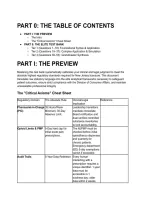
PART 0: THE TABLE OF CONTENTS
● PART I: THE PREVIEW
○ The Intro
○ The "Critical Axioms" Cheat Sheet
● PART II: THE ELITE TEST BANK
○ Tier 1 (Questions 1–18): Foundational Syntax & Application
○ Tier 2 (Questions 19–37): Complex Application & Simulation
○ Tier 3 (Questions 38–55): Grandmaster Synthesis
PART I: THE PREVIEW
Mastering this test bank systematically calibrates your clinical and legal judgment to meet the
absolute highest regulatory standards required for New Jersey licensure. This document
translates raw statutory language into the elite analytical frameworks necessary to safeguard
patient outcomes, ensure strict compliance with the Division of Consumer Affairs, and maintain
unassailable professional integrity.
The "Critical Axioms" Cheat Sheet
Regulatory Domain The Absolute Rule Clinical/Legal Reference
Implication
Pharmacist-in-Charge 35 Hours/Week Leadership transitions
(PIC) Minimum; 30-Day mandate immediate
Absence Limit. Board notification and
dual-verified controlled
substance inventories
to lock accountability.
Opioid Limits & PMP 5-Day hard cap for The NJPMP must be
initial acute pain checked before initial
prescriptions. opioid/benzo dispenses
and quarterly for
chronic patients.
Emergency department
(ED) 5-day exemptions
vanish if exceeded.
Audit Trails 5-Year Data Retention. Every human
interacting with a
prescription requires a
unique identifier. 1-year
data must be
accessible in 1
business day; older
data within 2 weeks.
,Regulatory Domain The Absolute Rule Clinical/Legal Reference
Implication
Immunizations Patients 5+ for Minors require written
COVID/Flu; 24hr/72hr parental consent.
Reporting. Adverse events must
be reported to the
delegating physician
(24h) and government
(72h).
Pharmacy 180-Day Applicant Technicians cannot
Technicians Window; Default 1:2 perform clinical
Ratio. reviews. Unchanged
renewals are permitted.
Ratios exceeding 1:2
require signed P&P
manuals and
documented training.
PART II: THE ELITE TEST BANK
Tier 1: Foundational Syntax & Application
Q1: A retail pharmacy is undergoing a change in Pharmacist-in-Charge (PIC). Based on the
principles of N.J.A.C. 13:39-6.2, which action regarding controlled substances is REQUIRED?
A) A complete inventory of all controlled dangerous substances must be performed by the
incoming PIC within 72 hours of assuming the role. B) The outgoing PIC must solely execute a
biennial inventory and submit it to the Drug Control Unit. C) An inventory of all controlled
dangerous substances must be performed by both the outgoing and incoming PIC. D) The
pharmacy permit holder must hire an independent auditor to inventory Schedule II medications.
● Answer: C (An inventory of all controlled dangerous substances must be performed by
both the outgoing and incoming PIC)
● Distractor Analysis:
○ A is incorrect: The inventory must be executed jointly to establish a shared chain of
custody, not solely by the incoming PIC .
○ B is incorrect: The legal burden falls upon both individuals simultaneously to
prevent diversion during leadership transitions .
○ D is incorrect: There is no statutory framework requiring external auditors for routine
PIC changes .
The Mentor's Analysis: Controlled substance accountability demands seamless continuity.
When leadership transitions, dual verification establishes a definitive baseline and immediately
transfers legal liability to the incoming PIC. When facing a PIC transition, the immediate priority
is dual-verification. By utilizing a joint inventory, you bypass the common trap of inherited
discrepancies. Professional Intuition: Always conduct a joint controlled substance inventory
when the PIC changes to securely transfer legal liability.
Q2: A newly licensed pharmacist is calculating their continuing education (CE) requirements for
their first full biennial renewal period. Based on New Jersey Pharmacy Law, what is the
MINIMUM distribution of CE credits?
, A) 30 total hours, with at least 15 live hours, 3 hours of law, and 2 hours on opioids. B) 30 total
hours, with at least 10 live hours, 3 hours of pharmacy law, and 1 hour on prescription opioids.
C) 40 total hours, with at least 20 live hours, and 5 hours of pharmacy law. D) 30 total hours,
with no specific live hour requirement, but 3 hours of law and 1 hour of opioids.
● Answer: B (30 total hours, with at least 10 live hours, 3 hours of pharmacy law, and 1 hour
on prescription opioids)
● Distractor Analysis:
○ A is incorrect: The opioid requirement is exactly 1 hour, and the live requirement is
10 hours, not 15.
○ C is incorrect: New Jersey strictly requires 30 total hours, not 40.
○ D is incorrect: A minimum of 10 didactic, interactive live hours is an absolute
mandate.
The Mentor's Analysis: Regulatory competence requires structured, ongoing education. The
Board targets high-risk domains—jurisprudence and opioid management—to maintain baseline
public safety. When facing license renewal, the immediate priority is verifying specific category
minimums. By utilizing the 30-10-3-1 matrix, you bypass the common trap of generic hour
accumulation. Professional Intuition: Memorize the baseline matrix: 30 total, 10 live, 3 law, 1
opioid.
Q3: A patient presents a new prescription for an immediate-release opioid for acute back pain,
having never received an opioid previously. Based on New Jersey opioid prescribing laws, what
is the MAXIMUM supply the pharmacist may legally dispense initially?
A) A 3-day supply B) A 7-day supply C) A 5-day supply D) A 14-day supply
● Answer: C (A 5-day supply)
● Distractor Analysis:
○ A is incorrect: While stringent, the New Jersey statute sets the threshold at 5 days,
not 3.
○ B is incorrect: Dispensing a 7-day initial supply violates the core legislation
designed to curb iatrogenic dependence.
○ D is incorrect: Fourteen-day protocols apply to subsequent or chronic pain
management, not naive initial acute presentations.
The Mentor's Analysis: Initial opioid exposure is the primary vector for addiction. The 5-day limit
forces a rapid, mandatory clinical reassessment by the prescriber before further opioids are
authorized. When facing naive acute pain prescriptions, the immediate priority is limiting
exposure. By utilizing the 5-day hard cap, you bypass the common trap of over-dispensing
high-risk narcotics. Professional Intuition: Initial acute opioid prescriptions are hard-capped
at 5 days; flag and reject any initial order exceeding this limit.
Q4: A pharmacist is establishing a workflow for the New Jersey Prescription Monitoring Program
(NJPMP). Based on N.J.A.C. 13:45A-35.9, which scenario requires a MANDATORY lookup by
the dispensing pharmacist?
A) Prior to dispensing any non-controlled maintenance prescription for a patient concurrently
taking an opioid. B) When the pharmacist has a reasonable belief the person is seeking a
Schedule II-V drug for diversion or misuse. C) Prior to dispensing every single refill of a
Schedule IV sleep aid. D) Prior to dispensing a 3-day supply of a Schedule II drug prescribed in
a hospital emergency department.
● Answer: B (When the pharmacist has a reasonable belief the person is seeking a
Schedule II-V drug for diversion or misuse)
● Distractor Analysis:
○ A is incorrect: The NJPMP mandate strictly applies to controlled dangerous
● PART I: THE PREVIEW
○ The Intro
○ The "Critical Axioms" Cheat Sheet
● PART II: THE ELITE TEST BANK
○ Tier 1 (Questions 1–18): Foundational Syntax & Application
○ Tier 2 (Questions 19–37): Complex Application & Simulation
○ Tier 3 (Questions 38–55): Grandmaster Synthesis
PART I: THE PREVIEW
Mastering this test bank systematically calibrates your clinical and legal judgment to meet the
absolute highest regulatory standards required for New Jersey licensure. This document
translates raw statutory language into the elite analytical frameworks necessary to safeguard
patient outcomes, ensure strict compliance with the Division of Consumer Affairs, and maintain
unassailable professional integrity.
The "Critical Axioms" Cheat Sheet
Regulatory Domain The Absolute Rule Clinical/Legal Reference
Implication
Pharmacist-in-Charge 35 Hours/Week Leadership transitions
(PIC) Minimum; 30-Day mandate immediate
Absence Limit. Board notification and
dual-verified controlled
substance inventories
to lock accountability.
Opioid Limits & PMP 5-Day hard cap for The NJPMP must be
initial acute pain checked before initial
prescriptions. opioid/benzo dispenses
and quarterly for
chronic patients.
Emergency department
(ED) 5-day exemptions
vanish if exceeded.
Audit Trails 5-Year Data Retention. Every human
interacting with a
prescription requires a
unique identifier. 1-year
data must be
accessible in 1
business day; older
data within 2 weeks.
,Regulatory Domain The Absolute Rule Clinical/Legal Reference
Implication
Immunizations Patients 5+ for Minors require written
COVID/Flu; 24hr/72hr parental consent.
Reporting. Adverse events must
be reported to the
delegating physician
(24h) and government
(72h).
Pharmacy 180-Day Applicant Technicians cannot
Technicians Window; Default 1:2 perform clinical
Ratio. reviews. Unchanged
renewals are permitted.
Ratios exceeding 1:2
require signed P&P
manuals and
documented training.
PART II: THE ELITE TEST BANK
Tier 1: Foundational Syntax & Application
Q1: A retail pharmacy is undergoing a change in Pharmacist-in-Charge (PIC). Based on the
principles of N.J.A.C. 13:39-6.2, which action regarding controlled substances is REQUIRED?
A) A complete inventory of all controlled dangerous substances must be performed by the
incoming PIC within 72 hours of assuming the role. B) The outgoing PIC must solely execute a
biennial inventory and submit it to the Drug Control Unit. C) An inventory of all controlled
dangerous substances must be performed by both the outgoing and incoming PIC. D) The
pharmacy permit holder must hire an independent auditor to inventory Schedule II medications.
● Answer: C (An inventory of all controlled dangerous substances must be performed by
both the outgoing and incoming PIC)
● Distractor Analysis:
○ A is incorrect: The inventory must be executed jointly to establish a shared chain of
custody, not solely by the incoming PIC .
○ B is incorrect: The legal burden falls upon both individuals simultaneously to
prevent diversion during leadership transitions .
○ D is incorrect: There is no statutory framework requiring external auditors for routine
PIC changes .
The Mentor's Analysis: Controlled substance accountability demands seamless continuity.
When leadership transitions, dual verification establishes a definitive baseline and immediately
transfers legal liability to the incoming PIC. When facing a PIC transition, the immediate priority
is dual-verification. By utilizing a joint inventory, you bypass the common trap of inherited
discrepancies. Professional Intuition: Always conduct a joint controlled substance inventory
when the PIC changes to securely transfer legal liability.
Q2: A newly licensed pharmacist is calculating their continuing education (CE) requirements for
their first full biennial renewal period. Based on New Jersey Pharmacy Law, what is the
MINIMUM distribution of CE credits?
, A) 30 total hours, with at least 15 live hours, 3 hours of law, and 2 hours on opioids. B) 30 total
hours, with at least 10 live hours, 3 hours of pharmacy law, and 1 hour on prescription opioids.
C) 40 total hours, with at least 20 live hours, and 5 hours of pharmacy law. D) 30 total hours,
with no specific live hour requirement, but 3 hours of law and 1 hour of opioids.
● Answer: B (30 total hours, with at least 10 live hours, 3 hours of pharmacy law, and 1 hour
on prescription opioids)
● Distractor Analysis:
○ A is incorrect: The opioid requirement is exactly 1 hour, and the live requirement is
10 hours, not 15.
○ C is incorrect: New Jersey strictly requires 30 total hours, not 40.
○ D is incorrect: A minimum of 10 didactic, interactive live hours is an absolute
mandate.
The Mentor's Analysis: Regulatory competence requires structured, ongoing education. The
Board targets high-risk domains—jurisprudence and opioid management—to maintain baseline
public safety. When facing license renewal, the immediate priority is verifying specific category
minimums. By utilizing the 30-10-3-1 matrix, you bypass the common trap of generic hour
accumulation. Professional Intuition: Memorize the baseline matrix: 30 total, 10 live, 3 law, 1
opioid.
Q3: A patient presents a new prescription for an immediate-release opioid for acute back pain,
having never received an opioid previously. Based on New Jersey opioid prescribing laws, what
is the MAXIMUM supply the pharmacist may legally dispense initially?
A) A 3-day supply B) A 7-day supply C) A 5-day supply D) A 14-day supply
● Answer: C (A 5-day supply)
● Distractor Analysis:
○ A is incorrect: While stringent, the New Jersey statute sets the threshold at 5 days,
not 3.
○ B is incorrect: Dispensing a 7-day initial supply violates the core legislation
designed to curb iatrogenic dependence.
○ D is incorrect: Fourteen-day protocols apply to subsequent or chronic pain
management, not naive initial acute presentations.
The Mentor's Analysis: Initial opioid exposure is the primary vector for addiction. The 5-day limit
forces a rapid, mandatory clinical reassessment by the prescriber before further opioids are
authorized. When facing naive acute pain prescriptions, the immediate priority is limiting
exposure. By utilizing the 5-day hard cap, you bypass the common trap of over-dispensing
high-risk narcotics. Professional Intuition: Initial acute opioid prescriptions are hard-capped
at 5 days; flag and reject any initial order exceeding this limit.
Q4: A pharmacist is establishing a workflow for the New Jersey Prescription Monitoring Program
(NJPMP). Based on N.J.A.C. 13:45A-35.9, which scenario requires a MANDATORY lookup by
the dispensing pharmacist?
A) Prior to dispensing any non-controlled maintenance prescription for a patient concurrently
taking an opioid. B) When the pharmacist has a reasonable belief the person is seeking a
Schedule II-V drug for diversion or misuse. C) Prior to dispensing every single refill of a
Schedule IV sleep aid. D) Prior to dispensing a 3-day supply of a Schedule II drug prescribed in
a hospital emergency department.
● Answer: B (When the pharmacist has a reasonable belief the person is seeking a
Schedule II-V drug for diversion or misuse)
● Distractor Analysis:
○ A is incorrect: The NJPMP mandate strictly applies to controlled dangerous


