
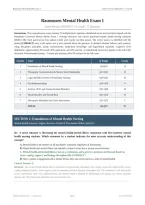
Rasmussen Mental Health Exam 1 Latest Version (2026/2027) - A-Grade
Rasmussen Mental Health Exam 1
Latest Version (2026/2027) - A-Grade | 75 Questions
Instructions: This comprehensive exam contains 75 multiple-choice questions distributed across seven sections aligned with the
Rasmussen University Mental Health Exam 1 learning objectives and current psychiatric-mental health nursing standards
(DSM-5-TR). Each question has four options (A-D) with exactly one best answer. The correct answer is identified with the
marker [CORRECT] next to the option and is also repeated below the question. A detailed rationale follows each question,
citing therapeutic principles, safety considerations, medication knowledge, and legal/ethical standards. Cognitive level
distribution: approximately 30% recall, 50% application, and 20% analysis. A consolidated answer key appears at the end of the
document. Recommended pacing: ~1 minute per question; allow 90 minutes for the full exam.
Section Topic Q Range Count
1 Foundations of Mental Health Nursing Q1-Q12 12
2 Therapeutic Communication & Nurse-Client Relationship Q13-Q25 13
3 Legal and Ethical Issues in Psychiatric Nursing Q26-Q35 10
4 Psychopharmacology Q36-Q50 15
5 Anxiety, OCD, and Trauma-Related Disorders Q51-Q60 10
6 Mood Disorders and Suicide Risk Q61-Q70 10
7 Therapeutic Modalities and Crisis Intervention Q71-Q75 5
TOTAL Q1-Q75 75
SECTION 1: Foundations of Mental Health Nursing
Mental Health Concepts, Stigma, Recovery Model, & Therapeutic Milieu (Q1-Q12)
Q1: A nurse educator is discussing the mental health-mental illness continuum with first-semester mental
health nursing students. Which statement by a student indicates the most accurate understanding of this
concept?
A. Mental health is the absence of all psychiatric symptoms regardless of functioning
B. Mental health and mental illness are mutually exclusive states that a person moves between
C. Mental health and mental illness exist on a continuum, and a person's position can fluctuate based on
stress, coping, support, and biology throughout life [CORRECT]
D. Once a person is diagnosed with a mental illness, they can never return to a state of mental health
Correct Answer: C
Rationale: The mental health-mental illness continuum recognizes that individuals move along a spectrum influenced by stress,
coping, biological factors, social support, and environment; positions fluctuate throughout life. The continuum is not binary (B),
is not a permanent state once diagnosed (D), and mental health is defined by functioning and coping, not merely symptom
absence (A). This framework underlies recovery-oriented care.
Mental Health Exam 1 - 75 Questions Page 1 A-Grade Verified
,Rasmussen Mental Health Exam 1 Latest Version (2026/2027) - A-Grade
Q2: A new psychiatric-mental health nurse asks the charge nurse about stigma in mental health care. Which
response by the charge nurse best reflects the impact of stigma on client outcomes?
A. Stigma leads to delayed treatment seeking, reduced adherence, social isolation, and poorer outcomes, and
nurses can reduce it through respectful, person-first language and education [CORRECT]
B. Stigma is helpful because it motivates clients to hide symptoms and appear normal
C. Stigma only affects clients with severe psychotic disorders
D. Stigma is primarily an internal client problem with little effect on access to care
Correct Answer: A
Rationale: Stigma contributes to delayed treatment-seeking, medication nonadherence, social isolation, and poorer outcomes;
nurses can mitigate it through person-first language, education, and respectful, recovery-oriented care. Stigma is not merely an
internal issue (D), is not helpful (B), and affects clients across diagnostic categories (C). Addressing stigma is a SAMHSA
recovery priority.
Q3: A client with schizophrenia tells the nurse, 'I'm not like those people on TV who have mental illness. I'm a
person who happens to have schizophrenia.' Which concept is the client demonstrating, and what is the
nurse's most therapeutic response?
A. The client is in denial; the nurse should correct the client's understanding of the diagnosis
B. The client is using person-first language and demonstrating recovery-oriented self-identity; the nurse
should affirm this with 'You're right, you are a person first, and your diagnosis does not define you'
[CORRECT]
C. The client is showing thought disorder; the nurse should reorient to reality
D. The client is splitting; the nurse should set limits on the conversation
Correct Answer: B
Rationale: The client's statement reflects person-first language and recovery-oriented identity-separating self from diagnosis.
The nurse should affirm this ('You're right, you are a person first'). Correcting (A), reorienting (C), or setting limits (D) would be
non-therapeutic and invalidate the client's self-concept. Affirming personhood is core to recovery-oriented care.
Q4: A nurse manager is implementing the recovery model on an inpatient psychiatric unit. Which
intervention best reflects SAMHSA's recovery-oriented principles?
A. Collaboratively developing individualized recovery plans with clients that emphasize hope, empowerment,
self-determination, and meaningful life goals [CORRECT]
B. Restricting client access to information about their medications to prevent misuse
C. Making all decisions about discharge timing without involving the client
D. Developing unit rules that staff enforce uniformly without client input to maintain order
Correct Answer: A
Rationale: SAMHSA's recovery model emphasizes hope, empowerment, self-determination, person-driven care, and meaningful
life goals-collaboratively developed with the client. Uniform staff-enforced rules without client input (D), restricted medication
information (B), and excluding the client from discharge decisions (C) contradict recovery principles. Recovery-oriented care
positions the client as the driver of their own treatment.
Mental Health Exam 1 - 75 Questions Page 2 A-Grade Verified
, Rasmussen Mental Health Exam 1 Latest Version (2026/2027) - A-Grade
Q5: A nursing student is learning about resilience in mental health nursing. Which client scenario best
demonstrates resilience?
A. A client with bipolar disorder who, after a recent hospitalization, resumes work part-time, attends a
support group, and uses a relapse prevention plan developed with the team [CORRECT]
B. A client who refuses all medications because they believe their faith alone will prevent relapse
C. A client who isolates from family and friends to avoid burdening them with their illness
D. A client who has been symptom-free for 10 years after one episode of depression and avoids all stressors
Correct Answer: A
Rationale: Resilience is the ability to adapt and bounce back from adversity, demonstrated by the client with bipolar disorder
resuming work, attending support groups, and using a relapse prevention plan. Avoiding all stressors (D) is avoidance, not
resilience; refusing all medication against medical advice (B) risks relapse; and isolation (C) reflects maladaptive coping.
Resilience involves active coping and engagement.
Q6: A mental health nurse is establishing a therapeutic milieu on an inpatient unit. Which element is most
essential to the therapeutic milieu?
A. A purely medical environment where nurses administer medications without client interaction
B. An unstructured environment where clients do whatever they want at all times
C. A punitive environment where rule violations result in immediate seclusion
D. A structured, safe environment that supports therapeutic communication, client autonomy, and growth
through structured activities, community meetings, and consistent boundaries [CORRECT]
Correct Answer: D
Rationale: A therapeutic milieu is a structured, safe environment promoting therapeutic communication, client autonomy,
growth, and consistent boundaries through activities, community meetings, and predictable routines. Purely medical
environments (A), unstructured environments (B), and punitive settings (C) do not create therapeutic milieu. The milieu itself is a
treatment tool.
Q7: A nurse is caring for a client who recently immigrated and presents with symptoms of depression. The
client describes their symptoms using cultural terms that do not map directly onto DSM-5-TR categories.
Which nursing action best demonstrates cultural competence?
A. Telling the client their cultural beliefs are superstitions and should be abandoned
B. Documenting only observable behaviors and ignoring the client's narrative
C. Disregarding the client's cultural explanation and applying standard DSM-5-TR criteria only
D. Exploring the client's cultural understanding of their illness, involving cultural brokers or interpreters as
needed, and integrating cultural context into assessment and care planning [CORRECT]
Correct Answer: D
Rationale: Cultural competence involves exploring the client's explanatory model of illness, using interpreters or cultural
brokers as needed, and integrating cultural context into assessment and care planning. Disregarding cultural explanations (C),
dismissing beliefs as superstitions (A), or ignoring the client's narrative (B) are culturally insensitive. DSM-5-TR includes the
Cultural Formulation Interview for this purpose.
Mental Health Exam 1 - 75 Questions Page 3 A-Grade Verified
Rasmussen Mental Health Exam 1
Latest Version (2026/2027) - A-Grade | 75 Questions
Instructions: This comprehensive exam contains 75 multiple-choice questions distributed across seven sections aligned with the
Rasmussen University Mental Health Exam 1 learning objectives and current psychiatric-mental health nursing standards
(DSM-5-TR). Each question has four options (A-D) with exactly one best answer. The correct answer is identified with the
marker [CORRECT] next to the option and is also repeated below the question. A detailed rationale follows each question,
citing therapeutic principles, safety considerations, medication knowledge, and legal/ethical standards. Cognitive level
distribution: approximately 30% recall, 50% application, and 20% analysis. A consolidated answer key appears at the end of the
document. Recommended pacing: ~1 minute per question; allow 90 minutes for the full exam.
Section Topic Q Range Count
1 Foundations of Mental Health Nursing Q1-Q12 12
2 Therapeutic Communication & Nurse-Client Relationship Q13-Q25 13
3 Legal and Ethical Issues in Psychiatric Nursing Q26-Q35 10
4 Psychopharmacology Q36-Q50 15
5 Anxiety, OCD, and Trauma-Related Disorders Q51-Q60 10
6 Mood Disorders and Suicide Risk Q61-Q70 10
7 Therapeutic Modalities and Crisis Intervention Q71-Q75 5
TOTAL Q1-Q75 75
SECTION 1: Foundations of Mental Health Nursing
Mental Health Concepts, Stigma, Recovery Model, & Therapeutic Milieu (Q1-Q12)
Q1: A nurse educator is discussing the mental health-mental illness continuum with first-semester mental
health nursing students. Which statement by a student indicates the most accurate understanding of this
concept?
A. Mental health is the absence of all psychiatric symptoms regardless of functioning
B. Mental health and mental illness are mutually exclusive states that a person moves between
C. Mental health and mental illness exist on a continuum, and a person's position can fluctuate based on
stress, coping, support, and biology throughout life [CORRECT]
D. Once a person is diagnosed with a mental illness, they can never return to a state of mental health
Correct Answer: C
Rationale: The mental health-mental illness continuum recognizes that individuals move along a spectrum influenced by stress,
coping, biological factors, social support, and environment; positions fluctuate throughout life. The continuum is not binary (B),
is not a permanent state once diagnosed (D), and mental health is defined by functioning and coping, not merely symptom
absence (A). This framework underlies recovery-oriented care.
Mental Health Exam 1 - 75 Questions Page 1 A-Grade Verified
,Rasmussen Mental Health Exam 1 Latest Version (2026/2027) - A-Grade
Q2: A new psychiatric-mental health nurse asks the charge nurse about stigma in mental health care. Which
response by the charge nurse best reflects the impact of stigma on client outcomes?
A. Stigma leads to delayed treatment seeking, reduced adherence, social isolation, and poorer outcomes, and
nurses can reduce it through respectful, person-first language and education [CORRECT]
B. Stigma is helpful because it motivates clients to hide symptoms and appear normal
C. Stigma only affects clients with severe psychotic disorders
D. Stigma is primarily an internal client problem with little effect on access to care
Correct Answer: A
Rationale: Stigma contributes to delayed treatment-seeking, medication nonadherence, social isolation, and poorer outcomes;
nurses can mitigate it through person-first language, education, and respectful, recovery-oriented care. Stigma is not merely an
internal issue (D), is not helpful (B), and affects clients across diagnostic categories (C). Addressing stigma is a SAMHSA
recovery priority.
Q3: A client with schizophrenia tells the nurse, 'I'm not like those people on TV who have mental illness. I'm a
person who happens to have schizophrenia.' Which concept is the client demonstrating, and what is the
nurse's most therapeutic response?
A. The client is in denial; the nurse should correct the client's understanding of the diagnosis
B. The client is using person-first language and demonstrating recovery-oriented self-identity; the nurse
should affirm this with 'You're right, you are a person first, and your diagnosis does not define you'
[CORRECT]
C. The client is showing thought disorder; the nurse should reorient to reality
D. The client is splitting; the nurse should set limits on the conversation
Correct Answer: B
Rationale: The client's statement reflects person-first language and recovery-oriented identity-separating self from diagnosis.
The nurse should affirm this ('You're right, you are a person first'). Correcting (A), reorienting (C), or setting limits (D) would be
non-therapeutic and invalidate the client's self-concept. Affirming personhood is core to recovery-oriented care.
Q4: A nurse manager is implementing the recovery model on an inpatient psychiatric unit. Which
intervention best reflects SAMHSA's recovery-oriented principles?
A. Collaboratively developing individualized recovery plans with clients that emphasize hope, empowerment,
self-determination, and meaningful life goals [CORRECT]
B. Restricting client access to information about their medications to prevent misuse
C. Making all decisions about discharge timing without involving the client
D. Developing unit rules that staff enforce uniformly without client input to maintain order
Correct Answer: A
Rationale: SAMHSA's recovery model emphasizes hope, empowerment, self-determination, person-driven care, and meaningful
life goals-collaboratively developed with the client. Uniform staff-enforced rules without client input (D), restricted medication
information (B), and excluding the client from discharge decisions (C) contradict recovery principles. Recovery-oriented care
positions the client as the driver of their own treatment.
Mental Health Exam 1 - 75 Questions Page 2 A-Grade Verified
, Rasmussen Mental Health Exam 1 Latest Version (2026/2027) - A-Grade
Q5: A nursing student is learning about resilience in mental health nursing. Which client scenario best
demonstrates resilience?
A. A client with bipolar disorder who, after a recent hospitalization, resumes work part-time, attends a
support group, and uses a relapse prevention plan developed with the team [CORRECT]
B. A client who refuses all medications because they believe their faith alone will prevent relapse
C. A client who isolates from family and friends to avoid burdening them with their illness
D. A client who has been symptom-free for 10 years after one episode of depression and avoids all stressors
Correct Answer: A
Rationale: Resilience is the ability to adapt and bounce back from adversity, demonstrated by the client with bipolar disorder
resuming work, attending support groups, and using a relapse prevention plan. Avoiding all stressors (D) is avoidance, not
resilience; refusing all medication against medical advice (B) risks relapse; and isolation (C) reflects maladaptive coping.
Resilience involves active coping and engagement.
Q6: A mental health nurse is establishing a therapeutic milieu on an inpatient unit. Which element is most
essential to the therapeutic milieu?
A. A purely medical environment where nurses administer medications without client interaction
B. An unstructured environment where clients do whatever they want at all times
C. A punitive environment where rule violations result in immediate seclusion
D. A structured, safe environment that supports therapeutic communication, client autonomy, and growth
through structured activities, community meetings, and consistent boundaries [CORRECT]
Correct Answer: D
Rationale: A therapeutic milieu is a structured, safe environment promoting therapeutic communication, client autonomy,
growth, and consistent boundaries through activities, community meetings, and predictable routines. Purely medical
environments (A), unstructured environments (B), and punitive settings (C) do not create therapeutic milieu. The milieu itself is a
treatment tool.
Q7: A nurse is caring for a client who recently immigrated and presents with symptoms of depression. The
client describes their symptoms using cultural terms that do not map directly onto DSM-5-TR categories.
Which nursing action best demonstrates cultural competence?
A. Telling the client their cultural beliefs are superstitions and should be abandoned
B. Documenting only observable behaviors and ignoring the client's narrative
C. Disregarding the client's cultural explanation and applying standard DSM-5-TR criteria only
D. Exploring the client's cultural understanding of their illness, involving cultural brokers or interpreters as
needed, and integrating cultural context into assessment and care planning [CORRECT]
Correct Answer: D
Rationale: Cultural competence involves exploring the client's explanatory model of illness, using interpreters or cultural
brokers as needed, and integrating cultural context into assessment and care planning. Disregarding cultural explanations (C),
dismissing beliefs as superstitions (A), or ignoring the client's narrative (B) are culturally insensitive. DSM-5-TR includes the
Cultural Formulation Interview for this purpose.
Mental Health Exam 1 - 75 Questions Page 3 A-Grade Verified


