
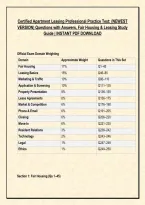
Certified Apartment Leasing Professional Practice Test: (NEWEST
VERSION) Questions with Answers, Fair Housing & Leasing Study
Guide | INSTANT PDF DOWNLOAD
Official Exam Domain Weighting
Domain Approximate Weight Questions in This Set
Fair Housing 17% Q1–45
Leasing Basics 15% Q46–85
Marketing & Traffic 10% Q86–110
Application & Screening 10% Q111–135
Property Presentation 9% Q136–155
Lease Agreements 8% Q156–175
Market & Competition 6% Q176–190
Phone & Email 6% Q191–205
Closing 6% Q206–220
Move-In 6% Q221–235
Resident Relations 3% Q236–242
Technology 2% Q243–246
Legal 1% Q247–248
Ethics 1% Q249–250
Section 1: Fair Housing (Qs 1–45)
,Q1. What are the physical changes made to an apartment home or common area to protect
the fair housing rights of persons with disabilities?
A) Accommodations
B) Considerations
C) Modifications
D) Regulations
Answer: C
Modifications are physical changes to a dwelling or common area to accommodate a person
with a disability. Accommodations are changes to rules, policies, or services .
Q2. Residential properties are permitted to use which screening criteria to legally
discriminate?
A) Handicap
B) Family status
C) Rental history
D) Employment status
Answer: C
Rental history is a legitimate, non-discriminatory screening criterion. Handicap and family
status are protected classes under fair housing law .
,Q3. Discrimination due to disparate impact means that a policy or procedure:
A) Negatively affects persons of a particular age group
B) Has different impacts on persons of certain protected classes
C) Adversely affects persons who do not have the capacity to legally abide
D) Violates the rights of persons as given in the Fair Credit Reporting Act
Answer: B
Disparate impact occurs when a neutral policy has a discriminatory effect on a protected
class, regardless of intent .
Q4. Which of the following is a protected class under the Fair Housing Act?
A) Source of income
B) Credit score
C) Rental history
D) Employment status
Answer: A
Source of income is a protected class in many jurisdictions. Credit score, rental history, and
employment status are legitimate screening criteria .
Q5. A prospect asks if the community is "family-friendly." How should the leasing
professional respond?
A) "We don't allow children."
, B) "We welcome all residents and comply with fair housing laws. Let me show you our
amenities."
C) "We have a separate building for families."
D) "Families are only allowed on the first floor."
Answer: B
The response should be welcoming and compliant, avoiding any discriminatory statements
about families or children .
Q6. What is the definition of a reasonable accommodation?
A) A physical change to a dwelling
B) A change in rules, policies, or services to allow a person with a disability equal
opportunity
C) A rent reduction for a disabled resident
D) A reserved parking space
Answer: B
A reasonable accommodation is a change in rules, policies, practices, or services to afford a
person with a disability equal opportunity to use and enjoy a dwelling .
Q7. A resident requests a reserved parking space due to a mobility impairment. What
should the leasing professional do?
A) Deny the request because parking is first-come, first-served
VERSION) Questions with Answers, Fair Housing & Leasing Study
Guide | INSTANT PDF DOWNLOAD
Official Exam Domain Weighting
Domain Approximate Weight Questions in This Set
Fair Housing 17% Q1–45
Leasing Basics 15% Q46–85
Marketing & Traffic 10% Q86–110
Application & Screening 10% Q111–135
Property Presentation 9% Q136–155
Lease Agreements 8% Q156–175
Market & Competition 6% Q176–190
Phone & Email 6% Q191–205
Closing 6% Q206–220
Move-In 6% Q221–235
Resident Relations 3% Q236–242
Technology 2% Q243–246
Legal 1% Q247–248
Ethics 1% Q249–250
Section 1: Fair Housing (Qs 1–45)
,Q1. What are the physical changes made to an apartment home or common area to protect
the fair housing rights of persons with disabilities?
A) Accommodations
B) Considerations
C) Modifications
D) Regulations
Answer: C
Modifications are physical changes to a dwelling or common area to accommodate a person
with a disability. Accommodations are changes to rules, policies, or services .
Q2. Residential properties are permitted to use which screening criteria to legally
discriminate?
A) Handicap
B) Family status
C) Rental history
D) Employment status
Answer: C
Rental history is a legitimate, non-discriminatory screening criterion. Handicap and family
status are protected classes under fair housing law .
,Q3. Discrimination due to disparate impact means that a policy or procedure:
A) Negatively affects persons of a particular age group
B) Has different impacts on persons of certain protected classes
C) Adversely affects persons who do not have the capacity to legally abide
D) Violates the rights of persons as given in the Fair Credit Reporting Act
Answer: B
Disparate impact occurs when a neutral policy has a discriminatory effect on a protected
class, regardless of intent .
Q4. Which of the following is a protected class under the Fair Housing Act?
A) Source of income
B) Credit score
C) Rental history
D) Employment status
Answer: A
Source of income is a protected class in many jurisdictions. Credit score, rental history, and
employment status are legitimate screening criteria .
Q5. A prospect asks if the community is "family-friendly." How should the leasing
professional respond?
A) "We don't allow children."
, B) "We welcome all residents and comply with fair housing laws. Let me show you our
amenities."
C) "We have a separate building for families."
D) "Families are only allowed on the first floor."
Answer: B
The response should be welcoming and compliant, avoiding any discriminatory statements
about families or children .
Q6. What is the definition of a reasonable accommodation?
A) A physical change to a dwelling
B) A change in rules, policies, or services to allow a person with a disability equal
opportunity
C) A rent reduction for a disabled resident
D) A reserved parking space
Answer: B
A reasonable accommodation is a change in rules, policies, practices, or services to afford a
person with a disability equal opportunity to use and enjoy a dwelling .
Q7. A resident requests a reserved parking space due to a mobility impairment. What
should the leasing professional do?
A) Deny the request because parking is first-come, first-served


