
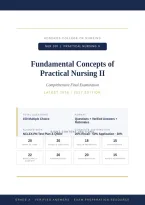
HONDROS COLLEGE OF NURSING
NUR 160 | PRACTICAL NURSING II
Fundamental Concepts of
Practical Nursing II
Comprehensive Final Examination
L AT E S T 2 0 2 0 2 7 E D I T I O N
T O TA L Q U E S T I O N S F O R M AT
150 Multiple Choice Questions + Verified Answers +
Rationales
ALIGNED WITH COGNITIVE DISTRIBUTION
EIGHT CONTENT SECTIONS
NCLEX-PN Test Plan & QSEN 20% Recall · 50% Application · 30%
Competencies Analysis
20 20 18 15
MGMT OF CARE SAFETY & INFECTION H E A LT H P R O M O T I O N PSYCHOSOCIAL
22 20 20 15
BASIC CARE & PHARMACOLOGY RISK REDUCTION P H Y S I O A D A P TAT I O N
C O M F O RT
G R A D E A · V E R I F I E D A N S W E R S · E X A M P R E PA R AT I O N R E S O U R C E
,HONDROS COLLEGE | NUR 160 GRADE A VERIFIED
NUR160 / NUR 160 FINAL EXAM (LATEST )
Fundamental Concepts of Practical Nursing II | Questions and Verified Answers | Grade A | Hondros
College
Section 1: Management of Care & Prioritization
Questions 1 through 20 | 20 questions
Q1: The LPN receives change-of-shift report on four assigned clients. Which client should the LPN assess
first?
A. A client who is 2 days postoperative requesting pain medication for incisional pain rated 6/10.
B. A client with chronic heart failure who reports new-onset shortness of breath and a hacking cough.
*[CORRECT]*
C. A client with type 2 diabetes mellitus awaiting a pre-breakfast blood glucose measurement.
D. A client with a stage 2 pressure injury scheduled for wound care after breakfast.
Correct Answer: B
Rationale: Using the ABC (Airway, Breathing, Circulation) prioritization framework, the client with new-onset
shortness of breath and cough must be assessed first, as these signs suggest acute decompensation in heart failure. The
NCLEX-PN Test Plan emphasizes that physiological instability involving airway or breathing always takes precedence
over pain, scheduled procedures, or routine assessments. Delayed evaluation of respiratory distress can rapidly progress
to respiratory failure and requires immediate RN notification and rapid response activation.
Q2: An LPN is assigned to care for a client who has just signed an informed consent form for an elective
cholecystectomy. The client says to the LPN, "I'm not really sure what they're going to do once I'm in
surgery." What is the LPN's best action?
A. Explain the surgical procedure in detail using simple language.
B. Document the client's statement and continue preoperative preparation.
C. Notify the surgeon and the RN that the client has questions about the procedure. *[CORRECT]*
D. Reassure the client that the surgeon knows what is best and proceed.
Correct Answer: C
Rationale: Informed consent requires that the client understand the procedure, risks, benefits, and alternatives. The
LPN's scope of practice does not include obtaining or explaining the procedural components of informed consent; that
responsibility belongs to the physician/surgeon. The LPN must notify the surgeon and RN so that consent can be
properly re-validated. Continuing preparation or providing a personal explanation violates the ethical principle of
veracity and exceeds LPN scope of practice under the Nurse Practice Act.
Q3: Which of the following tasks is most appropriate for the LPN to delegate to an unlicensed assistive
personnel (UAP)?
A. Teaching a newly diagnosed diabetic client about foot care.
B. Measuring and recording vital signs on a stable postoperative client. *[CORRECT]*
C. Assessing a client's wound for signs of infection.
NUR 160 Final Exam (2026/2027) | Page 1
,HONDROS COLLEGE | NUR 160 GRADE A VERIFIED
D. Evaluating a client's response to a new blood pressure medication.
Correct Answer: B
Rationale: The five rights of delegation specify that the task must be within the delegate's scope, require minimal
judgment, have a predictable outcome, and involve a stable client. Measuring vital signs on a stable postoperative client
meets all five rights of delegation (right task, right circumstance, right person, right direction, right supervision).
Teaching, assessing, and evaluating are professional nursing functions reserved for the LPN or RN and cannot be
delegated to UAP per the Nurse Practice Act and NCLEX-PN delegation principles.
Q4: A client with a terminal illness tells the LPN, "I don't want any more treatments. I just want to be
comfortable." The healthcare provider continues to order aggressive interventions. Which action should
the LPN take first?
A. Refuse to participate in providing the ordered interventions.
B. Notify the charge nurse and advocate for the client's wishes to be honored. *[CORRECT]*
C. Document the client's statement and continue with the prescribed treatment.
D. Contact the client's family to discuss the situation.
Correct Answer: B
Rationale: The principle of autonomy gives the client the right to refuse treatment, and the LPN serves as a client
advocate. The LPN should immediately notify the RN or charge nurse so that the healthcare team can address the
conflict between the client's wishes and the provider's orders. Refusing care without escalation, ignoring the client's
statement, or contacting family without consent all violate professional responsibility. The Patient Self-Determination
Act and the ethical principle of autonomy require that the client's informed decisions be respected.
Q5: While reviewing a client's chart, the LPN notices that a coworker documented giving a medication
that the LPN actually administered. What is the LPN's most appropriate action?
A. Confront the coworker privately and ask for an explanation.
B. Notify the charge nurse and complete an incident report. *[CORRECT]*
C. White-out the incorrect entry and rewrite the correct documentation.
D. Do nothing, since the medication was given and the client is not harmed.
Correct Answer: B
Rationale: Falsification of medical records is a serious legal and ethical violation that must be reported through the
chain of command. The LPN should notify the charge nurse and complete an incident/variance report; documentation
errors must be corrected using the proper late-entry or addendum format, never by obliterating original entries.
Confronting the coworker alone may compromise investigation, and ignoring the event enables falsification, which
violates HIPAA, professional standards, and the ethical principle of veracity.
Q6: An LPN is caring for a client who is HIV positive. The client's family is unaware of the diagnosis.
The family asks the LPN about the client's condition. What is the LPN's best response?
A. I'll share what I know, since they are immediate family.
B. I cannot discuss the client's condition; please speak directly with the client. *[CORRECT]*
C. The client has HIV, but it is being managed with medications.
D. You'll need to ask the doctor for that information.
Correct Answer: B
NUR 160 Final Exam (2026/2027) | Page 2
, HONDROS COLLEGE | NUR 160 GRADE A VERIFIED
Rationale: HIPAA Privacy Rule protects all protected health information (PHI), including HIV status, from being
disclosed without the client's explicit written consent. The LPN must decline to share information and direct the family
to the client. Disclosing HIV status to family without consent is a HIPAA violation and carries legal penalties. The
ethical principle of confidentiality is foundational to therapeutic nurse-client relationships.
Q7: Which situation requires the LPN to file an incident report?
A. A visitor slips in the hallway but is not injured. *[CORRECT]*
B. A client refuses to take a scheduled bath.
C. A UAP reports being dissatisfied with the work assignment.
D. A client asks to speak with the chaplain.
Correct Answer: A
Rationale: Incident reports (variance reports) are completed for any unexpected event that does or could harm a client,
visitor, or staff member, including near-misses. The visitor's fall, even without injury, is a sentinel event precursor and
must be documented to facilitate root cause analysis and prevent future occurrences. The other options represent routine
care situations handled through normal channels, not incident reporting. Incident reports are internal quality
improvement documents and are not part of the medical record.
Q8: The LPN is preparing to administer a medication when the client states, "That's not the pill I usually
take." What should the LPN do first?
A. Encourage the client to take the medication because the pharmacy sent it.
B. Stop and recheck the medication against the MAR and the original order. *[CORRECT]*
C. Tell the client the doctor probably changed the prescription.
D. Document the client's refusal in the medical record.
Correct Answer: B
Rationale: The client's statement is a critical safety check and one of the rights of medication administration (right
patient, drug, dose, route, time, documentation, reason, and response). The LPN should stop immediately and re-verify
the medication against the Medication Administration Record (MAR) and original order. Encouraging the client to take
a questioned medication ignores a potential error and violates the patient safety standard. Documentation of refusal
without verification is premature and unsafe.
Q9: An LPN is caring for four clients. Which client should the LPN assess first?
A. A client with pneumonia whose temperature is 101.2°F (38.4°C).
B. A client with a cast reporting burning sensation under the cast at the 4-hour mark. *[CORRECT]*
C. A client 1 day post-colonoscopy requesting lunch.
D. A client with chronic renal failure who is sleepy but arousable.
Correct Answer: B
Rationale: A burning sensation under a cast can indicate compartment syndrome, a limb-threatening complication
requiring immediate intervention. Using the ABC + Maslow prioritization framework, threats to tissue perfusion and
limb viability are urgent. The pneumonia temperature is expected; the post-colonoscopy request is routine; sleepiness in
a chronic renal failure client requires monitoring but is less acute. Compartment syndrome can cause permanent
neuromuscular damage within 4-6 hours if untreated.
Q10: A client with a do-not-resuscitate (DNR) order goes into cardiac arrest. The UAP begins chest
compressions. What should the LPN do?
NUR 160 Final Exam (2026/2027) | Page 3
NUR 160 | PRACTICAL NURSING II
Fundamental Concepts of
Practical Nursing II
Comprehensive Final Examination
L AT E S T 2 0 2 0 2 7 E D I T I O N
T O TA L Q U E S T I O N S F O R M AT
150 Multiple Choice Questions + Verified Answers +
Rationales
ALIGNED WITH COGNITIVE DISTRIBUTION
EIGHT CONTENT SECTIONS
NCLEX-PN Test Plan & QSEN 20% Recall · 50% Application · 30%
Competencies Analysis
20 20 18 15
MGMT OF CARE SAFETY & INFECTION H E A LT H P R O M O T I O N PSYCHOSOCIAL
22 20 20 15
BASIC CARE & PHARMACOLOGY RISK REDUCTION P H Y S I O A D A P TAT I O N
C O M F O RT
G R A D E A · V E R I F I E D A N S W E R S · E X A M P R E PA R AT I O N R E S O U R C E
,HONDROS COLLEGE | NUR 160 GRADE A VERIFIED
NUR160 / NUR 160 FINAL EXAM (LATEST )
Fundamental Concepts of Practical Nursing II | Questions and Verified Answers | Grade A | Hondros
College
Section 1: Management of Care & Prioritization
Questions 1 through 20 | 20 questions
Q1: The LPN receives change-of-shift report on four assigned clients. Which client should the LPN assess
first?
A. A client who is 2 days postoperative requesting pain medication for incisional pain rated 6/10.
B. A client with chronic heart failure who reports new-onset shortness of breath and a hacking cough.
*[CORRECT]*
C. A client with type 2 diabetes mellitus awaiting a pre-breakfast blood glucose measurement.
D. A client with a stage 2 pressure injury scheduled for wound care after breakfast.
Correct Answer: B
Rationale: Using the ABC (Airway, Breathing, Circulation) prioritization framework, the client with new-onset
shortness of breath and cough must be assessed first, as these signs suggest acute decompensation in heart failure. The
NCLEX-PN Test Plan emphasizes that physiological instability involving airway or breathing always takes precedence
over pain, scheduled procedures, or routine assessments. Delayed evaluation of respiratory distress can rapidly progress
to respiratory failure and requires immediate RN notification and rapid response activation.
Q2: An LPN is assigned to care for a client who has just signed an informed consent form for an elective
cholecystectomy. The client says to the LPN, "I'm not really sure what they're going to do once I'm in
surgery." What is the LPN's best action?
A. Explain the surgical procedure in detail using simple language.
B. Document the client's statement and continue preoperative preparation.
C. Notify the surgeon and the RN that the client has questions about the procedure. *[CORRECT]*
D. Reassure the client that the surgeon knows what is best and proceed.
Correct Answer: C
Rationale: Informed consent requires that the client understand the procedure, risks, benefits, and alternatives. The
LPN's scope of practice does not include obtaining or explaining the procedural components of informed consent; that
responsibility belongs to the physician/surgeon. The LPN must notify the surgeon and RN so that consent can be
properly re-validated. Continuing preparation or providing a personal explanation violates the ethical principle of
veracity and exceeds LPN scope of practice under the Nurse Practice Act.
Q3: Which of the following tasks is most appropriate for the LPN to delegate to an unlicensed assistive
personnel (UAP)?
A. Teaching a newly diagnosed diabetic client about foot care.
B. Measuring and recording vital signs on a stable postoperative client. *[CORRECT]*
C. Assessing a client's wound for signs of infection.
NUR 160 Final Exam (2026/2027) | Page 1
,HONDROS COLLEGE | NUR 160 GRADE A VERIFIED
D. Evaluating a client's response to a new blood pressure medication.
Correct Answer: B
Rationale: The five rights of delegation specify that the task must be within the delegate's scope, require minimal
judgment, have a predictable outcome, and involve a stable client. Measuring vital signs on a stable postoperative client
meets all five rights of delegation (right task, right circumstance, right person, right direction, right supervision).
Teaching, assessing, and evaluating are professional nursing functions reserved for the LPN or RN and cannot be
delegated to UAP per the Nurse Practice Act and NCLEX-PN delegation principles.
Q4: A client with a terminal illness tells the LPN, "I don't want any more treatments. I just want to be
comfortable." The healthcare provider continues to order aggressive interventions. Which action should
the LPN take first?
A. Refuse to participate in providing the ordered interventions.
B. Notify the charge nurse and advocate for the client's wishes to be honored. *[CORRECT]*
C. Document the client's statement and continue with the prescribed treatment.
D. Contact the client's family to discuss the situation.
Correct Answer: B
Rationale: The principle of autonomy gives the client the right to refuse treatment, and the LPN serves as a client
advocate. The LPN should immediately notify the RN or charge nurse so that the healthcare team can address the
conflict between the client's wishes and the provider's orders. Refusing care without escalation, ignoring the client's
statement, or contacting family without consent all violate professional responsibility. The Patient Self-Determination
Act and the ethical principle of autonomy require that the client's informed decisions be respected.
Q5: While reviewing a client's chart, the LPN notices that a coworker documented giving a medication
that the LPN actually administered. What is the LPN's most appropriate action?
A. Confront the coworker privately and ask for an explanation.
B. Notify the charge nurse and complete an incident report. *[CORRECT]*
C. White-out the incorrect entry and rewrite the correct documentation.
D. Do nothing, since the medication was given and the client is not harmed.
Correct Answer: B
Rationale: Falsification of medical records is a serious legal and ethical violation that must be reported through the
chain of command. The LPN should notify the charge nurse and complete an incident/variance report; documentation
errors must be corrected using the proper late-entry or addendum format, never by obliterating original entries.
Confronting the coworker alone may compromise investigation, and ignoring the event enables falsification, which
violates HIPAA, professional standards, and the ethical principle of veracity.
Q6: An LPN is caring for a client who is HIV positive. The client's family is unaware of the diagnosis.
The family asks the LPN about the client's condition. What is the LPN's best response?
A. I'll share what I know, since they are immediate family.
B. I cannot discuss the client's condition; please speak directly with the client. *[CORRECT]*
C. The client has HIV, but it is being managed with medications.
D. You'll need to ask the doctor for that information.
Correct Answer: B
NUR 160 Final Exam (2026/2027) | Page 2
, HONDROS COLLEGE | NUR 160 GRADE A VERIFIED
Rationale: HIPAA Privacy Rule protects all protected health information (PHI), including HIV status, from being
disclosed without the client's explicit written consent. The LPN must decline to share information and direct the family
to the client. Disclosing HIV status to family without consent is a HIPAA violation and carries legal penalties. The
ethical principle of confidentiality is foundational to therapeutic nurse-client relationships.
Q7: Which situation requires the LPN to file an incident report?
A. A visitor slips in the hallway but is not injured. *[CORRECT]*
B. A client refuses to take a scheduled bath.
C. A UAP reports being dissatisfied with the work assignment.
D. A client asks to speak with the chaplain.
Correct Answer: A
Rationale: Incident reports (variance reports) are completed for any unexpected event that does or could harm a client,
visitor, or staff member, including near-misses. The visitor's fall, even without injury, is a sentinel event precursor and
must be documented to facilitate root cause analysis and prevent future occurrences. The other options represent routine
care situations handled through normal channels, not incident reporting. Incident reports are internal quality
improvement documents and are not part of the medical record.
Q8: The LPN is preparing to administer a medication when the client states, "That's not the pill I usually
take." What should the LPN do first?
A. Encourage the client to take the medication because the pharmacy sent it.
B. Stop and recheck the medication against the MAR and the original order. *[CORRECT]*
C. Tell the client the doctor probably changed the prescription.
D. Document the client's refusal in the medical record.
Correct Answer: B
Rationale: The client's statement is a critical safety check and one of the rights of medication administration (right
patient, drug, dose, route, time, documentation, reason, and response). The LPN should stop immediately and re-verify
the medication against the Medication Administration Record (MAR) and original order. Encouraging the client to take
a questioned medication ignores a potential error and violates the patient safety standard. Documentation of refusal
without verification is premature and unsafe.
Q9: An LPN is caring for four clients. Which client should the LPN assess first?
A. A client with pneumonia whose temperature is 101.2°F (38.4°C).
B. A client with a cast reporting burning sensation under the cast at the 4-hour mark. *[CORRECT]*
C. A client 1 day post-colonoscopy requesting lunch.
D. A client with chronic renal failure who is sleepy but arousable.
Correct Answer: B
Rationale: A burning sensation under a cast can indicate compartment syndrome, a limb-threatening complication
requiring immediate intervention. Using the ABC + Maslow prioritization framework, threats to tissue perfusion and
limb viability are urgent. The pneumonia temperature is expected; the post-colonoscopy request is routine; sleepiness in
a chronic renal failure client requires monitoring but is less acute. Compartment syndrome can cause permanent
neuromuscular damage within 4-6 hours if untreated.
Q10: A client with a do-not-resuscitate (DNR) order goes into cardiac arrest. The UAP begins chest
compressions. What should the LPN do?
NUR 160 Final Exam (2026/2027) | Page 3


