
CUSECO: Certified U.S. Export Compliance Officer Exam (2026/2027) Grade A | 100% Verified
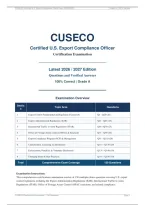
CUSECO
Certified U.S. Export Compliance Officer
Certification Examination
Latest Edition
Questions and Verified Answers
100% Correct | Grade A
Examination Overview
Sectio
Topic Area Questions
n
1 Export Control Fundamentals & Regulatory Framework Q1 - Q20 (20)
2 Export Administration Regulations (EAR) Q21 - Q45 (25)
3 International Traffic in Arms Regulations (ITAR) Q46 - Q70 (25)
4 Office of Foreign Assets Control (OFAC) & Sanctions Q71 - Q90 (20)
5 Export Compliance Program (ECP) & Management Q91 - Q110 (20)
6 Classification, Licensing, & Jurisdiction Q111 - Q130 (20)
7 Enforcement, Penalties, & Voluntary Disclosures Q131 - Q140 (10)
8 Emerging Issues & Best Practices Q141 - Q150 (10)
Total Comprehensive Exam Coverage 150 Questions
Examination Instructions:
This comprehensive certification examination consists of 150 multiple-choice questions covering U.S. export
control regulations including the Export Administration Regulations (EAR), International Traffic in Arms
Regulations (ITAR), Office of Foreign Assets Control (OFAC) sanctions, and related compliance
CUSECO Certification Examination - 150 Questions Page 1
,CUSECO: Certified U.S. Export Compliance Officer Exam (2026/2027) Grade A | 100% Verified
competencies. Each question has exactly ONE correct answer marked with *[CORRECT]*. Detailed
rationales provide regulatory references and explain why the correct answer is correct and why the distractors
are incorrect. Cognitive distribution: 25% recall, 50% application, 25% analysis (including scenario-based
decisions).
CUSECO Certification Examination - 150 Questions Page 2
,CUSECO: Certified U.S. Export Compliance Officer Exam (2026/2027) Grade A | 100% Verified
Section 1: Export Control Fundamentals & Regulatory
Framework
Q1: Under U.S. export control regulations, which of the following constitutes an 'export' requiring
compliance review?
A. Only the physical shipment of tangible goods across a U.S. border to a foreign destination
B. The physical shipment of goods, the electronic transmission of technical data to a foreign person
located outside the United States, or the release of technology to a foreign person inside the United
States (deemed export) *[CORRECT]*
C. Only shipments valued above $2,500 that require Schedule B classification
D. Any international financial transaction involving a foreign bank
Correct Answer: B
Rationale: Under the EAR (15 CFR §734.13) and ITAR (22 CFR §120.17), an 'export' includes not only the physical
movement of items across borders, but also the electronic transmission of technical data or software to a foreign person
abroad, and the release of controlled technology or source code to a foreign person inside the United States (a 'deemed
export'). Options A, C, and D reflect common misconceptions that unduly narrow the regulatory definition and create
compliance gaps. A CUSECO officer must apply the broader functional definition whenever evaluating any cross-border
or cross-national release of controlled items, technology, or software.
Q2: A U.S. university research lab employs a Chinese-national postdoctoral researcher who will have
access to controlled dual-use technology controlled under ECCN 3E001. Which statement most
accurately describes the compliance requirement?
A. No license is required because the researcher is employed by a U.S. university and accesses the technology
within the United States
B. A deemed export license from BIS is required because the release of controlled technology to a
foreign person inside the United States is 'deemed' to be an export to that person's country of
citizenship (China) *[CORRECT]*
C. The researcher must obtain a student visa amendment from the Department of State before access is
permitted
D. Only the university's Institutional Review Board (IRB) approval is required for compliance
Correct Answer: B
Rationale: Under 15 CFR §734.13(b), the release of technology or source code subject to the EAR to a foreign person
within the United States is 'deemed' to be an export to the person's most recent country(ies) of citizenship or permanent
residency. Because China is subject to a license requirement for the relevant ECCN, BIS authorization is required before
access. Option A misapplies the territorial-location principle; option C conflates visa rules with export licensing; option D
misallocates the compliance review to an IRB rather than to the export control function. CUSECO officers must screen
personnel access against the country chart and deemed export rules.
Q3: A U.S. defense contractor manufactures a tactical unmanned aerial vehicle (UAV) with a
maximum range of 300 km and a payload capacity of 500 kg. Which agency has jurisdiction over this
item, and what is the most appropriate classification pathway?
A. Commerce Department (BIS) under ECCN 9A012 because UAVs are dual-use items
CUSECO Certification Examination - 150 Questions Page 3
, CUSECO: Certified U.S. Export Compliance Officer Exam (2026/2027) Grade A | 100% Verified
B. State Department (DDTC) under USML Category VIII because the UAV's range exceeds 300 km
and payload characteristics meet MTCR Category I parameters *[CORRECT]*
C. Department of Energy (DOE) because the propulsion system contains advanced materials
D. Federal Aviation Administration (FAA) because all UAVs are regulated as aircraft
Correct Answer: B
Rationale: Under ITAR §121.1 Category VIII, unmanned aerial vehicles with a range exceeding 300 km are subject to
State Department/DDTC jurisdiction as defense articles, consistent with the Missile Technology Control Regime (MTCR)
Annex parameters. While the MTCR is a multilateral regime administered by multiple agencies, U.S. implementation
places MTCR Category I items under ITAR when they have substantial military application. Option A incorrectly routes
the item to BIS; option C is irrelevant for a non-nuclear propulsion system; option D addresses aviation safety, not export
control jurisdiction. A CUSECO officer should consult the ITAR USML categories first when MTCR thresholds are
implicated.
Q4: During a routine pre-transaction screening, your screening tool returns a 92% match against a
party on the BIS Entity List for a prospective customer in Singapore. What is the most appropriate
next step under a CUSECO-aligned compliance program?
A. Proceed with the transaction because the match is below 100% and the customer is in a friendly jurisdiction
B. Apply a hold on the transaction and conduct an enhanced due diligence review to determine whether
the match is a true positive, and document the analysis under your ECP recordkeeping requirements
*[CORRECT]*
C. Notify the customer that they must obtain a letter of assurance from the U.S. Embassy before proceeding
D. Immediately self-disclose to BIS without further investigation
Correct Answer: B
Rationale: A CUSECO-aligned compliance program requires a risk-based escalation protocol for restricted party
screening matches. A 92% fuzzy match warrants a transaction hold pending enhanced due diligence to confirm whether
the prospective customer is the listed entity, taking into account name similarity, addresses, beneficial ownership, and
related parties. Option A is a common failure mode that exposes the company to Entity List violations; option C is not a
recognized compliance pathway; option D over-escalates before any actual violation occurs. Documenting the review
process also satisfies the 5-year recordkeeping requirement under 15 CFR §762.
Q5: A U.S. semiconductor company is exporting advanced lithography equipment to a foreign
end-user. The equipment is controlled under ECCN 3B001 for National Security (NS) reasons. Which
multilateral export control regime most likely established the control parameters for this item, and
what is the practical compliance significance?
A. The Australia Group, because semiconductor materials have chemical weapons applications
B. The Wassenaar Arrangement, because it covers dual-use items including advanced semiconductor
manufacturing equipment for National Security reasons; the regime's control list parameters are
implemented through ECCNs in the EAR's Commerce Control List *[CORRECT]*
C. The Nuclear Suppliers Group, because lithography equipment can be used for nuclear enrichment
D. The Missile Technology Control Regime, because lithography is integral to missile guidance systems
Correct Answer: B
Rationale: The Wassenaar Arrangement is the multilateral regime governing dual-use items, including advanced
semiconductor manufacturing equipment controlled for National Security reasons. While the U.S. implements Wassenaar
controls through its domestic ECCNs, the regime itself establishes the multilateral baseline that participating states adopt.
Options A, C, and D attribute the controls to incorrect regimes that target weapons of mass destruction or delivery
systems. A CUSECO officer should understand regime-to-ECCN mapping because it informs both license review
CUSECO Certification Examination - 150 Questions Page 4
CUSECO
Certified U.S. Export Compliance Officer
Certification Examination
Latest Edition
Questions and Verified Answers
100% Correct | Grade A
Examination Overview
Sectio
Topic Area Questions
n
1 Export Control Fundamentals & Regulatory Framework Q1 - Q20 (20)
2 Export Administration Regulations (EAR) Q21 - Q45 (25)
3 International Traffic in Arms Regulations (ITAR) Q46 - Q70 (25)
4 Office of Foreign Assets Control (OFAC) & Sanctions Q71 - Q90 (20)
5 Export Compliance Program (ECP) & Management Q91 - Q110 (20)
6 Classification, Licensing, & Jurisdiction Q111 - Q130 (20)
7 Enforcement, Penalties, & Voluntary Disclosures Q131 - Q140 (10)
8 Emerging Issues & Best Practices Q141 - Q150 (10)
Total Comprehensive Exam Coverage 150 Questions
Examination Instructions:
This comprehensive certification examination consists of 150 multiple-choice questions covering U.S. export
control regulations including the Export Administration Regulations (EAR), International Traffic in Arms
Regulations (ITAR), Office of Foreign Assets Control (OFAC) sanctions, and related compliance
CUSECO Certification Examination - 150 Questions Page 1
,CUSECO: Certified U.S. Export Compliance Officer Exam (2026/2027) Grade A | 100% Verified
competencies. Each question has exactly ONE correct answer marked with *[CORRECT]*. Detailed
rationales provide regulatory references and explain why the correct answer is correct and why the distractors
are incorrect. Cognitive distribution: 25% recall, 50% application, 25% analysis (including scenario-based
decisions).
CUSECO Certification Examination - 150 Questions Page 2
,CUSECO: Certified U.S. Export Compliance Officer Exam (2026/2027) Grade A | 100% Verified
Section 1: Export Control Fundamentals & Regulatory
Framework
Q1: Under U.S. export control regulations, which of the following constitutes an 'export' requiring
compliance review?
A. Only the physical shipment of tangible goods across a U.S. border to a foreign destination
B. The physical shipment of goods, the electronic transmission of technical data to a foreign person
located outside the United States, or the release of technology to a foreign person inside the United
States (deemed export) *[CORRECT]*
C. Only shipments valued above $2,500 that require Schedule B classification
D. Any international financial transaction involving a foreign bank
Correct Answer: B
Rationale: Under the EAR (15 CFR §734.13) and ITAR (22 CFR §120.17), an 'export' includes not only the physical
movement of items across borders, but also the electronic transmission of technical data or software to a foreign person
abroad, and the release of controlled technology or source code to a foreign person inside the United States (a 'deemed
export'). Options A, C, and D reflect common misconceptions that unduly narrow the regulatory definition and create
compliance gaps. A CUSECO officer must apply the broader functional definition whenever evaluating any cross-border
or cross-national release of controlled items, technology, or software.
Q2: A U.S. university research lab employs a Chinese-national postdoctoral researcher who will have
access to controlled dual-use technology controlled under ECCN 3E001. Which statement most
accurately describes the compliance requirement?
A. No license is required because the researcher is employed by a U.S. university and accesses the technology
within the United States
B. A deemed export license from BIS is required because the release of controlled technology to a
foreign person inside the United States is 'deemed' to be an export to that person's country of
citizenship (China) *[CORRECT]*
C. The researcher must obtain a student visa amendment from the Department of State before access is
permitted
D. Only the university's Institutional Review Board (IRB) approval is required for compliance
Correct Answer: B
Rationale: Under 15 CFR §734.13(b), the release of technology or source code subject to the EAR to a foreign person
within the United States is 'deemed' to be an export to the person's most recent country(ies) of citizenship or permanent
residency. Because China is subject to a license requirement for the relevant ECCN, BIS authorization is required before
access. Option A misapplies the territorial-location principle; option C conflates visa rules with export licensing; option D
misallocates the compliance review to an IRB rather than to the export control function. CUSECO officers must screen
personnel access against the country chart and deemed export rules.
Q3: A U.S. defense contractor manufactures a tactical unmanned aerial vehicle (UAV) with a
maximum range of 300 km and a payload capacity of 500 kg. Which agency has jurisdiction over this
item, and what is the most appropriate classification pathway?
A. Commerce Department (BIS) under ECCN 9A012 because UAVs are dual-use items
CUSECO Certification Examination - 150 Questions Page 3
, CUSECO: Certified U.S. Export Compliance Officer Exam (2026/2027) Grade A | 100% Verified
B. State Department (DDTC) under USML Category VIII because the UAV's range exceeds 300 km
and payload characteristics meet MTCR Category I parameters *[CORRECT]*
C. Department of Energy (DOE) because the propulsion system contains advanced materials
D. Federal Aviation Administration (FAA) because all UAVs are regulated as aircraft
Correct Answer: B
Rationale: Under ITAR §121.1 Category VIII, unmanned aerial vehicles with a range exceeding 300 km are subject to
State Department/DDTC jurisdiction as defense articles, consistent with the Missile Technology Control Regime (MTCR)
Annex parameters. While the MTCR is a multilateral regime administered by multiple agencies, U.S. implementation
places MTCR Category I items under ITAR when they have substantial military application. Option A incorrectly routes
the item to BIS; option C is irrelevant for a non-nuclear propulsion system; option D addresses aviation safety, not export
control jurisdiction. A CUSECO officer should consult the ITAR USML categories first when MTCR thresholds are
implicated.
Q4: During a routine pre-transaction screening, your screening tool returns a 92% match against a
party on the BIS Entity List for a prospective customer in Singapore. What is the most appropriate
next step under a CUSECO-aligned compliance program?
A. Proceed with the transaction because the match is below 100% and the customer is in a friendly jurisdiction
B. Apply a hold on the transaction and conduct an enhanced due diligence review to determine whether
the match is a true positive, and document the analysis under your ECP recordkeeping requirements
*[CORRECT]*
C. Notify the customer that they must obtain a letter of assurance from the U.S. Embassy before proceeding
D. Immediately self-disclose to BIS without further investigation
Correct Answer: B
Rationale: A CUSECO-aligned compliance program requires a risk-based escalation protocol for restricted party
screening matches. A 92% fuzzy match warrants a transaction hold pending enhanced due diligence to confirm whether
the prospective customer is the listed entity, taking into account name similarity, addresses, beneficial ownership, and
related parties. Option A is a common failure mode that exposes the company to Entity List violations; option C is not a
recognized compliance pathway; option D over-escalates before any actual violation occurs. Documenting the review
process also satisfies the 5-year recordkeeping requirement under 15 CFR §762.
Q5: A U.S. semiconductor company is exporting advanced lithography equipment to a foreign
end-user. The equipment is controlled under ECCN 3B001 for National Security (NS) reasons. Which
multilateral export control regime most likely established the control parameters for this item, and
what is the practical compliance significance?
A. The Australia Group, because semiconductor materials have chemical weapons applications
B. The Wassenaar Arrangement, because it covers dual-use items including advanced semiconductor
manufacturing equipment for National Security reasons; the regime's control list parameters are
implemented through ECCNs in the EAR's Commerce Control List *[CORRECT]*
C. The Nuclear Suppliers Group, because lithography equipment can be used for nuclear enrichment
D. The Missile Technology Control Regime, because lithography is integral to missile guidance systems
Correct Answer: B
Rationale: The Wassenaar Arrangement is the multilateral regime governing dual-use items, including advanced
semiconductor manufacturing equipment controlled for National Security reasons. While the U.S. implements Wassenaar
controls through its domestic ECCNs, the regime itself establishes the multilateral baseline that participating states adopt.
Options A, C, and D attribute the controls to incorrect regimes that target weapons of mass destruction or delivery
systems. A CUSECO officer should understand regime-to-ECCN mapping because it informs both license review
CUSECO Certification Examination - 150 Questions Page 4


