
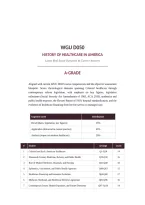
WGU D050
HISTORY OF HEALTHCARE IN AMERICA
Latest Real Exam Questions & Correct Answers
A-GRADE
Aligned with current WGU D050 course competencies and the objective assessment
blueprint. Seven chronological domains spanning Colonial healthcare through
contemporary reform legislation, with emphasis on key figures, legislative
milestones (Social Security Act Amendments of 1965, ACA 2010), epidemics and
public health response, the Flexner Report of 1910, hospital standardization, and the
evolution of healthcare financing from fee-for-service to managed care.
Cognitive Level Distribution
Recall (dates, legislation, key figures) 35%
Application (historical to current practice) 45%
Analysis (impact on modern healthcare) 20%
# Section Q Range Count
1 Colonial and Early American Healthcare Q1-Q14 14
2 Nineteenth Century Medicine, Reform, and Public Health Q15-Q30 16
3 Rise of Modern Medicine, Hospitals, and Nursing Q31-Q48 18
4 Epidemics, Vaccination, and Public Health Agencies Q49-Q63 15
5 Healthcare Financing and Insurance Evolution Q64-Q80 17
6 Medicare, Medicaid, and Healthcare Reform Legislation Q81-Q96 16
7 Contemporary Issues, Health Disparities, and Future Directions Q97-Q110 14
,WGU D050 History of Healthcare in America — 110-Question Exam A-Grade | Latest Real Exam
TOTAL Q1-Q110 110
Z.ai Healthcare History Education Page 2
,WGU D050 History of Healthcare in America — 110-Question Exam A-Grade | Latest Real Exam
SECTION 1 - COLONIAL AND EARLY AMERICAN HEALTHCARE (Colonial
Practices, Almshouses, Pest Houses, & Early Medical Education)
Q1: A nursing student is studying early colonial American healthcare. Which individual was MOST likely
responsible for delivering babies and providing primary healthcare in 17th-century colonial America?
A. A university-trained physician from Edinburgh
B. A barber-surgeon who also performed bloodletting
C. A lay midwife using traditional herbal remedies passed through generations [CORRECT]
D. An apothecary licensed by the colonial governor
Correct Answer: C
Rationale:
In 17th-century colonial America, formal medical education was virtually nonexistent. Lay midwives provided most
obstetric and primary care, drawing on traditional European and Indigenous herbal knowledge. University-trained
physicians were extremely rare, and barber-surgeons focused on minor procedures, not obstetrics. The midwifery model
remained dominant until the early 19th century, when male physicians began 'man-midwifery.' Understanding this
foundation helps explain modern debates over midwifery licensure.
Q2: A healthcare historian is researching the first incorporated hospital in the American colonies. Which
institution, founded in 1751 with support from Benjamin Franklin and Dr. Thomas Bond, is considered the
first general hospital in America?
A. Massachusetts General Hospital
B. Pennsylvania Hospital [CORRECT]
C. New York Hospital
D. Bellevue Hospital
Correct Answer: B
Rationale:
Pennsylvania Hospital, chartered in 1751 and opened in 1756, was co-founded by Benjamin Franklin and Dr. Thomas
Bond. It was the first incorporated hospital in the American colonies and served both wealthy and poor patients.
Massachusetts General (1811), New York Hospital (1771), and Bellevue (1736 as almshouse, later hospital) came later.
Pennsylvania Hospital's establishment marked the beginning of institutional healthcare in America.
Z.ai Healthcare History Education Page 3
, WGU D050 History of Healthcare in America — 110-Question Exam A-Grade | Latest Real Exam
Q3: An instructor explains the role of almshouses in colonial healthcare. Which statement BEST describes the
primary function of an almshouse in early America?
A. A specialized facility for treating infectious diseases
B. A municipal institution housing the poor, elderly, mentally ill, and sick who lacked family support
[CORRECT]
C. A private charitable hospital funded by religious donations
D. A medical school where physicians apprenticed under experienced doctors
Correct Answer: B
Rationale:
Almshouses (also called poorhouses) were municipal institutions that warehoused the destitute, elderly, orphaned,
mentally ill, and sick who had no family to care for them. They were not medical facilities per se but provided minimal
custodial care. The almshouse model revealed early America's view that poverty and illness were intertwined social
problems. New York's Bellevue began as an almshouse in 1736 before evolving into a hospital.
Q4: A student is studying colonial-era infectious disease control. What was the PRIMARY purpose of a 'pest
house' (pesthouse) in 18th-century America?
A. A public clinic providing free smallpox vaccinations
B. A residence for the wealthy seeking refuge from epidemics
C. An isolation facility outside town walls where victims of contagious diseases like smallpox and yellow
fever were quarantined [CORRECT]
D. A government building that issued health certificates to immigrants
Correct Answer: C
Rationale:
Pest houses were isolation hospitals located outside town boundaries where individuals with highly contagious diseases
(smallpox, yellow fever, cholera) were sent to prevent spread. They were often crude and underfunded, reflecting early
understanding of contagion before germ theory. Pest houses represent one of the earliest forms of organized public health
response in America, even though they primarily served as quarantine rather than treatment facilities.
Q5: A historian discusses the apprenticeship model of medical education in colonial America. Which
statement BEST describes this model?
A. Students attended university medical schools for four years of formal training
B. A prospective physician learned by observing and assisting an established physician for several years,
with no standardized curriculum or licensing requirements [CORRECT]
C. Medical students completed clinical rotations in hospitals supervised by faculty physicians
D. Apprentices were required to pass a national licensing examination before practicing
Correct Answer: B
Rationale:
In colonial America, the apprenticeship model was the dominant path to becoming a physician. A young man would train
under an established physician for 2-3 years, learning by observation and assisting with patients. There were no
standardized curricula, no national licensing exams, and no required qualifications. This unregulated system produced
physicians of widely varying competence, a problem the Flexner Report of 1910 later addressed. The apprenticeship
model reflects the era's limited educational infrastructure.
Z.ai Healthcare History Education Page 4
HISTORY OF HEALTHCARE IN AMERICA
Latest Real Exam Questions & Correct Answers
A-GRADE
Aligned with current WGU D050 course competencies and the objective assessment
blueprint. Seven chronological domains spanning Colonial healthcare through
contemporary reform legislation, with emphasis on key figures, legislative
milestones (Social Security Act Amendments of 1965, ACA 2010), epidemics and
public health response, the Flexner Report of 1910, hospital standardization, and the
evolution of healthcare financing from fee-for-service to managed care.
Cognitive Level Distribution
Recall (dates, legislation, key figures) 35%
Application (historical to current practice) 45%
Analysis (impact on modern healthcare) 20%
# Section Q Range Count
1 Colonial and Early American Healthcare Q1-Q14 14
2 Nineteenth Century Medicine, Reform, and Public Health Q15-Q30 16
3 Rise of Modern Medicine, Hospitals, and Nursing Q31-Q48 18
4 Epidemics, Vaccination, and Public Health Agencies Q49-Q63 15
5 Healthcare Financing and Insurance Evolution Q64-Q80 17
6 Medicare, Medicaid, and Healthcare Reform Legislation Q81-Q96 16
7 Contemporary Issues, Health Disparities, and Future Directions Q97-Q110 14
,WGU D050 History of Healthcare in America — 110-Question Exam A-Grade | Latest Real Exam
TOTAL Q1-Q110 110
Z.ai Healthcare History Education Page 2
,WGU D050 History of Healthcare in America — 110-Question Exam A-Grade | Latest Real Exam
SECTION 1 - COLONIAL AND EARLY AMERICAN HEALTHCARE (Colonial
Practices, Almshouses, Pest Houses, & Early Medical Education)
Q1: A nursing student is studying early colonial American healthcare. Which individual was MOST likely
responsible for delivering babies and providing primary healthcare in 17th-century colonial America?
A. A university-trained physician from Edinburgh
B. A barber-surgeon who also performed bloodletting
C. A lay midwife using traditional herbal remedies passed through generations [CORRECT]
D. An apothecary licensed by the colonial governor
Correct Answer: C
Rationale:
In 17th-century colonial America, formal medical education was virtually nonexistent. Lay midwives provided most
obstetric and primary care, drawing on traditional European and Indigenous herbal knowledge. University-trained
physicians were extremely rare, and barber-surgeons focused on minor procedures, not obstetrics. The midwifery model
remained dominant until the early 19th century, when male physicians began 'man-midwifery.' Understanding this
foundation helps explain modern debates over midwifery licensure.
Q2: A healthcare historian is researching the first incorporated hospital in the American colonies. Which
institution, founded in 1751 with support from Benjamin Franklin and Dr. Thomas Bond, is considered the
first general hospital in America?
A. Massachusetts General Hospital
B. Pennsylvania Hospital [CORRECT]
C. New York Hospital
D. Bellevue Hospital
Correct Answer: B
Rationale:
Pennsylvania Hospital, chartered in 1751 and opened in 1756, was co-founded by Benjamin Franklin and Dr. Thomas
Bond. It was the first incorporated hospital in the American colonies and served both wealthy and poor patients.
Massachusetts General (1811), New York Hospital (1771), and Bellevue (1736 as almshouse, later hospital) came later.
Pennsylvania Hospital's establishment marked the beginning of institutional healthcare in America.
Z.ai Healthcare History Education Page 3
, WGU D050 History of Healthcare in America — 110-Question Exam A-Grade | Latest Real Exam
Q3: An instructor explains the role of almshouses in colonial healthcare. Which statement BEST describes the
primary function of an almshouse in early America?
A. A specialized facility for treating infectious diseases
B. A municipal institution housing the poor, elderly, mentally ill, and sick who lacked family support
[CORRECT]
C. A private charitable hospital funded by religious donations
D. A medical school where physicians apprenticed under experienced doctors
Correct Answer: B
Rationale:
Almshouses (also called poorhouses) were municipal institutions that warehoused the destitute, elderly, orphaned,
mentally ill, and sick who had no family to care for them. They were not medical facilities per se but provided minimal
custodial care. The almshouse model revealed early America's view that poverty and illness were intertwined social
problems. New York's Bellevue began as an almshouse in 1736 before evolving into a hospital.
Q4: A student is studying colonial-era infectious disease control. What was the PRIMARY purpose of a 'pest
house' (pesthouse) in 18th-century America?
A. A public clinic providing free smallpox vaccinations
B. A residence for the wealthy seeking refuge from epidemics
C. An isolation facility outside town walls where victims of contagious diseases like smallpox and yellow
fever were quarantined [CORRECT]
D. A government building that issued health certificates to immigrants
Correct Answer: C
Rationale:
Pest houses were isolation hospitals located outside town boundaries where individuals with highly contagious diseases
(smallpox, yellow fever, cholera) were sent to prevent spread. They were often crude and underfunded, reflecting early
understanding of contagion before germ theory. Pest houses represent one of the earliest forms of organized public health
response in America, even though they primarily served as quarantine rather than treatment facilities.
Q5: A historian discusses the apprenticeship model of medical education in colonial America. Which
statement BEST describes this model?
A. Students attended university medical schools for four years of formal training
B. A prospective physician learned by observing and assisting an established physician for several years,
with no standardized curriculum or licensing requirements [CORRECT]
C. Medical students completed clinical rotations in hospitals supervised by faculty physicians
D. Apprentices were required to pass a national licensing examination before practicing
Correct Answer: B
Rationale:
In colonial America, the apprenticeship model was the dominant path to becoming a physician. A young man would train
under an established physician for 2-3 years, learning by observation and assisting with patients. There were no
standardized curricula, no national licensing exams, and no required qualifications. This unregulated system produced
physicians of widely varying competence, a problem the Flexner Report of 1910 later addressed. The apprenticeship
model reflects the era's limited educational infrastructure.
Z.ai Healthcare History Education Page 4


