
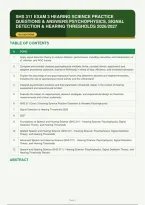
SHS 311 EXAM 3 HEARING SCIENCE PRACTICE
QUESTIONS & ANSWERS PSYCHOPHYSICS, SIGNAL
DETECTION & HEARING THRESHOLDS 2026/2027
50 QUESTIONS
TABLE OF CONTENTS
# TOPIC
1 Apply signal detection theory to analyze detection performance, including calculation and interpretation of
d', criterion, and ROC curves
2 Compare and contrast classical psychophysical methods (limits, constant stimuli, adjustment) and
adaptive procedures (staircase, maximum-likelihood) in terms of bias, efficiency, and threshold estimation
3 Explain the physiological and psychophysical factors that determine absolute and masked thresholds,
including the role of spontaneous neural activity and the critical band
4 Interpret psychometric functions and their parameters (threshold, slope) in the context of hearing
assessment and sensorineural function
5 Evaluate the impact of response bias, decision strategies, and experimental design on threshold
measurements and clinical audiometry
6 SHS 311 Exam 3 Hearing Science Practice Questions & Answers Psychophysics
7 Signal Detection & Hearing Thresholds 2026
8 2027
9 Foundations of Speech and Hearing Science (SHS 311) - Hearing Science: Psychophysics, Signal
Detection Theory, and Hearing Thresholds
10 Applied Speech and Hearing Science (SHS 311) - Hearing Science: Psychophysics, Signal Detection
Theory, and Hearing Thresholds
11 Advanced Speech and Hearing Science (SHS 311) - Hearing Science: Psychophysics, Signal Detection
Theory, and Hearing Thresholds
12 Speech and Hearing Science (SHS 311) - Hearing Science: Psychophysics, Signal Detection Theory, and
Hearing Thresholds Review
ABSTRACT
Page 1
,This study document brings together 50 carefully worded exam questions drawn from SHS 311
Exam 3 Hearing Science Practice Questions & Answers Psychophysics, Signal Detection &
Hearing Thresholds 2026/2027, with the strongest emphasis placed on Apply signal detection
theory to analyze detection performance, including calculation and interpretation of d', criterion,
and ROC curves, Compare and contrast classical psychophysical methods (limits, constant stimuli,
adjustment) and adaptive procedures (staircase, maximum-likelihood) in terms of bias, efficiency,
and threshold estimation, Explain the physiological and psychophysical factors that determine
absolute and masked thresholds and including the role of spontaneous neural activity and the
critical band. Every item follows the wording style and level of reasoning you meet in the real
paper, and each one is paired with a clear rationale so the correct choice is never a guess. Work
through the set at your own pace, mark the questions that slow you down, then come back to them
until the reasoning feels automatic. Learners who revise this way walk into the exam room
recognising the pattern behind the questions instead of meeting them for the first time. Keep going
- steady, honest practice is what turns a difficult paper into a comfortable pass.
Q1 APPLY SIGNAL DETECTION THEORY TO ANALYZE DETECTION PERFORMANCE,
INCLUDING CALCULATION AND INTERPRETATION OF D', CRITERION, AND ROC CURVES
In a yes/no detection task, the hit rate is 0.90 and the false alarm rate is 0.30. If the
observer becomes more conservative (criterion shifts to the right) while sensitivity
remains unchanged, which set of hit and false alarm rates is most likely?
A. Hit rate = 0.80, false alarm rate = 0.20
B. Hit rate = 0.95, false alarm rate = 0.40
C. Hit rate = 0.70, false alarm rate = 0.10 CORRECT
D. Hit rate = 0.90, false alarm rate = 0.30
RATIONALE: A conservative shift (increased criterion) reduces both hit and false alarm rates, but
the hit rate decreases less than the false alarm rate if sensitivity is unchanged. Option C shows a
decrease in both, with a larger drop in false alarms, consistent with a rightward criterion shift.
Option A also shows a decrease but the drop is symmetric, which would imply a change in
sensitivity; Option B shows an increase in both, indicating a liberal shift; Option D indicates no
change.
Page 2
, Q2 APPLY SIGNAL DETECTION THEORY TO ANALYZE DETECTION PERFORMANCE,
INCLUDING CALCULATION AND INTERPRETATION OF D', CRITERION, AND ROC CURVES
Which method of threshold estimation is most susceptible to the influence of
response bias, and why?
A. Method of constant stimuli, because it presents stimuli in random order.
B. Method of limits, because it relies on the observer's criterion for changing response.
CORRECT
C. Adaptive staircase, because it converges on a specific performance level.
D. Method of adjustment, because the observer directly controls stimulus intensity.
RATIONALE: The method of limits is highly susceptible to response bias because the observer's
decision to change from 'yes' to 'no' (or vice versa) depends on their internal criterion, not just
sensitivity. The method of constant stimuli (A) is less affected because it uses fixed stimuli and
calculates threshold from the psychometric function, though bias can still influence responses.
Adaptive staircases (C) target a specific performance level and are relatively robust to bias.
Method of adjustment (D) is also influenced by bias but typically less so than limits because the
observer adjusts continuously.
Q3 APPLY SIGNAL DETECTION THEORY TO ANALYZE DETECTION PERFORMANCE,
INCLUDING CALCULATION AND INTERPRETATION OF D', CRITERION, AND ROC CURVES
A psychometric function for detection of a tone in noise has a slope of 2.5 %/dB. If
the threshold is defined as the 70.7% correct point, what is the expected change in
performance (in % correct) when the signal level is increased by 4 dB?
A. 2.5%
B. 5%
C. 10% CORRECT
D. 17.5%
RATIONALE: The slope indicates the change in performance per dB. A 4 dB increase would yield
a 4 × 2.5 = 10% increase in correct responses, assuming linearity around the threshold. This is a
straightforward application of the slope definition. Options A, B, and D misapply the multiplication
or confuse the slope with absolute performance.
Page 3


