
NSG 552 — Exam 2: Psychopharmacology | Wilkes University | 2026/2027 Edition
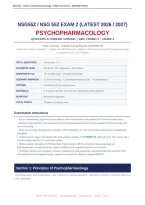
NSG552 / NSG 552 EXAM 2 (LATEST )
PSYCHOPHARMACOLOGY
QUESTIONS & VERIFIED ANSWERS | 100% CORRECT | GRADE A
Wilkes University | Graduate Nursing Program (MSN/PMHNP)
Passaic-like academic standards | Aligned with AACN Essentials of Master’s Education & Advanced Psychopharmacology
Competencies ( Edition)
TOTAL QUESTIONS 100 (Sections 1–7)
COGNITIVE LEVEL 20% Recall · 50% Application · 30% Analysis
QUESTION STYLE 75% Scenario-based · 25% Direct knowledge
SCENARIO EMPHASIS 20 clinical-reasoning · 15 antidepressant/antipsychotic · 10 mood/anxiolytic
OPTIONS Four choices (A–D), one best answer
RATIONALE 2–4 sentences per item, with NSG 552 curriculum & AACN alignment
DURATION 180 minutes (suggested)
TOTAL POINTS 100 points (1 point per item)
Examination Instructions
• This is a closed-book, single-best-answer multiple-choice examination. Each question has ONE most-correct option.
• Read each stem carefully; several questions describe patient presentations and require integration of pharmacology with
clinical reasoning.
• Black box warnings, FDA-approved indications, DEA scheduling, and AACN Essentials competencies are emphasized
throughout.
• Verified answers appear immediately after each question, marked with [CORRECT], followed by the letter answer and a
rationale referencing NSG 552 curriculum content.
• Pharmacokinetic principles (CYP450 enzymes, P-glycoprotein, half-life, therapeutic drug monitoring) and
pharmacodynamic concepts (receptors, signal transduction) are integrated across all seven sections.
• Treatment-resistant cases, pregnancy/lactation considerations, drug interactions, and patient-education scenarios reflect
advanced practice psychopharmacology competencies expected of a Master’s-prepared PMHNP.
Section 1: Principles of Psychopharmacology
Pharmacokinetics, pharmacodynamics, drug interactions, pharmacogenomics, prescriptive authority, controlled substances,
DEA regulations.
NSG552 / NSG 552 Exam 2 — Psychopharmacology — Verified Answers — Grade A — Page 1
,NSG 552 — Exam 2: Psychopharmacology | Wilkes University | 2026/2027 Edition
Q1: Which cytochrome P450 enzyme is responsible for metabolizing approximately 25% of all clinically
prescribed medications, including many antidepressants and antipsychotics, and is also highly polymorphic in
the general population?
A. CYP1A2
B. CYP2D6 [CORRECT]
C. CYP3A4
D. CYP2C19
Correct Answer: C
Rationale: CYP2D6 metabolizes about a quarter of all clinically used drugs, including most SSRIs (fluoxetine, paroxetine),
TCAs, and many antipsychotics (risperidone, aripiprazole). It is also highly polymorphic, with poor, intermediate, extensive, and
ultra-rapid metabolizer phenotypes — central concepts in NSG 552 pharmacogenomics content. CYP3A4 handles the largest
total mass of drugs but is less polymorphic; CYP1A2 and CYP2C19 are important but cover fewer psychotropic agents.
Q2: The blood-brain barrier, which restricts penetration of many psychotropic drugs into the central nervous
system, is primarily composed of which structural element?
A. Astrocyte foot processes and oligodendrocytes
B. Capillary endothelial cells joined by tight junctions with pericyte and astrocyte support [CORRECT]
C. Ependymal cells lining the ventricular system
D. Microglia and meningeal cells only
Correct Answer: B
Rationale: The blood-brain barrier is formed by brain capillary endothelial cells connected by tight junctions, supported by
pericytes and astrocyte end-feet; this restricts paracellular drug diffusion. P-glycoprotein efflux transporters further limit CNS
penetration of many drugs. Astrocytes and microglia support barrier function but do not constitute the barrier itself; ependymal
cells line ventricles and form the blood-CSF barrier.
Q3: Which pharmacokinetic process describes the movement of a drug from its site of administration into the
systemic circulation, and is affected by first-pass metabolism when given orally?
A. Distribution
B. Metabolism
C. Absorption [CORRECT]
D. Excretion
Correct Answer: C
Rationale: Absorption is the process by which a drug moves from the site of administration into systemic circulation. Oral drugs
undergo first-pass hepatic metabolism that reduces bioavailability. Distribution describes movement into tissues; metabolism is
biotransformation; excretion is elimination. These four processes — absorption, distribution, metabolism, excretion — define
pharmacokinetics, a foundational NSG 552 competency.
NSG552 / NSG 552 Exam 2 — Psychopharmacology — Verified Answers — Grade A — Page 2
,NSG 552 — Exam 2: Psychopharmacology | Wilkes University | 2026/2027 Edition
Q4: A 42-year-old patient undergoes pharmacogenomic testing prior to starting an SSRI and is identified as a
CYP2D6 poor metabolizer. Which antidepressant should be dosed at a significantly reduced level or avoided
entirely in this patient?
A. Sertraline
B. Paroxetine [CORRECT]
C. Citalopram
D. Escitalopram
Correct Answer: B
Rationale: Paroxetine is a potent CYP2D6 substrate and inhibitor; in CYP2D6 poor metabolizers, paroxetine levels accumulate
markedly, increasing risk of side effects including serotonin syndrome. The Clinical Pharmacogenetics Implementation
Consortium (CPIC) recommends a 25-50% dose reduction or selection of an alternative not predominantly metabolized by
CYP2D6 (such as citalopram, escitalopram, or sertraline). Pharmacogenomic-guided prescribing aligns with AACN Essentials
competencies for safe, individualized prescribing.
Q5: A 65-year-old patient with major depressive disorder is started on fluoxetine 20 mg daily. After four
weeks the patient reports persistent insomnia, restlessness, and a five-pound weight loss. Steady-state drug
levels are higher than anticipated. Which pharmacokinetic explanation best accounts for this finding?
A. Increased hepatic blood flow with aging
B. Fluoxetine's long half-life and reduced metabolic clearance in older adults [CORRECT]
C. Enhanced renal elimination of the parent compound
D. Decreased plasma protein binding alone
Correct Answer: B
Rationale: Fluoxetine and its active metabolite norfluoxetine have half-lives of 1-4 days and 7-15 days respectively — among
the longest in the SSRI class. Hepatic CYP2D6 activity declines modestly with aging, and older adults are more sensitive to
serotonergic effects, increasing drug accumulation and adverse events. Increased hepatic blood flow would lower, not raise,
levels; renal clearance of unchanged fluoxetine is minimal; protein-binding changes alone do not explain the clinical picture.
Q6: A 45-year-old woman with major depressive disorder has been taking fluoxetine 20 mg/day for six weeks.
She is prescribed tramadol 50 mg every six hours for acute back pain. Three days later she presents to the
emergency department with restlessness, confusion, diaphoresis, myoclonus, and hyperreflexia. Vital signs: T
38.5°C, HR 122 bpm, BP 158/96 mmHg. What is the most likely diagnosis?
A. Neuroleptic malignant syndrome
B. Anticholinergic toxicity
C. Serotonin syndrome [CORRECT]
D. Thyroid storm
Correct Answer: C
Rationale: The triad of autonomic instability (hyperthermia, tachycardia, hypertension), neuromuscular excitation (myoclonus,
hyperreflexia), and altered mental status in the setting of two serotonergic agents (fluoxetine + tramadol, which inhibits serotonin
reuptake) is classic for serotonin syndrome. NMS presents with lead-pipe rigidity and hyporeflexia, anticholinergic toxicity with
dry skin and urinary retention, and thyroid storm with a hyperthyroid history. Discontinuation of serotonergic agents and
supportive care (cyproheptadine in severe cases) is the standard of care.
NSG552 / NSG 552 Exam 2 — Psychopharmacology — Verified Answers — Grade A — Page 3
, NSG 552 — Exam 2: Psychopharmacology | Wilkes University | 2026/2027 Edition
Q7: A patient who has been taking phenelzine (an MAOI) for atypical depression presents to the emergency
department with hypertensive crisis after consuming aged cheese, red wine, and smoked meats at a
restaurant. Which medication should be available for immediate administration to control the hypertensive
emergency?
A. Phentolamine [CORRECT]
B. Nifedipine
C. Lisinopril
D. Lorazepam
Correct Answer: A
Rationale: Hypertensive crisis from MAOI-tyramine interaction requires rapid control of blood pressure with a short-acting,
titratable parenteral antihypertensive. Phentolamine, a non-selective alpha-blocker, is the classic first-line agent because it
directly reverses the alpha-1 mediated vasoconstriction from accumulated norepinephrine. Nifedipine has a slower onset and is
harder to titrate; ACE inhibitors have too slow an onset; lorazepam addresses anxiety but not the underlying vasospasm. Patient
education on tyramine-restricted diet is a core NSG 552 competency for MAOI prescribing.
Q8: Which statement most accurately describes the role of P-glycoprotein (P-gp) in psychopharmacology?
A. It is expressed only in the gastrointestinal tract
B. It actively transports drugs into the CNS across the blood-brain barrier
C. It is an ATP-dependent efflux transporter that limits drug absorption in the gut and CNS penetration
[CORRECT]
D. It selectively metabolizes antipsychotics only
Correct Answer: C
Rationale: P-glycoprotein (encoded by ABCB1/MDR1) is an ATP-dependent efflux transporter expressed in intestinal
epithelium, the blood-brain barrier, hepatocytes, and renal tubules. It limits absorption of many drugs (e.g., loperamide,
dabigatran) and prevents CNS penetration. P-gp is a major determinant of response to antipsychotics, antidepressants, and mood
stabilizers. It does not metabolize drugs (it transports them) and is not confined to a single tissue.
Q9: Therapeutic drug monitoring with serum levels is essential for safe and effective prescribing of which of
the following psychotropic medications?
A. Sertraline
B. Lithium [CORRECT]
C. Alprazolam
D. Methylphenidate
Correct Answer: B
Rationale: Lithium has a narrow therapeutic index (0.6-1.2 mEq/L for maintenance; 0.8-1.2 mEq/L for acute mania), with
toxicity emerging above 1.5 mEq/L. Routine 12-hour post-dose serum levels are required. Among other psychotropics, serum
monitoring is also standard for valproate, carbamazepine, clozapine (in select cases), and tricyclic antidepressants. SSRIs,
benzodiazepines, and stimulants are generally monitored clinically rather than by serum level.
NSG552 / NSG 552 Exam 2 — Psychopharmacology — Verified Answers — Grade A — Page 4
NSG552 / NSG 552 EXAM 2 (LATEST )
PSYCHOPHARMACOLOGY
QUESTIONS & VERIFIED ANSWERS | 100% CORRECT | GRADE A
Wilkes University | Graduate Nursing Program (MSN/PMHNP)
Passaic-like academic standards | Aligned with AACN Essentials of Master’s Education & Advanced Psychopharmacology
Competencies ( Edition)
TOTAL QUESTIONS 100 (Sections 1–7)
COGNITIVE LEVEL 20% Recall · 50% Application · 30% Analysis
QUESTION STYLE 75% Scenario-based · 25% Direct knowledge
SCENARIO EMPHASIS 20 clinical-reasoning · 15 antidepressant/antipsychotic · 10 mood/anxiolytic
OPTIONS Four choices (A–D), one best answer
RATIONALE 2–4 sentences per item, with NSG 552 curriculum & AACN alignment
DURATION 180 minutes (suggested)
TOTAL POINTS 100 points (1 point per item)
Examination Instructions
• This is a closed-book, single-best-answer multiple-choice examination. Each question has ONE most-correct option.
• Read each stem carefully; several questions describe patient presentations and require integration of pharmacology with
clinical reasoning.
• Black box warnings, FDA-approved indications, DEA scheduling, and AACN Essentials competencies are emphasized
throughout.
• Verified answers appear immediately after each question, marked with [CORRECT], followed by the letter answer and a
rationale referencing NSG 552 curriculum content.
• Pharmacokinetic principles (CYP450 enzymes, P-glycoprotein, half-life, therapeutic drug monitoring) and
pharmacodynamic concepts (receptors, signal transduction) are integrated across all seven sections.
• Treatment-resistant cases, pregnancy/lactation considerations, drug interactions, and patient-education scenarios reflect
advanced practice psychopharmacology competencies expected of a Master’s-prepared PMHNP.
Section 1: Principles of Psychopharmacology
Pharmacokinetics, pharmacodynamics, drug interactions, pharmacogenomics, prescriptive authority, controlled substances,
DEA regulations.
NSG552 / NSG 552 Exam 2 — Psychopharmacology — Verified Answers — Grade A — Page 1
,NSG 552 — Exam 2: Psychopharmacology | Wilkes University | 2026/2027 Edition
Q1: Which cytochrome P450 enzyme is responsible for metabolizing approximately 25% of all clinically
prescribed medications, including many antidepressants and antipsychotics, and is also highly polymorphic in
the general population?
A. CYP1A2
B. CYP2D6 [CORRECT]
C. CYP3A4
D. CYP2C19
Correct Answer: C
Rationale: CYP2D6 metabolizes about a quarter of all clinically used drugs, including most SSRIs (fluoxetine, paroxetine),
TCAs, and many antipsychotics (risperidone, aripiprazole). It is also highly polymorphic, with poor, intermediate, extensive, and
ultra-rapid metabolizer phenotypes — central concepts in NSG 552 pharmacogenomics content. CYP3A4 handles the largest
total mass of drugs but is less polymorphic; CYP1A2 and CYP2C19 are important but cover fewer psychotropic agents.
Q2: The blood-brain barrier, which restricts penetration of many psychotropic drugs into the central nervous
system, is primarily composed of which structural element?
A. Astrocyte foot processes and oligodendrocytes
B. Capillary endothelial cells joined by tight junctions with pericyte and astrocyte support [CORRECT]
C. Ependymal cells lining the ventricular system
D. Microglia and meningeal cells only
Correct Answer: B
Rationale: The blood-brain barrier is formed by brain capillary endothelial cells connected by tight junctions, supported by
pericytes and astrocyte end-feet; this restricts paracellular drug diffusion. P-glycoprotein efflux transporters further limit CNS
penetration of many drugs. Astrocytes and microglia support barrier function but do not constitute the barrier itself; ependymal
cells line ventricles and form the blood-CSF barrier.
Q3: Which pharmacokinetic process describes the movement of a drug from its site of administration into the
systemic circulation, and is affected by first-pass metabolism when given orally?
A. Distribution
B. Metabolism
C. Absorption [CORRECT]
D. Excretion
Correct Answer: C
Rationale: Absorption is the process by which a drug moves from the site of administration into systemic circulation. Oral drugs
undergo first-pass hepatic metabolism that reduces bioavailability. Distribution describes movement into tissues; metabolism is
biotransformation; excretion is elimination. These four processes — absorption, distribution, metabolism, excretion — define
pharmacokinetics, a foundational NSG 552 competency.
NSG552 / NSG 552 Exam 2 — Psychopharmacology — Verified Answers — Grade A — Page 2
,NSG 552 — Exam 2: Psychopharmacology | Wilkes University | 2026/2027 Edition
Q4: A 42-year-old patient undergoes pharmacogenomic testing prior to starting an SSRI and is identified as a
CYP2D6 poor metabolizer. Which antidepressant should be dosed at a significantly reduced level or avoided
entirely in this patient?
A. Sertraline
B. Paroxetine [CORRECT]
C. Citalopram
D. Escitalopram
Correct Answer: B
Rationale: Paroxetine is a potent CYP2D6 substrate and inhibitor; in CYP2D6 poor metabolizers, paroxetine levels accumulate
markedly, increasing risk of side effects including serotonin syndrome. The Clinical Pharmacogenetics Implementation
Consortium (CPIC) recommends a 25-50% dose reduction or selection of an alternative not predominantly metabolized by
CYP2D6 (such as citalopram, escitalopram, or sertraline). Pharmacogenomic-guided prescribing aligns with AACN Essentials
competencies for safe, individualized prescribing.
Q5: A 65-year-old patient with major depressive disorder is started on fluoxetine 20 mg daily. After four
weeks the patient reports persistent insomnia, restlessness, and a five-pound weight loss. Steady-state drug
levels are higher than anticipated. Which pharmacokinetic explanation best accounts for this finding?
A. Increased hepatic blood flow with aging
B. Fluoxetine's long half-life and reduced metabolic clearance in older adults [CORRECT]
C. Enhanced renal elimination of the parent compound
D. Decreased plasma protein binding alone
Correct Answer: B
Rationale: Fluoxetine and its active metabolite norfluoxetine have half-lives of 1-4 days and 7-15 days respectively — among
the longest in the SSRI class. Hepatic CYP2D6 activity declines modestly with aging, and older adults are more sensitive to
serotonergic effects, increasing drug accumulation and adverse events. Increased hepatic blood flow would lower, not raise,
levels; renal clearance of unchanged fluoxetine is minimal; protein-binding changes alone do not explain the clinical picture.
Q6: A 45-year-old woman with major depressive disorder has been taking fluoxetine 20 mg/day for six weeks.
She is prescribed tramadol 50 mg every six hours for acute back pain. Three days later she presents to the
emergency department with restlessness, confusion, diaphoresis, myoclonus, and hyperreflexia. Vital signs: T
38.5°C, HR 122 bpm, BP 158/96 mmHg. What is the most likely diagnosis?
A. Neuroleptic malignant syndrome
B. Anticholinergic toxicity
C. Serotonin syndrome [CORRECT]
D. Thyroid storm
Correct Answer: C
Rationale: The triad of autonomic instability (hyperthermia, tachycardia, hypertension), neuromuscular excitation (myoclonus,
hyperreflexia), and altered mental status in the setting of two serotonergic agents (fluoxetine + tramadol, which inhibits serotonin
reuptake) is classic for serotonin syndrome. NMS presents with lead-pipe rigidity and hyporeflexia, anticholinergic toxicity with
dry skin and urinary retention, and thyroid storm with a hyperthyroid history. Discontinuation of serotonergic agents and
supportive care (cyproheptadine in severe cases) is the standard of care.
NSG552 / NSG 552 Exam 2 — Psychopharmacology — Verified Answers — Grade A — Page 3
, NSG 552 — Exam 2: Psychopharmacology | Wilkes University | 2026/2027 Edition
Q7: A patient who has been taking phenelzine (an MAOI) for atypical depression presents to the emergency
department with hypertensive crisis after consuming aged cheese, red wine, and smoked meats at a
restaurant. Which medication should be available for immediate administration to control the hypertensive
emergency?
A. Phentolamine [CORRECT]
B. Nifedipine
C. Lisinopril
D. Lorazepam
Correct Answer: A
Rationale: Hypertensive crisis from MAOI-tyramine interaction requires rapid control of blood pressure with a short-acting,
titratable parenteral antihypertensive. Phentolamine, a non-selective alpha-blocker, is the classic first-line agent because it
directly reverses the alpha-1 mediated vasoconstriction from accumulated norepinephrine. Nifedipine has a slower onset and is
harder to titrate; ACE inhibitors have too slow an onset; lorazepam addresses anxiety but not the underlying vasospasm. Patient
education on tyramine-restricted diet is a core NSG 552 competency for MAOI prescribing.
Q8: Which statement most accurately describes the role of P-glycoprotein (P-gp) in psychopharmacology?
A. It is expressed only in the gastrointestinal tract
B. It actively transports drugs into the CNS across the blood-brain barrier
C. It is an ATP-dependent efflux transporter that limits drug absorption in the gut and CNS penetration
[CORRECT]
D. It selectively metabolizes antipsychotics only
Correct Answer: C
Rationale: P-glycoprotein (encoded by ABCB1/MDR1) is an ATP-dependent efflux transporter expressed in intestinal
epithelium, the blood-brain barrier, hepatocytes, and renal tubules. It limits absorption of many drugs (e.g., loperamide,
dabigatran) and prevents CNS penetration. P-gp is a major determinant of response to antipsychotics, antidepressants, and mood
stabilizers. It does not metabolize drugs (it transports them) and is not confined to a single tissue.
Q9: Therapeutic drug monitoring with serum levels is essential for safe and effective prescribing of which of
the following psychotropic medications?
A. Sertraline
B. Lithium [CORRECT]
C. Alprazolam
D. Methylphenidate
Correct Answer: B
Rationale: Lithium has a narrow therapeutic index (0.6-1.2 mEq/L for maintenance; 0.8-1.2 mEq/L for acute mania), with
toxicity emerging above 1.5 mEq/L. Routine 12-hour post-dose serum levels are required. Among other psychotropics, serum
monitoring is also standard for valproate, carbamazepine, clozapine (in select cases), and tricyclic antidepressants. SSRIs,
benzodiazepines, and stimulants are generally monitored clinically rather than by serum level.
NSG552 / NSG 552 Exam 2 — Psychopharmacology — Verified Answers — Grade A — Page 4


