
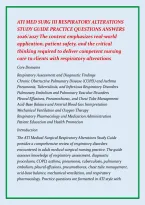
ATI MED SURG III RESPIRATORY ALTERATIONS
STUDY GUIDE PRACTICE QUESTIONS ANSWERS
2026/2027 The content emphasizes real-world
application, patient safety, and the critical
thinking required to deliver competent nursing
care to clients with respiratory alterations
Core Domains
Respiratory Assessment and Diagnostic Findings
Chronic Obstructive Pulmonary Disease (COPD) and Asthma
Pneumonia, Tuberculosis, and Infectious Respiratory Disorders
Pulmonary Embolism and Pulmonary Vascular Disorders
Pleural Effusions, Pneumothorax, and Chest Tube Management
Acid-Base Balance and Arterial Blood Gas Interpretation
Mechanical Ventilation and Oxygen Therapy
Respiratory Pharmacology and Medication Administration
Patient Education and Health Promotion
Introduction
The ATI Medical-Surgical Respiratory Alterations Study Guide
provides a comprehensive review of respiratory disorders
encountered in adult medical-surgical nursing practice. The guide
assesses knowledge of respiratory assessment, diagnostic
procedures, COPD, asthma, pneumonia, tuberculosis, pulmonary
embolism, pleural effusions, pneumothorax, chest tube management,
acid-base balance, mechanical ventilation, and respiratory
pharmacology. Practice questions are formatted in ATI style with
,detailed rationales to reinforce clinical judgment and decision-
making. The content emphasizes real-world application, patient
safety, and the critical thinking required to deliver competent nursing
care to clients with respiratory alterations.
SECTION ONE: QUESTIONS 1–100
1. A nurse is assessing a client with COPD. Which finding
should the nurse expect?
A. Decreased anterior-posterior chest diameter
B. Increased residual volume
C. Increased PaO2
D. Normal breath sounds
RATIONALE: COPD causes air trapping due to loss of lung
elasticity and airway collapse. This leads to an increase in residual
volume (the amount of air left in the lungs after forced exhalation).
Clients also develop a barrel chest (increased AP diameter),
decreased PaO2, and diminished breath sounds.
2. A nurse is assessing an elderly client. Which respiratory
finding is considered normal in an older adult?
A. Respiratory rate of 28 breaths per minute
B. Decreased breath sounds in the lower lobes
C. Slightly diminished lung sounds at the bases
D. Audible wheezing on expiration
, RATIONALE: Age-related changes include decreased chest wall
compliance, reduced elastic recoil, and slightly diminished lung
sounds, especially at the bases. Tachypnea (rate >20), absent breath
sounds, or wheezing are abnormal findings that require further
assessment.
3. A client with asthma has a peak flow reading of 50% of
personal best. What is the nurse's priority action?
A. Continue current management
B. Administer rescue medication and reassess
C. Increase controller medication
D. Notify the provider immediately
RATIONALE: The red zone (<50% of personal best) indicates
severe airway narrowing. The client should take a rescue
bronchodilator (short-acting beta-agonist) immediately. If no
improvement occurs after medication, emergency services must be
contacted.
4. Which finding is most indicative of early hypoxia?
A. Restlessness and confusion
B. High blood pressure
C. Increased urine output
D. Bradypnea with normal SpO2
RATIONALE: Early central nervous system signs of hypoxia
include restlessness, confusion, agitation, and anxiety. Tachycardia
, and tachypnea occur early. Bradycardia and bradypnea are late,
ominous signs.
5. A nurse is assessing a client with pneumonia. What is the
most common physical exam finding?
A. Crackles on auscultation
B. Decreased tactile fremitus
C. Dullness on percussion
D. Increased resonance
RATIONALE: Crackles (rales) are the hallmark finding in
pneumonia due to fluid or exudate in the alveoli. Dullness on
percussion may be present with consolidation, but crackles are most
common and often the earliest finding.
6. A nurse reviews ABG results: pH 7.30, PaCO2 55 mm Hg,
HCO3- 24 mEq/L. Which condition does this represent?
A. Metabolic acidosis
B. Metabolic alkalosis
C. Respiratory acidosis
D. Respiratory alkalosis
RATIONALE: Low pH (<7.35) indicates acidosis. Elevated
PaCO2 (>45 mm Hg) indicates a respiratory cause. Normal HCO3-
(22-26 mEq/L) shows no metabolic compensation. This is acute
respiratory acidosis from hypoventilation (e.g., COPD exacerbation,
opioid overdose).
STUDY GUIDE PRACTICE QUESTIONS ANSWERS
2026/2027 The content emphasizes real-world
application, patient safety, and the critical
thinking required to deliver competent nursing
care to clients with respiratory alterations
Core Domains
Respiratory Assessment and Diagnostic Findings
Chronic Obstructive Pulmonary Disease (COPD) and Asthma
Pneumonia, Tuberculosis, and Infectious Respiratory Disorders
Pulmonary Embolism and Pulmonary Vascular Disorders
Pleural Effusions, Pneumothorax, and Chest Tube Management
Acid-Base Balance and Arterial Blood Gas Interpretation
Mechanical Ventilation and Oxygen Therapy
Respiratory Pharmacology and Medication Administration
Patient Education and Health Promotion
Introduction
The ATI Medical-Surgical Respiratory Alterations Study Guide
provides a comprehensive review of respiratory disorders
encountered in adult medical-surgical nursing practice. The guide
assesses knowledge of respiratory assessment, diagnostic
procedures, COPD, asthma, pneumonia, tuberculosis, pulmonary
embolism, pleural effusions, pneumothorax, chest tube management,
acid-base balance, mechanical ventilation, and respiratory
pharmacology. Practice questions are formatted in ATI style with
,detailed rationales to reinforce clinical judgment and decision-
making. The content emphasizes real-world application, patient
safety, and the critical thinking required to deliver competent nursing
care to clients with respiratory alterations.
SECTION ONE: QUESTIONS 1–100
1. A nurse is assessing a client with COPD. Which finding
should the nurse expect?
A. Decreased anterior-posterior chest diameter
B. Increased residual volume
C. Increased PaO2
D. Normal breath sounds
RATIONALE: COPD causes air trapping due to loss of lung
elasticity and airway collapse. This leads to an increase in residual
volume (the amount of air left in the lungs after forced exhalation).
Clients also develop a barrel chest (increased AP diameter),
decreased PaO2, and diminished breath sounds.
2. A nurse is assessing an elderly client. Which respiratory
finding is considered normal in an older adult?
A. Respiratory rate of 28 breaths per minute
B. Decreased breath sounds in the lower lobes
C. Slightly diminished lung sounds at the bases
D. Audible wheezing on expiration
, RATIONALE: Age-related changes include decreased chest wall
compliance, reduced elastic recoil, and slightly diminished lung
sounds, especially at the bases. Tachypnea (rate >20), absent breath
sounds, or wheezing are abnormal findings that require further
assessment.
3. A client with asthma has a peak flow reading of 50% of
personal best. What is the nurse's priority action?
A. Continue current management
B. Administer rescue medication and reassess
C. Increase controller medication
D. Notify the provider immediately
RATIONALE: The red zone (<50% of personal best) indicates
severe airway narrowing. The client should take a rescue
bronchodilator (short-acting beta-agonist) immediately. If no
improvement occurs after medication, emergency services must be
contacted.
4. Which finding is most indicative of early hypoxia?
A. Restlessness and confusion
B. High blood pressure
C. Increased urine output
D. Bradypnea with normal SpO2
RATIONALE: Early central nervous system signs of hypoxia
include restlessness, confusion, agitation, and anxiety. Tachycardia
, and tachypnea occur early. Bradycardia and bradypnea are late,
ominous signs.
5. A nurse is assessing a client with pneumonia. What is the
most common physical exam finding?
A. Crackles on auscultation
B. Decreased tactile fremitus
C. Dullness on percussion
D. Increased resonance
RATIONALE: Crackles (rales) are the hallmark finding in
pneumonia due to fluid or exudate in the alveoli. Dullness on
percussion may be present with consolidation, but crackles are most
common and often the earliest finding.
6. A nurse reviews ABG results: pH 7.30, PaCO2 55 mm Hg,
HCO3- 24 mEq/L. Which condition does this represent?
A. Metabolic acidosis
B. Metabolic alkalosis
C. Respiratory acidosis
D. Respiratory alkalosis
RATIONALE: Low pH (<7.35) indicates acidosis. Elevated
PaCO2 (>45 mm Hg) indicates a respiratory cause. Normal HCO3-
(22-26 mEq/L) shows no metabolic compensation. This is acute
respiratory acidosis from hypoventilation (e.g., COPD exacerbation,
opioid overdose).


