
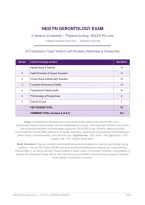
HESI PN GERONTOLOGY EXAM
3 Versions (Combined) • Practical Nursing / NCLEX-PN Level
COMPREHENSIVE PRACTICE • 2026/2027 EDITION
210 Questions (70 per Version) with Answers, Rationales & Answer Key
Section Content Area (per version) Questions
1 Aging Process & Theories 10
2 Health Promotion & Disease Prevention 10
3 Chronic Illness & Multisystem Disorders 15
4 Functional Assessment & Safety 10
5 Psychosocial & Mental Health 10
6 Pharmacology & Polypharmacy 8
7 End-of-Life Care 7
PER VERSION TOTAL 70
COMBINED TOTAL (Versions A, B & C) 210
Scope: Comprehensive gerontological nursing review at the practical nurse (NCLEX-PN) level —
biological/psychosocial aging theories and normal physiological changes, health promotion and screening, chronic
and multisystem disorders, functional/safety assessment (ADLs/IADLs, falls, restraints, pressure injuries),
psychosocial and mental health (delirium vs. dementia, depression, elder abuse), pharmacology and polypharmacy
(Beers criteria, pharmacokinetics), and end-of-life care. Cognitive mix: ~30% recall • ~50% application • ~20%
analysis, with ~75% scenario-based items.
Study disclaimer. These are original AI-authored practice questions modeled on a general gerontology nursing
blueprint — they are NOT actual HESI® exam items and are not affiliated with, endorsed by, or sponsored by
Elsevier/HESI or any testing authority. Clinical guidelines, Beers criteria, immunization schedules, and standards of
practice are periodically revised; always verify against current authoritative sources and your program's materials
before relying on this content in practice.
HESI PN Gerontology Exam — 3 Versions (Combined) (2026/2027) Page 1
, VERSION A
Section 1: Aging Process & Theories — Biological, Psychosocial, Physiological Changes (10
questions)
Q1. According to Erikson, the primary psychosocial developmental task of older adulthood is:
A. Integrity versus despair
B. Trust versus mistrust
C. Identity versus role confusion
D. Intimacy versus isolation
Correct Answer: A
Rationale: Erikson's final stage is integrity versus despair, involving reflection on a life well lived. The other
stages belong to earlier developmental periods.
Q2. Which is a normal age-related change of the cardiovascular system?
A. Increased maximum heart rate
B. Decreased elasticity of blood vessels and increased systolic blood pressure
C. Faster response to position changes
D. Thinner, more elastic arteries
Correct Answer: B
Rationale: Aging arteries stiffen, raising systolic pressure and reducing baroreceptor responsiveness. Maximum
heart rate decreases and vessels become less elastic with age.
Q3. A normal age-related change in the renal system is:
A. Decreased glomerular filtration rate (GFR)
B. Increased number of functioning nephrons
C. Improved drug clearance
D. Enhanced ability to concentrate urine
Correct Answer: A
Rationale: Aging reduces GFR and nephron number, decreasing drug clearance and concentrating ability. This
affects medication dosing in older adults.
Q4. Which integumentary change is expected with normal aging?
A. Thicker, more elastic skin
B. Increased subcutaneous fat everywhere
C. Faster wound healing
D. Thinning skin with decreased elasticity and increased fragility
Correct Answer: D
Rationale: Aging skin thins, loses elasticity, and becomes more fragile, and wounds heal more slowly. These
changes increase injury and pressure-injury risk.
HESI PN Gerontology Exam — 3 Versions (Combined) (2026/2027) Page 2
, Q5. A normal age-related sensory change is:
A. Increased tear production
B. Improved night vision
C. Presbyopia (decreased near vision) and presbycusis (high-frequency hearing loss)
D. Enhanced taste sensitivity
Correct Answer: C
Rationale: Presbyopia and presbycusis are common aging changes affecting vision and hearing. Night vision,
taste, and tear production typically decline, not improve.
Q6. Which statement about cognition in normal aging is accurate?
A. All older adults develop dementia
B. Severe memory loss is expected and normal
C. Processing speed may slow, but significant memory loss is not a normal part of aging
D. Learning becomes impossible
Correct Answer: C
Rationale: Normal aging may slow processing speed, but significant memory loss/dementia is not normal aging.
Older adults can still learn.
Q7. A normal respiratory change with aging is:
A. Improved gas exchange
B. Stronger respiratory muscles
C. Decreased lung elasticity and reduced cough effectiveness
D. Increased vital capacity
Correct Answer: C
Rationale: Aging reduces lung elasticity, respiratory muscle strength, and cough effectiveness, increasing
infection risk. Vital capacity and gas exchange decline.
Q8. Which musculoskeletal change is associated with normal aging?
A. Increased bone density
B. Decreased bone density and loss of muscle mass (sarcopenia)
C. Greater joint flexibility
D. Increased muscle mass
Correct Answer: B
Rationale: Aging brings decreased bone density and sarcopenia, raising fracture and frailty risk. Bone density
and muscle mass decline rather than increase.
Q9. The 'activity theory' of aging proposes that older adults:
A. Lose all social roles
B. Maintain well-being by staying active and engaged in meaningful activities
C. Inevitably become isolated
D. Should withdraw from society
Correct Answer: B
Rationale: Activity theory holds that remaining active and engaged supports well-being in aging. Disengagement
theory, by contrast, emphasizes withdrawal.
HESI PN Gerontology Exam — 3 Versions (Combined) (2026/2027) Page 3
, Q10. A normal neurological change in aging is:
A. Slower nerve conduction and reflexes
B. No change in balance
C. Increased number of neurons
D. Faster reaction time
Correct Answer: A
Rationale: Aging slows nerve conduction and reflexes and can affect balance, increasing fall risk. Reaction time
slows rather than speeds up.
Section 2: Health Promotion & Disease Prevention — Nutrition, Exercise, Immunizations,
Screening (10 questions)
Q11. Which vaccine is recommended annually for older adults to prevent respiratory illness?
A. Influenza vaccine
B. Yellow fever vaccine
C. Smallpox vaccine
D. Rabies vaccine
Correct Answer: A
Rationale: An annual influenza vaccine is recommended for older adults to reduce respiratory illness. The other
vaccines are not routine annual recommendations.
Q12. An older adult at risk for dehydration should be encouraged to:
A. Only drink with meals
B. Wait until very thirsty to drink
C. Drink fluids regularly throughout the day unless contraindicated
D. Avoid all fluids
Correct Answer: C
Rationale: Because thirst is blunted with aging, older adults should drink regularly unless restricted. Waiting for
thirst or avoiding fluids risks dehydration.
Q13. Which is the best nurse-recommended strategy to prevent falls at home?
A. Encourage walking in the dark
B. Remove loose rugs, improve lighting, and install grab bars
C. Keep clutter in walkways
D. Discourage all activity
Correct Answer: B
Rationale: Removing hazards, improving lighting, and adding grab bars reduce fall risk. Darkness, clutter, and
immobility increase falls.
HESI PN Gerontology Exam — 3 Versions (Combined) (2026/2027) Page 4
3 Versions (Combined) • Practical Nursing / NCLEX-PN Level
COMPREHENSIVE PRACTICE • 2026/2027 EDITION
210 Questions (70 per Version) with Answers, Rationales & Answer Key
Section Content Area (per version) Questions
1 Aging Process & Theories 10
2 Health Promotion & Disease Prevention 10
3 Chronic Illness & Multisystem Disorders 15
4 Functional Assessment & Safety 10
5 Psychosocial & Mental Health 10
6 Pharmacology & Polypharmacy 8
7 End-of-Life Care 7
PER VERSION TOTAL 70
COMBINED TOTAL (Versions A, B & C) 210
Scope: Comprehensive gerontological nursing review at the practical nurse (NCLEX-PN) level —
biological/psychosocial aging theories and normal physiological changes, health promotion and screening, chronic
and multisystem disorders, functional/safety assessment (ADLs/IADLs, falls, restraints, pressure injuries),
psychosocial and mental health (delirium vs. dementia, depression, elder abuse), pharmacology and polypharmacy
(Beers criteria, pharmacokinetics), and end-of-life care. Cognitive mix: ~30% recall • ~50% application • ~20%
analysis, with ~75% scenario-based items.
Study disclaimer. These are original AI-authored practice questions modeled on a general gerontology nursing
blueprint — they are NOT actual HESI® exam items and are not affiliated with, endorsed by, or sponsored by
Elsevier/HESI or any testing authority. Clinical guidelines, Beers criteria, immunization schedules, and standards of
practice are periodically revised; always verify against current authoritative sources and your program's materials
before relying on this content in practice.
HESI PN Gerontology Exam — 3 Versions (Combined) (2026/2027) Page 1
, VERSION A
Section 1: Aging Process & Theories — Biological, Psychosocial, Physiological Changes (10
questions)
Q1. According to Erikson, the primary psychosocial developmental task of older adulthood is:
A. Integrity versus despair
B. Trust versus mistrust
C. Identity versus role confusion
D. Intimacy versus isolation
Correct Answer: A
Rationale: Erikson's final stage is integrity versus despair, involving reflection on a life well lived. The other
stages belong to earlier developmental periods.
Q2. Which is a normal age-related change of the cardiovascular system?
A. Increased maximum heart rate
B. Decreased elasticity of blood vessels and increased systolic blood pressure
C. Faster response to position changes
D. Thinner, more elastic arteries
Correct Answer: B
Rationale: Aging arteries stiffen, raising systolic pressure and reducing baroreceptor responsiveness. Maximum
heart rate decreases and vessels become less elastic with age.
Q3. A normal age-related change in the renal system is:
A. Decreased glomerular filtration rate (GFR)
B. Increased number of functioning nephrons
C. Improved drug clearance
D. Enhanced ability to concentrate urine
Correct Answer: A
Rationale: Aging reduces GFR and nephron number, decreasing drug clearance and concentrating ability. This
affects medication dosing in older adults.
Q4. Which integumentary change is expected with normal aging?
A. Thicker, more elastic skin
B. Increased subcutaneous fat everywhere
C. Faster wound healing
D. Thinning skin with decreased elasticity and increased fragility
Correct Answer: D
Rationale: Aging skin thins, loses elasticity, and becomes more fragile, and wounds heal more slowly. These
changes increase injury and pressure-injury risk.
HESI PN Gerontology Exam — 3 Versions (Combined) (2026/2027) Page 2
, Q5. A normal age-related sensory change is:
A. Increased tear production
B. Improved night vision
C. Presbyopia (decreased near vision) and presbycusis (high-frequency hearing loss)
D. Enhanced taste sensitivity
Correct Answer: C
Rationale: Presbyopia and presbycusis are common aging changes affecting vision and hearing. Night vision,
taste, and tear production typically decline, not improve.
Q6. Which statement about cognition in normal aging is accurate?
A. All older adults develop dementia
B. Severe memory loss is expected and normal
C. Processing speed may slow, but significant memory loss is not a normal part of aging
D. Learning becomes impossible
Correct Answer: C
Rationale: Normal aging may slow processing speed, but significant memory loss/dementia is not normal aging.
Older adults can still learn.
Q7. A normal respiratory change with aging is:
A. Improved gas exchange
B. Stronger respiratory muscles
C. Decreased lung elasticity and reduced cough effectiveness
D. Increased vital capacity
Correct Answer: C
Rationale: Aging reduces lung elasticity, respiratory muscle strength, and cough effectiveness, increasing
infection risk. Vital capacity and gas exchange decline.
Q8. Which musculoskeletal change is associated with normal aging?
A. Increased bone density
B. Decreased bone density and loss of muscle mass (sarcopenia)
C. Greater joint flexibility
D. Increased muscle mass
Correct Answer: B
Rationale: Aging brings decreased bone density and sarcopenia, raising fracture and frailty risk. Bone density
and muscle mass decline rather than increase.
Q9. The 'activity theory' of aging proposes that older adults:
A. Lose all social roles
B. Maintain well-being by staying active and engaged in meaningful activities
C. Inevitably become isolated
D. Should withdraw from society
Correct Answer: B
Rationale: Activity theory holds that remaining active and engaged supports well-being in aging. Disengagement
theory, by contrast, emphasizes withdrawal.
HESI PN Gerontology Exam — 3 Versions (Combined) (2026/2027) Page 3
, Q10. A normal neurological change in aging is:
A. Slower nerve conduction and reflexes
B. No change in balance
C. Increased number of neurons
D. Faster reaction time
Correct Answer: A
Rationale: Aging slows nerve conduction and reflexes and can affect balance, increasing fall risk. Reaction time
slows rather than speeds up.
Section 2: Health Promotion & Disease Prevention — Nutrition, Exercise, Immunizations,
Screening (10 questions)
Q11. Which vaccine is recommended annually for older adults to prevent respiratory illness?
A. Influenza vaccine
B. Yellow fever vaccine
C. Smallpox vaccine
D. Rabies vaccine
Correct Answer: A
Rationale: An annual influenza vaccine is recommended for older adults to reduce respiratory illness. The other
vaccines are not routine annual recommendations.
Q12. An older adult at risk for dehydration should be encouraged to:
A. Only drink with meals
B. Wait until very thirsty to drink
C. Drink fluids regularly throughout the day unless contraindicated
D. Avoid all fluids
Correct Answer: C
Rationale: Because thirst is blunted with aging, older adults should drink regularly unless restricted. Waiting for
thirst or avoiding fluids risks dehydration.
Q13. Which is the best nurse-recommended strategy to prevent falls at home?
A. Encourage walking in the dark
B. Remove loose rugs, improve lighting, and install grab bars
C. Keep clutter in walkways
D. Discourage all activity
Correct Answer: B
Rationale: Removing hazards, improving lighting, and adding grab bars reduce fall risk. Darkness, clutter, and
immobility increase falls.
HESI PN Gerontology Exam — 3 Versions (Combined) (2026/2027) Page 4


