
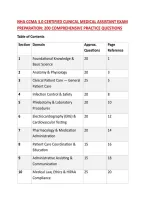
NHA CCMA 3.0 CERTIFIED CLINICAL MEDICAL ASSISTANT EXAM
PREPARATION: 200 COMPREHENSIVE PRACTICE QUESTIONS
Table of Contents
Section Domain Approx. Page
Questions Reference
1 Foundational Knowledge & 20 1
Basic Science
2 Anatomy & Physiology 20 3
3 Clinical Patient Care — General 25 5
Patient Care
4 Infection Control & Safety 20 8
5 Phlebotomy & Laboratory 20 10
Procedures
6 Electrocardiography (EKG) & 20 12
Cardiovascular Testing
7 Pharmacology & Medication 20 14
Administration
8 Patient Care Coordination & 15 16
Education
9 Administrative Assisting & 15 18
Communication
10 Medical Law, Ethics & HIPAA 25 20
Compliance
,Section 1: Foundational Knowledge & Basic Science (Questions 1-20)
1. Which of the following prefixes means "fast" or "rapid"?
A. Brady-
B. Tachy-
C. Neo-
D. Macro-
Correct Answer: B
Rationale: The prefix "tachy-" denotes rapid or fast, often used in terms
like tachycardia (fast heart rate). "Brady-" means slow.
2. What is the normal resting heart rate range for a healthy adult?
A. 40-60 beats per minute
B. 60-100 beats per minute
C. 100-120 beats per minute
D. 120-140 beats per minute
Correct Answer: B
Rationale: The universally accepted normal resting heart rate for adults
is 60 to 100 beats per minute.
3. Which body cavity contains the heart and lungs?
A. Cranial cavity
B. Abdominal cavity
C. Thoracic cavity
D. Pelvic cavity
Correct Answer: C
Rationale: The thoracic cavity is the chamber of the body of vertebrates
that is protected by the thoracic wall, containing the heart and lungs.
,4. What does the abbreviation "NPO" stand for in a medical setting?
A. Nothing by mouth
B. Normal postoperative order
C. New patient orientation
D. No physical output
Correct Answer: A
Rationale: NPO is derived from the Latin "nil per os," which means
nothing by mouth, indicating a patient should not eat or drink.
5. Which of the following is a standard temperature range for an
adult?
A. 95.0°F to 97.5°F
B. 97.6°F to 99.6°F
C. 99.8°F to 101.5°F
D. 101.6°F to 103.0°F
Correct Answer: B
Rationale: The average normal oral body temperature is generally
accepted to be around 98.6°F, with a normal range spanning from
97.6°F to 99.6°F.
6. In medical terminology, what does the suffix "-itis" indicate?
A. Inflammation
B. Surgical removal
C. Pain
D. Enlargement
Correct Answer: A
Rationale: The suffix "-itis" is used to denote inflammation of a specific
organ or tissue (e.g., arthritis, hepatitis).
, 7. Which of the following is the correct conversion of 2.5 kilograms to
pounds?
A. 2.5 lbs
B. 5.0 lbs
C. 5.5 lbs
D. 6.5 lbs
Correct Answer: C
Rationale: To convert kilograms to pounds, multiply by 2.2. Therefore,
2.5 kg * 2.2 = 5.5 lbs.
8. What is the medical term for "difficulty breathing"?
A. Apnea
B. Dyspnea
C. Tachypnea
D. Orthopnea
Correct Answer: B
Rationale: Dyspnea refers to difficult or labored breathing. Apnea is the
absence of breathing, and tachypnea is rapid breathing.
9. Which organelle is responsible for producing energy in the cell?
A. Nucleus
B. Ribosome
C. Mitochondria
D. Golgi apparatus
Correct Answer: C
Rationale: Mitochondria are known as the powerhouse of the cell
because they generate most of the cell's supply of adenosine
triphosphate (ATP), used as a source of chemical energy.
PREPARATION: 200 COMPREHENSIVE PRACTICE QUESTIONS
Table of Contents
Section Domain Approx. Page
Questions Reference
1 Foundational Knowledge & 20 1
Basic Science
2 Anatomy & Physiology 20 3
3 Clinical Patient Care — General 25 5
Patient Care
4 Infection Control & Safety 20 8
5 Phlebotomy & Laboratory 20 10
Procedures
6 Electrocardiography (EKG) & 20 12
Cardiovascular Testing
7 Pharmacology & Medication 20 14
Administration
8 Patient Care Coordination & 15 16
Education
9 Administrative Assisting & 15 18
Communication
10 Medical Law, Ethics & HIPAA 25 20
Compliance
,Section 1: Foundational Knowledge & Basic Science (Questions 1-20)
1. Which of the following prefixes means "fast" or "rapid"?
A. Brady-
B. Tachy-
C. Neo-
D. Macro-
Correct Answer: B
Rationale: The prefix "tachy-" denotes rapid or fast, often used in terms
like tachycardia (fast heart rate). "Brady-" means slow.
2. What is the normal resting heart rate range for a healthy adult?
A. 40-60 beats per minute
B. 60-100 beats per minute
C. 100-120 beats per minute
D. 120-140 beats per minute
Correct Answer: B
Rationale: The universally accepted normal resting heart rate for adults
is 60 to 100 beats per minute.
3. Which body cavity contains the heart and lungs?
A. Cranial cavity
B. Abdominal cavity
C. Thoracic cavity
D. Pelvic cavity
Correct Answer: C
Rationale: The thoracic cavity is the chamber of the body of vertebrates
that is protected by the thoracic wall, containing the heart and lungs.
,4. What does the abbreviation "NPO" stand for in a medical setting?
A. Nothing by mouth
B. Normal postoperative order
C. New patient orientation
D. No physical output
Correct Answer: A
Rationale: NPO is derived from the Latin "nil per os," which means
nothing by mouth, indicating a patient should not eat or drink.
5. Which of the following is a standard temperature range for an
adult?
A. 95.0°F to 97.5°F
B. 97.6°F to 99.6°F
C. 99.8°F to 101.5°F
D. 101.6°F to 103.0°F
Correct Answer: B
Rationale: The average normal oral body temperature is generally
accepted to be around 98.6°F, with a normal range spanning from
97.6°F to 99.6°F.
6. In medical terminology, what does the suffix "-itis" indicate?
A. Inflammation
B. Surgical removal
C. Pain
D. Enlargement
Correct Answer: A
Rationale: The suffix "-itis" is used to denote inflammation of a specific
organ or tissue (e.g., arthritis, hepatitis).
, 7. Which of the following is the correct conversion of 2.5 kilograms to
pounds?
A. 2.5 lbs
B. 5.0 lbs
C. 5.5 lbs
D. 6.5 lbs
Correct Answer: C
Rationale: To convert kilograms to pounds, multiply by 2.2. Therefore,
2.5 kg * 2.2 = 5.5 lbs.
8. What is the medical term for "difficulty breathing"?
A. Apnea
B. Dyspnea
C. Tachypnea
D. Orthopnea
Correct Answer: B
Rationale: Dyspnea refers to difficult or labored breathing. Apnea is the
absence of breathing, and tachypnea is rapid breathing.
9. Which organelle is responsible for producing energy in the cell?
A. Nucleus
B. Ribosome
C. Mitochondria
D. Golgi apparatus
Correct Answer: C
Rationale: Mitochondria are known as the powerhouse of the cell
because they generate most of the cell's supply of adenosine
triphosphate (ATP), used as a source of chemical energy.


