
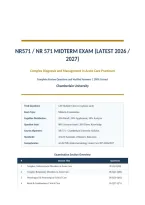
NR571 / NR 571 MIDTERM EXAM (LATEST 2026 /
2027)
Complex Diagnosis and Management in Acute Care Practicum
Complete Review Questions and Verified Answers | 100% Correct
Chamberlain University
Total Questions: 120 Multiple Choice (4 options each)
Exam Type: Midterm Examination
Cognitive Distribution: 20% Recall | 50% Application | 30% Analysis
Question Style: 80% Scenario-based | 20% Direct Knowledge
Course Alignment: NR 571 - Chamberlain University Syllabus
Standards: AACN Essentials of Master's Education
Competencies: AGACNP (Adult-Gerontology Acute Care NP) 2026/2027
Examination Section Overview
# Section Title Questions
1 Complex Cardiovascular Disorders in Acute Care 20 (Q1-Q20)
2 Complex Respiratory Disorders in Acute Care 18 (Q21-Q38)
3 Neurological & Neurosurgical Critical Care 18 (Q39-Q56)
4 Renal & Genitourinary Critical Care 15 (Q57-Q71)
,NR571 Midterm Exam (2026/2027) - Chamberlain University
5 Endocrine & Metabolic Critical Care 15 (Q72-Q86)
6 Gastrointestinal & Hepatic Critical Care 12 (Q87-Q98)
7 Hematological & Oncological Critical Care 12 (Q99-Q110)
8 Multisystem & Sepsis Critical Care 10 (Q111-Q120)
TOTAL 120 QUESTIONS
This examination is designed to assess advanced practice nursing competency in acute care diagnosis and management. Each question includes
a verified correct answer and detailed rationale aligned with current clinical guidelines, AACN Essentials, and AGACNP certification standards.
Page 2 of 42
,NR571 Midterm Exam (2026/2027) - Chamberlain University
Section 1: Complex Cardiovascular Disorders in Acute Care
Q1: A 58-year-old male presents to the ED with crushing substernal chest pain, diaphoresis, and nausea.
ECG shows 2 mm ST-segment elevation in leads II, III, and aVF. Which intervention is the highest
priority?
A. Administer sublingual nitroglycerin
B. Initiate IV access and administer aspirin 325 mg
C. Activate the cardiac catheterization lab for primary PCI *[CORRECT]*
D. Administer morphine 4 mg IV
Correct Answer: C
Rationale: The patient presents with an inferior STEMI. Per the NR 571 curriculum and ACC/AHA guidelines,
immediate reperfusion via primary PCI within 90 minutes of first medical contact is the standard of care for STEMI.
Time-to-reperfusion is the strongest predictor of mortality benefit; activation of the cath lab must precede adjunctive
medications. Nitroglycerin is relatively contraindicated in inferior wall MI due to risk of right ventricular infarct and
profound hypotension. Aspirin and IV access are essential but should occur simultaneously with PCI activation, not
delay it.
Q2: A 65-year-old female post-MI presents with hypotension (BP 78/50), oliguria, cool extremities, and
pulmonary edema. PA catheter reveals cardiac index 1.6 L/min/m2 and PCWP 28 mmHg. Which
pharmacologic intervention is most appropriate?
A. IV fluids 500 mL bolus
B. Dobutamine infusion *[CORRECT]*
C. Norepinephrine infusion
D. Nitroprusside infusion
Correct Answer: B
Rationale: The patient has cardiogenic shock (CI <2.2, PCWP >18) with pulmonary edema. Per AACN Essentials and
the NR 571 curriculum, dobutamine (inotrope) improves cardiac output while reducing PCWP. Additional IV fluids
would worsen pulmonary edema. Norepinephrine may increase afterload and worsen pump failure; nitroprusside
would cause profound hypotension. Inotrope plus vasopressor (e.g., dobutamine plus norepinephrine) is the standard if
MAP remains low after inotrope alone.
Q3: A patient's ECG shows a regular, wide-QRS tachycardia at 180 bpm. The patient is alert and
hemodynamically stable. What is the recommended first-line intervention?
A. IV adenosine 6 mg rapid push
B. Synchronized cardioversion 50 joules
C. IV amiodarone 150 mg over 10 minutes *[CORRECT]*
D. IV verapamil 5 mg
Correct Answer: C
Rationale: For stable monomorphic ventricular tachycardia, the AHA ACLS guidelines and NR 571 curriculum
recommend IV amiodarone 150 mg as first-line therapy. Adenosine is only indicated for regular monomorphic
Page 3 of 42
, NR571 Midterm Exam (2026/2027) - Chamberlain University
wide-complex tachycardia when the rhythm is confirmed SVT with aberrancy. Synchronized cardioversion is reserved
for unstable patients. Verapamil is contraindicated in VT and can cause hemodynamic collapse.
Q4: A 72-year-old male with new-onset atrial fibrillation with rapid ventricular response (HR 152)
presents with hypotension (BP 84/52), altered mental status, and chest pain. What is the priority
intervention?
A. IV diltiazem 0.25 mg/kg
B. IV amiodarone 150 mg
C. Synchronized electrical cardioversion 120 joules biphasic *[CORRECT]*
D. IV metoprolol 5 mg
Correct Answer: C
Rationale: Per AHA ACLS, unstable atrial fibrillation with hemodynamic compromise (hypotension, altered mental
status, chest pain) requires immediate synchronized cardioversion. Rate control agents (diltiazem, metoprolol) and
antiarrhythmics (amiodarone) are appropriate for stable patients only. Delaying cardioversion for pharmacologic
intervention in unstable AFib increases risk of stroke and clinical deterioration, per AACN Essentials.
Q5: A 68-year-old female with decompensated systolic heart failure presents with jugular venous
distention, bilateral crackles, S3 gallop, and 2+ pitting edema. BP 168/96. Which diuretic regimen is most
appropriate initially?
A. Hydrochlorothiazide 25 mg PO
B. Furosemide 40 mg IV push *[CORRECT]*
C. Spironolactone 25 mg PO
D. Furosemide 20 mg PO
Correct Answer: B
Rationale: Per ADHERE registry data and the NR 571 curriculum, IV loop diuretics (furosemide) are first-line therapy
for acute decompensated heart failure with volume overload. IV administration ensures bioavailability in patients with
gut edema and provides faster symptomatic relief than oral formulations. Thiazides and oral furosemide are inadequate
for acute pulmonary congestion. Spironolactone is adjunctive therapy in chronic HF management.
Q6: A patient with a PA catheter has the following data: PAP 38/18 mmHg, PCWP 22 mmHg, CO 4.0
L/min, and systemic BP 110/70. Estimate the systemic vascular resistance (SVR).
A. 800 dynes/sec/cm5
B. 1200 dynes/sec/cm5
C. 1500 dynes/sec/cm5 *[CORRECT]*
D. 1800 dynes/sec/cm5
Correct Answer: C
Rationale: SVR = (MAP - CVP) x 80 / CO. MAP = (110 + 2x70)/3 = 83. Assuming CVP ~ 5 (or PCWP estimate), SVR
= (83 - 5) x = 1560, approximating 1500 dynes/sec/cm5. Normal SVR is 800-1200; this patient is approaching
the upper limit, consistent with compensated heart failure. AACN Essentials emphasize accurate hemodynamic
calculation as a core AGACNP competency.
Page 4 of 42
2027)
Complex Diagnosis and Management in Acute Care Practicum
Complete Review Questions and Verified Answers | 100% Correct
Chamberlain University
Total Questions: 120 Multiple Choice (4 options each)
Exam Type: Midterm Examination
Cognitive Distribution: 20% Recall | 50% Application | 30% Analysis
Question Style: 80% Scenario-based | 20% Direct Knowledge
Course Alignment: NR 571 - Chamberlain University Syllabus
Standards: AACN Essentials of Master's Education
Competencies: AGACNP (Adult-Gerontology Acute Care NP) 2026/2027
Examination Section Overview
# Section Title Questions
1 Complex Cardiovascular Disorders in Acute Care 20 (Q1-Q20)
2 Complex Respiratory Disorders in Acute Care 18 (Q21-Q38)
3 Neurological & Neurosurgical Critical Care 18 (Q39-Q56)
4 Renal & Genitourinary Critical Care 15 (Q57-Q71)
,NR571 Midterm Exam (2026/2027) - Chamberlain University
5 Endocrine & Metabolic Critical Care 15 (Q72-Q86)
6 Gastrointestinal & Hepatic Critical Care 12 (Q87-Q98)
7 Hematological & Oncological Critical Care 12 (Q99-Q110)
8 Multisystem & Sepsis Critical Care 10 (Q111-Q120)
TOTAL 120 QUESTIONS
This examination is designed to assess advanced practice nursing competency in acute care diagnosis and management. Each question includes
a verified correct answer and detailed rationale aligned with current clinical guidelines, AACN Essentials, and AGACNP certification standards.
Page 2 of 42
,NR571 Midterm Exam (2026/2027) - Chamberlain University
Section 1: Complex Cardiovascular Disorders in Acute Care
Q1: A 58-year-old male presents to the ED with crushing substernal chest pain, diaphoresis, and nausea.
ECG shows 2 mm ST-segment elevation in leads II, III, and aVF. Which intervention is the highest
priority?
A. Administer sublingual nitroglycerin
B. Initiate IV access and administer aspirin 325 mg
C. Activate the cardiac catheterization lab for primary PCI *[CORRECT]*
D. Administer morphine 4 mg IV
Correct Answer: C
Rationale: The patient presents with an inferior STEMI. Per the NR 571 curriculum and ACC/AHA guidelines,
immediate reperfusion via primary PCI within 90 minutes of first medical contact is the standard of care for STEMI.
Time-to-reperfusion is the strongest predictor of mortality benefit; activation of the cath lab must precede adjunctive
medications. Nitroglycerin is relatively contraindicated in inferior wall MI due to risk of right ventricular infarct and
profound hypotension. Aspirin and IV access are essential but should occur simultaneously with PCI activation, not
delay it.
Q2: A 65-year-old female post-MI presents with hypotension (BP 78/50), oliguria, cool extremities, and
pulmonary edema. PA catheter reveals cardiac index 1.6 L/min/m2 and PCWP 28 mmHg. Which
pharmacologic intervention is most appropriate?
A. IV fluids 500 mL bolus
B. Dobutamine infusion *[CORRECT]*
C. Norepinephrine infusion
D. Nitroprusside infusion
Correct Answer: B
Rationale: The patient has cardiogenic shock (CI <2.2, PCWP >18) with pulmonary edema. Per AACN Essentials and
the NR 571 curriculum, dobutamine (inotrope) improves cardiac output while reducing PCWP. Additional IV fluids
would worsen pulmonary edema. Norepinephrine may increase afterload and worsen pump failure; nitroprusside
would cause profound hypotension. Inotrope plus vasopressor (e.g., dobutamine plus norepinephrine) is the standard if
MAP remains low after inotrope alone.
Q3: A patient's ECG shows a regular, wide-QRS tachycardia at 180 bpm. The patient is alert and
hemodynamically stable. What is the recommended first-line intervention?
A. IV adenosine 6 mg rapid push
B. Synchronized cardioversion 50 joules
C. IV amiodarone 150 mg over 10 minutes *[CORRECT]*
D. IV verapamil 5 mg
Correct Answer: C
Rationale: For stable monomorphic ventricular tachycardia, the AHA ACLS guidelines and NR 571 curriculum
recommend IV amiodarone 150 mg as first-line therapy. Adenosine is only indicated for regular monomorphic
Page 3 of 42
, NR571 Midterm Exam (2026/2027) - Chamberlain University
wide-complex tachycardia when the rhythm is confirmed SVT with aberrancy. Synchronized cardioversion is reserved
for unstable patients. Verapamil is contraindicated in VT and can cause hemodynamic collapse.
Q4: A 72-year-old male with new-onset atrial fibrillation with rapid ventricular response (HR 152)
presents with hypotension (BP 84/52), altered mental status, and chest pain. What is the priority
intervention?
A. IV diltiazem 0.25 mg/kg
B. IV amiodarone 150 mg
C. Synchronized electrical cardioversion 120 joules biphasic *[CORRECT]*
D. IV metoprolol 5 mg
Correct Answer: C
Rationale: Per AHA ACLS, unstable atrial fibrillation with hemodynamic compromise (hypotension, altered mental
status, chest pain) requires immediate synchronized cardioversion. Rate control agents (diltiazem, metoprolol) and
antiarrhythmics (amiodarone) are appropriate for stable patients only. Delaying cardioversion for pharmacologic
intervention in unstable AFib increases risk of stroke and clinical deterioration, per AACN Essentials.
Q5: A 68-year-old female with decompensated systolic heart failure presents with jugular venous
distention, bilateral crackles, S3 gallop, and 2+ pitting edema. BP 168/96. Which diuretic regimen is most
appropriate initially?
A. Hydrochlorothiazide 25 mg PO
B. Furosemide 40 mg IV push *[CORRECT]*
C. Spironolactone 25 mg PO
D. Furosemide 20 mg PO
Correct Answer: B
Rationale: Per ADHERE registry data and the NR 571 curriculum, IV loop diuretics (furosemide) are first-line therapy
for acute decompensated heart failure with volume overload. IV administration ensures bioavailability in patients with
gut edema and provides faster symptomatic relief than oral formulations. Thiazides and oral furosemide are inadequate
for acute pulmonary congestion. Spironolactone is adjunctive therapy in chronic HF management.
Q6: A patient with a PA catheter has the following data: PAP 38/18 mmHg, PCWP 22 mmHg, CO 4.0
L/min, and systemic BP 110/70. Estimate the systemic vascular resistance (SVR).
A. 800 dynes/sec/cm5
B. 1200 dynes/sec/cm5
C. 1500 dynes/sec/cm5 *[CORRECT]*
D. 1800 dynes/sec/cm5
Correct Answer: C
Rationale: SVR = (MAP - CVP) x 80 / CO. MAP = (110 + 2x70)/3 = 83. Assuming CVP ~ 5 (or PCWP estimate), SVR
= (83 - 5) x = 1560, approximating 1500 dynes/sec/cm5. Normal SVR is 800-1200; this patient is approaching
the upper limit, consistent with compensated heart failure. AACN Essentials emphasize accurate hemodynamic
calculation as a core AGACNP competency.
Page 4 of 42


