
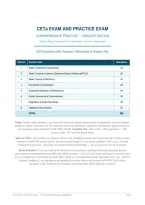
CETa EXAM AND PRACTICE EXAM
COMPREHENSIVE PRACTICE • 2026/2027 EDITION
Dialysis Water Treatment & Environmental Technician Preparation
300 Questions with Answers, Rationales & Answer Key
Section Content Area Questions
1 Water Treatment Fundamentals 40
2 Water Treatment Systems (Sediment/Carbon/Softening/RO/DI) 50
3 Water Testing & Monitoring 45
4 Disinfection & Sanitization 40
5 Equipment Operation & Maintenance 40
6 Quality Assurance & Documentation 35
7 Regulatory & Safety Standards 30
8 Integrated Case Studies 20
TOTAL 300
Scope: Dialysis water treatment / environmental technician review covering water fundamentals, treatment systems
(sediment, carbon, softening, RO, DI), testing & monitoring, disinfection, equipment maintenance, quality assurance,
and regulatory/safety standards (AAMI, CMS, OSHA). Cognitive mix: ~30% recall • ~50% application • ~20%
analysis, with ~75% scenario-based items.
Note on 'CETa'. This practice set interprets CETa as the Certified Environmental Technician role for dialysis water
treatment (AAMI/CMS-based content), per the provided blueprint. If you meant a different 'CETa' (e.g., Certified
Electronics Technician - Associate), the content domains would differ — let us know and it can be re-scoped.
Study disclaimer. These are original AI-authored practice questions modeled on publicly described dialysis
water-treatment competencies and AAMI/CMS/OSHA concepts — they are NOT actual certification exam items and
are not affiliated with or endorsed by AAMI, CMS, OSHA, or any credentialing body. Standards, limits (e.g., chlorine,
bacteria, endotoxin), and regulations are periodically revised; always verify current AAMI/ISO 23500-series
standards, CMS Conditions for Coverage, and facility policy before applying to practice.
CETa Exam & Practice Exam — Comprehensive Practice (2026/2027) Page 1
, Section 1: Water Treatment Fundamentals — Sources, Contaminants, Purification, AAMI
Standards (40 questions)
Q1. Why must water used to prepare dialysate be treated far more rigorously than ordinary drinking
water?
A. Because dialysis patients drink large volumes of it
B. Because a hemodialysis patient's blood is exposed to about 120+ liters of water per treatment across
only a membrane, bypassing the GI barrier
C. Because tap water is always contaminated with bacteria
D. Because dialysis water must taste better
Correct Answer: B
Rationale: During dialysis, the patient's blood contacts large volumes of water separated only by a thin
membrane, so contaminants can pass directly into the blood. This bypasses the protective GI tract, requiring far
stricter purity than drinking water.
Q2. According to AAMI standards, the maximum allowable level of total chlorine in water used for dialysis
is:
A. Less than 1.0 mg/L
B. Less than 0.1 mg/L
C. Less than 10 mg/L
D. Less than 4.0 mg/L
Correct Answer: B
Rationale: AAMI limits total chlorine to less than 0.1 mg/L because chlorine/chloramine can cause hemolysis in
dialysis patients. Higher limits apply to drinking water, not dialysis water.
Q3. Which category best describes bacteria and endotoxins as water contaminants?
A. Particulate contaminants
B. Microbiological contaminants
C. Chemical contaminants
D. Radiological contaminants
Correct Answer: B
Rationale: Bacteria and their byproducts (endotoxins) are microbiological contaminants. Particulates are
undissolved solids, and chemicals include dissolved ions and disinfectants.
Q4. Chloramine is added to many municipal water supplies as a:
A. Disinfectant (in place of or with free chlorine)
B. Corrosion inhibitor only
C. Fluoridation agent
D. Softening agent
Correct Answer: A
Rationale: Chloramine is used by municipalities as a disinfectant because it is more stable than free chlorine.
However, it is highly toxic to dialysis patients and must be removed.
CETa Exam & Practice Exam — Comprehensive Practice (2026/2027) Page 2
, Q5. Which contaminant is specifically associated with causing hemolytic anemia in dialysis patients if not
removed?
A. Calcium
B. Sodium
C. Chloramine
D. Sediment
Correct Answer: C
Rationale: Chloramine (and chlorine) can cause hemolysis and hemolytic anemia in dialysis patients. Sodium,
calcium, and sediment cause other problems but are not the classic cause of hemolysis from oxidants.
Q6. Aluminum contamination in dialysis water has historically been linked to:
A. Simple dehydration
B. Hemolysis
C. Bone disease and neurologic toxicity (encephalopathy)
D. Improved clotting
Correct Answer: C
Rationale: Aluminum toxicity in dialysis patients causes bone disease (osteomalacia) and dialysis
encephalopathy. This is why aluminum has a strict AAMI limit.
Q7. The primary purpose of reverse osmosis (RO) in a dialysis water system is to:
A. Chlorinate the water
B. Add minerals to the water
C. Remove only large particles
D. Remove a high percentage of dissolved ions, organics, bacteria, and endotoxins
Correct Answer: D
Rationale: RO forces water through a semipermeable membrane, rejecting most dissolved solids, organics,
bacteria, and endotoxins. It is the primary purification step in most dialysis systems.
Q8. Which purification method removes dissolved ions using cation and anion exchange resins?
A. Deionization (DI)
B. Sediment filtration
C. Ultraviolet irradiation
D. Carbon filtration
Correct Answer: A
Rationale: Deionization uses cation and anion exchange resins to remove charged ions. Sediment and carbon
filters remove particulates and organics/chlorine, respectively.
Q9. High levels of which contaminants cause 'hard' water that can foul RO membranes?
A. Nitrate and fluoride
B. Sodium and potassium
C. Chlorine and chloramine
D. Calcium and magnesium
Correct Answer: D
Rationale: Calcium and magnesium are the hardness ions that scale and foul RO membranes. Softeners remove
these to protect downstream equipment.
CETa Exam & Practice Exam — Comprehensive Practice (2026/2027) Page 3
, Q10. Endotoxins are best described as:
A. Living bacteria
B. A disinfectant
C. A type of dissolved metal
D. Fragments of the cell walls of gram-negative bacteria that can cause pyrogenic reactions
Correct Answer: D
Rationale: Endotoxins (lipopolysaccharides) are components of gram-negative bacterial cell walls that trigger
pyrogenic (fever) reactions. They can pass through some systems and must be controlled.
Q11. The AAMI documents most associated with dialysis water and dialysate quality (now largely
consolidated into the 23500 series) historically included:
A. RD52, RD62, and related standards
B. FDA food codes
C. The NEC electrical code
D. OSHA 1910 only
Correct Answer: A
Rationale: AAMI standards such as RD52 (water for dialysis) and RD62 (product water quality) historically
governed dialysis water, now consolidated into the ANSI/AAMI/ISO 23500 series. OSHA, FDA food codes, and
the NEC address other areas.
Q12. Which sequence best represents the typical order of a dialysis water treatment train?
A. Deionization only, with no pretreatment
B. Pretreatment (sediment filter, softener, carbon), then RO, then distribution
C. RO first, then sediment filter, then carbon
D. Distribution loop first, then carbon
Correct Answer: B
Rationale: Water is pretreated (sediment, softener, carbon) to protect the RO, which then produces product water
sent to distribution. Placing RO first would foul it quickly.
Q13. The main reason carbon filtration is placed BEFORE the RO membrane is to:
A. Remove chlorine/chloramine, which can damage RO membranes and harm patients
B. Add chlorine to the water
C. Increase water hardness
D. Cool the water
Correct Answer: A
Rationale: Carbon removes chlorine/chloramine, protecting the RO membrane (which chlorine can degrade) and
preventing patient exposure. Softeners also precede RO to remove hardness.
Q14. Which is considered a 'particulate' contaminant in source water?
A. Sand, silt, and rust particles
B. Dissolved sodium
C. Endotoxin
D. Dissolved chloramine
Correct Answer: A
Rationale: Particulates are undissolved solids like sand, silt, and rust removed by sediment filtration. Sodium and
chloramine are dissolved, and endotoxin is microbiological.
CETa Exam & Practice Exam — Comprehensive Practice (2026/2027) Page 4
COMPREHENSIVE PRACTICE • 2026/2027 EDITION
Dialysis Water Treatment & Environmental Technician Preparation
300 Questions with Answers, Rationales & Answer Key
Section Content Area Questions
1 Water Treatment Fundamentals 40
2 Water Treatment Systems (Sediment/Carbon/Softening/RO/DI) 50
3 Water Testing & Monitoring 45
4 Disinfection & Sanitization 40
5 Equipment Operation & Maintenance 40
6 Quality Assurance & Documentation 35
7 Regulatory & Safety Standards 30
8 Integrated Case Studies 20
TOTAL 300
Scope: Dialysis water treatment / environmental technician review covering water fundamentals, treatment systems
(sediment, carbon, softening, RO, DI), testing & monitoring, disinfection, equipment maintenance, quality assurance,
and regulatory/safety standards (AAMI, CMS, OSHA). Cognitive mix: ~30% recall • ~50% application • ~20%
analysis, with ~75% scenario-based items.
Note on 'CETa'. This practice set interprets CETa as the Certified Environmental Technician role for dialysis water
treatment (AAMI/CMS-based content), per the provided blueprint. If you meant a different 'CETa' (e.g., Certified
Electronics Technician - Associate), the content domains would differ — let us know and it can be re-scoped.
Study disclaimer. These are original AI-authored practice questions modeled on publicly described dialysis
water-treatment competencies and AAMI/CMS/OSHA concepts — they are NOT actual certification exam items and
are not affiliated with or endorsed by AAMI, CMS, OSHA, or any credentialing body. Standards, limits (e.g., chlorine,
bacteria, endotoxin), and regulations are periodically revised; always verify current AAMI/ISO 23500-series
standards, CMS Conditions for Coverage, and facility policy before applying to practice.
CETa Exam & Practice Exam — Comprehensive Practice (2026/2027) Page 1
, Section 1: Water Treatment Fundamentals — Sources, Contaminants, Purification, AAMI
Standards (40 questions)
Q1. Why must water used to prepare dialysate be treated far more rigorously than ordinary drinking
water?
A. Because dialysis patients drink large volumes of it
B. Because a hemodialysis patient's blood is exposed to about 120+ liters of water per treatment across
only a membrane, bypassing the GI barrier
C. Because tap water is always contaminated with bacteria
D. Because dialysis water must taste better
Correct Answer: B
Rationale: During dialysis, the patient's blood contacts large volumes of water separated only by a thin
membrane, so contaminants can pass directly into the blood. This bypasses the protective GI tract, requiring far
stricter purity than drinking water.
Q2. According to AAMI standards, the maximum allowable level of total chlorine in water used for dialysis
is:
A. Less than 1.0 mg/L
B. Less than 0.1 mg/L
C. Less than 10 mg/L
D. Less than 4.0 mg/L
Correct Answer: B
Rationale: AAMI limits total chlorine to less than 0.1 mg/L because chlorine/chloramine can cause hemolysis in
dialysis patients. Higher limits apply to drinking water, not dialysis water.
Q3. Which category best describes bacteria and endotoxins as water contaminants?
A. Particulate contaminants
B. Microbiological contaminants
C. Chemical contaminants
D. Radiological contaminants
Correct Answer: B
Rationale: Bacteria and their byproducts (endotoxins) are microbiological contaminants. Particulates are
undissolved solids, and chemicals include dissolved ions and disinfectants.
Q4. Chloramine is added to many municipal water supplies as a:
A. Disinfectant (in place of or with free chlorine)
B. Corrosion inhibitor only
C. Fluoridation agent
D. Softening agent
Correct Answer: A
Rationale: Chloramine is used by municipalities as a disinfectant because it is more stable than free chlorine.
However, it is highly toxic to dialysis patients and must be removed.
CETa Exam & Practice Exam — Comprehensive Practice (2026/2027) Page 2
, Q5. Which contaminant is specifically associated with causing hemolytic anemia in dialysis patients if not
removed?
A. Calcium
B. Sodium
C. Chloramine
D. Sediment
Correct Answer: C
Rationale: Chloramine (and chlorine) can cause hemolysis and hemolytic anemia in dialysis patients. Sodium,
calcium, and sediment cause other problems but are not the classic cause of hemolysis from oxidants.
Q6. Aluminum contamination in dialysis water has historically been linked to:
A. Simple dehydration
B. Hemolysis
C. Bone disease and neurologic toxicity (encephalopathy)
D. Improved clotting
Correct Answer: C
Rationale: Aluminum toxicity in dialysis patients causes bone disease (osteomalacia) and dialysis
encephalopathy. This is why aluminum has a strict AAMI limit.
Q7. The primary purpose of reverse osmosis (RO) in a dialysis water system is to:
A. Chlorinate the water
B. Add minerals to the water
C. Remove only large particles
D. Remove a high percentage of dissolved ions, organics, bacteria, and endotoxins
Correct Answer: D
Rationale: RO forces water through a semipermeable membrane, rejecting most dissolved solids, organics,
bacteria, and endotoxins. It is the primary purification step in most dialysis systems.
Q8. Which purification method removes dissolved ions using cation and anion exchange resins?
A. Deionization (DI)
B. Sediment filtration
C. Ultraviolet irradiation
D. Carbon filtration
Correct Answer: A
Rationale: Deionization uses cation and anion exchange resins to remove charged ions. Sediment and carbon
filters remove particulates and organics/chlorine, respectively.
Q9. High levels of which contaminants cause 'hard' water that can foul RO membranes?
A. Nitrate and fluoride
B. Sodium and potassium
C. Chlorine and chloramine
D. Calcium and magnesium
Correct Answer: D
Rationale: Calcium and magnesium are the hardness ions that scale and foul RO membranes. Softeners remove
these to protect downstream equipment.
CETa Exam & Practice Exam — Comprehensive Practice (2026/2027) Page 3
, Q10. Endotoxins are best described as:
A. Living bacteria
B. A disinfectant
C. A type of dissolved metal
D. Fragments of the cell walls of gram-negative bacteria that can cause pyrogenic reactions
Correct Answer: D
Rationale: Endotoxins (lipopolysaccharides) are components of gram-negative bacterial cell walls that trigger
pyrogenic (fever) reactions. They can pass through some systems and must be controlled.
Q11. The AAMI documents most associated with dialysis water and dialysate quality (now largely
consolidated into the 23500 series) historically included:
A. RD52, RD62, and related standards
B. FDA food codes
C. The NEC electrical code
D. OSHA 1910 only
Correct Answer: A
Rationale: AAMI standards such as RD52 (water for dialysis) and RD62 (product water quality) historically
governed dialysis water, now consolidated into the ANSI/AAMI/ISO 23500 series. OSHA, FDA food codes, and
the NEC address other areas.
Q12. Which sequence best represents the typical order of a dialysis water treatment train?
A. Deionization only, with no pretreatment
B. Pretreatment (sediment filter, softener, carbon), then RO, then distribution
C. RO first, then sediment filter, then carbon
D. Distribution loop first, then carbon
Correct Answer: B
Rationale: Water is pretreated (sediment, softener, carbon) to protect the RO, which then produces product water
sent to distribution. Placing RO first would foul it quickly.
Q13. The main reason carbon filtration is placed BEFORE the RO membrane is to:
A. Remove chlorine/chloramine, which can damage RO membranes and harm patients
B. Add chlorine to the water
C. Increase water hardness
D. Cool the water
Correct Answer: A
Rationale: Carbon removes chlorine/chloramine, protecting the RO membrane (which chlorine can degrade) and
preventing patient exposure. Softeners also precede RO to remove hardness.
Q14. Which is considered a 'particulate' contaminant in source water?
A. Sand, silt, and rust particles
B. Dissolved sodium
C. Endotoxin
D. Dissolved chloramine
Correct Answer: A
Rationale: Particulates are undissolved solids like sand, silt, and rust removed by sediment filtration. Sodium and
chloramine are dissolved, and endotoxin is microbiological.
CETa Exam & Practice Exam — Comprehensive Practice (2026/2027) Page 4


