
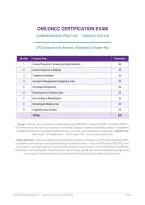
ONS/ONCC CERTIFICATION EXAM
COMPREHENSIVE PRACTICE • 2026/2027 EDITION
270 Questions with Answers, Rationales & Answer Key
Section Content Area Questions
1 Cancer Prevention, Screening & Early Detection 30
2 Cancer Diagnosis & Staging 30
3 Treatment Modalities 50
4 Symptom Management & Supportive Care 40
5 Oncologic Emergencies 30
6 Psychosocial & Palliative Care 25
7 Survivorship & Rehabilitation 25
8 Hematologic Malignancies 20
9 Integrated Case Studies 20
TOTAL 270
Scope: Oncology nursing certification review aligned with ONS/ONCC blueprints (OCN®, CPHON®, CBCN®,
AOCNP®) across the cancer care continuum • prevention, diagnosis, treatment modalities, symptom management,
oncologic emergencies, psychosocial/palliative care, survivorship, and hematologic malignancies. Cognitive mix:
~30% recall • ~50% application • ~20% analysis, with ~75% scenario-based items.
Study disclaimer. These are original AI-authored practice questions modeled on publicly described ONS/ONCC
certification content domains and standard oncology-nursing references — they are NOT actual ONS/ONCC exam
items and are not affiliated with or endorsed by the Oncology Nursing Society, the Oncology Nursing Certification
Corporation, or any testing body. Clinical practices, drug protocols, dosing, and screening guidelines change; always
verify against current authoritative sources and institutional policy before applying to patient care.
ONS/ONCC Certification Exam — Comprehensive Practice (2026/2027) Page 1
, Section 1: Cancer Prevention, Screening & Early Detection — Risk Factors, Screening,
Genetics (30 questions)
Q1. A 45-year-old woman with a mother and sister who both had premenopausal breast cancer asks
about her risk. Which genetic mutation is most associated with hereditary breast and ovarian cancer?
A. APC
B. BRCA1/BRCA2
C. RET
D. BCR-ABL
Correct Answer: B
Rationale: BRCA1/BRCA2 mutations are the classic cause of hereditary breast and ovarian cancer syndrome.
APC relates to familial adenomatous polyposis, RET to MEN syndromes, and BCR-ABL to CML.
Q2. Which hereditary syndrome is most associated with an increased risk of colorectal and endometrial
cancer?
A. Li-Fraumeni syndrome
B. Lynch syndrome (HNPCC)
C. Peutz-Jeghers syndrome
D. Cowden syndrome
Correct Answer: B
Rationale: Lynch syndrome (hereditary nonpolyposis colorectal cancer) markedly increases colorectal and
endometrial cancer risk via DNA mismatch repair gene mutations. The other syndromes have different
predominant cancer patterns.
Q3. According to widely used guidelines, average-risk colorectal cancer screening with colonoscopy
generally begins at what age?
A. Age 30
B. Age 45
C. Age 60
D. Age 70
Correct Answer: B
Rationale: Current guidelines recommend average-risk colorectal cancer screening begin at age 45. Beginning at
30 is too early for average risk, and delaying to 60-70 misses early detection.
Q4. A nurse teaches that the single most important modifiable risk factor for lung cancer is:
A. Cigarette smoking
B. Air pollution
C. Family history
D. Radon exposure
Correct Answer: A
Rationale: Cigarette smoking is by far the leading modifiable cause of lung cancer. Radon and pollution
contribute, and family history is not modifiable.
ONS/ONCC Certification Exam — Comprehensive Practice (2026/2027) Page 2
, Q5. Low-dose CT lung cancer screening is recommended for which patient?
A. A 70-year-old who quit 25 years ago
B. A 55-year-old with a 30 pack-year history who currently smokes
C. A 40-year-old never-smoker
D. A 25-year-old with occasional cigar use
Correct Answer: B
Rationale: Annual low-dose CT is recommended for adults ~50-80 with a significant smoking history (about 20+
pack-years) who currently smoke or quit within 15 years. Never-smokers and remote quitters generally do not
qualify.
Q6. Which vaccine is most directly associated with primary prevention of cervical and other HPV-related
cancers?
A. Influenza vaccine
B. Human papillomavirus (HPV) vaccine
C. Hepatitis B vaccine
D. Pneumococcal vaccine
Correct Answer: B
Rationale: The HPV vaccine prevents infection with high-risk HPV types that cause most cervical and several
other cancers. Hepatitis B vaccine reduces liver cancer risk but not cervical cancer.
Q7. A patient asks about primary prevention of cancer. Which is the best example?
A. A Pap test
B. A colonoscopy that removes a polyp
C. A screening mammogram
D. Smoking cessation and HPV vaccination
Correct Answer: D
Rationale: Primary prevention aims to prevent disease before it occurs (e.g., smoking cessation, vaccination).
Mammography and Pap testing are secondary prevention (early detection), and polyp removal is secondary
prevention/treatment.
Q8. Which finding on a Papanicolaou (Pap) test workflow best reflects the purpose of secondary
prevention?
A. Detecting precancerous cervical changes early so they can be treated
B. Preventing HPV infection
C. Vaccinating against HPV
D. Curing invasive cervical cancer
Correct Answer: A
Rationale: Secondary prevention detects disease or precursors early (e.g., cervical dysplasia) to allow timely
intervention. Preventing infection and vaccination are primary prevention.
ONS/ONCC Certification Exam — Comprehensive Practice (2026/2027) Page 3
, Q9. A nurse counsels a patient with a BRCA1 mutation. Which risk-reducing strategy may be discussed?
A. Avoiding all physical activity
B. Annual chest x-ray only
C. No additional screening
D. Enhanced surveillance and consideration of risk-reducing surgery (e.g., salpingo-oophorectomy)
Correct Answer: D
Rationale: BRCA carriers benefit from enhanced surveillance (e.g., breast MRI) and may consider risk-reducing
surgeries such as bilateral salpingo-oophorectomy. Chest x-ray is not appropriate breast/ovarian screening.
Q10. Which dietary/lifestyle recommendation is associated with reduced cancer risk?
A. High intake of processed and red meats
B. Heavy alcohol consumption
C. Sedentary behavior
D. Regular physical activity and a diet rich in fruits and vegetables
Correct Answer: D
Rationale: Physical activity and a plant-rich diet are linked to lower cancer risk. Processed/red meats, inactivity,
and heavy alcohol use increase risk.
Q11. A 25-year-old woman asks when to begin cervical cancer screening. Current guidance commonly
recommends starting at:
A. Age 13
B. Age 40
C. Age 50
D. Age 21 (or 25 per some guidelines)
Correct Answer: D
Rationale: Cervical cancer screening generally begins around age 21 (age 25 in some updated guidelines).
Starting in the teens or delaying to 40-50 is not recommended for average risk.
Q12. Which patient statement about sun exposure indicates a need for further teaching regarding skin
cancer prevention?
A. 'I avoid peak midday sun.'
B. 'A base tan from a tanning bed protects me from skin cancer.'
C. 'I apply broad-spectrum sunscreen and reapply it.'
D. 'I wear protective clothing and a hat outdoors.'
Correct Answer: B
Rationale: Tanning beds increase skin cancer risk and do not provide protection; this statement needs correction.
Sunscreen, protective clothing, and avoiding peak sun are appropriate.
Q13. Chronic infection with which organism is a major risk factor for gastric cancer?
A. Escherichia coli
B. Helicobacter pylori
C. Candida albicans
D. Clostridioides difficile
Correct Answer: B
Rationale: Chronic H. pylori infection is a well-established risk factor for gastric cancer. The other organisms are
not established gastric carcinogens.
ONS/ONCC Certification Exam — Comprehensive Practice (2026/2027) Page 4


