
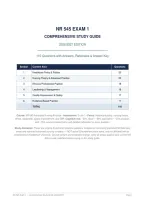
NR 545 EXAM 1
COMPREHENSIVE STUDY GUIDE
2026/2027 EDITION
110 Questions with Answers, Rationales & Answer Key
Section Content Area Questions
1 Healthcare Policy & Politics 20
2 Nursing Theory & Advanced Practice 20
3 Ethics & Professional Practice 18
4 Leadership & Management 18
5 Quality Improvement & Safety 17
6 Evidence-Based Practice 17
TOTAL 110
Course: NR 545 Advanced Nursing Practice • Assessment: Exam 1 • Focus: healthcare policy, nursing theory,
ethics, leadership, quality improvement, and EBP. Cognitive mix: ~30% recall • ~50% application • ~20% analysis,
with ~75% scenario-based items and detailed rationales for every question.
Study disclaimer. These are original AI-authored practice questions modeled on commonly published NR 545 topic
areas and standard advanced-nursing concepts — NOT actual Chamberlain exam items, and not affiliated with or
endorsed by Chamberlain University. Course content and emphasis change; verify all details against your current NR
545 course materials before relying on this study guide.
NR 545 Exam 1 — Comprehensive Study Guide (2026/2027) Page 1
, Section 1: Healthcare Policy & Politics — Policy Development, Advocacy, Healthcare Reform
(20 questions)
Q1. Which step typically comes FIRST in the health policy development process?
A. Policy evaluation
B. Agenda setting (identifying and defining the problem)
C. Policy implementation
D. Repealing the policy
Correct Answer: B
Rationale: Policy development begins with agenda setting, in which a problem is identified and gains attention.
Formulation, implementation, and evaluation follow.
Q2. A nurse testifies before a state legislative committee about safe staffing ratios. This action is an
example of:
A. Health policy advocacy
B. Direct patient care
C. Peer review
D. Clinical documentation
Correct Answer: A
Rationale: Testifying to influence legislation is health policy advocacy at the population/systems level. It is not
direct care, documentation, or peer review.
Q3. Which federal agency administers the Medicare and Medicaid programs?
A. The FDA
B. The Centers for Medicare & Medicaid Services (CMS)
C. OSHA
D. The CDC
Correct Answer: B
Rationale: CMS administers Medicare and Medicaid. The FDA regulates drugs and devices, OSHA addresses
workplace safety, and the CDC focuses on public health.
Q4. The Patient Protection and Affordable Care Act (ACA) is best described as legislation that:
A. Expanded access to health insurance coverage and emphasized prevention
B. Repealed Medicare
C. Banned Medicaid expansion nationwide
D. Eliminated all private insurance
Correct Answer: A
Rationale: The ACA expanded insurance access (e.g., marketplaces, Medicaid expansion options) and
emphasized preventive services. It did not eliminate private insurance or repeal Medicare.
NR 545 Exam 1 — Comprehensive Study Guide (2026/2027) Page 2
, Q5. Which agency is primarily responsible for approving the safety and efficacy of new prescription
medications?
A. The Joint Commission
B. The Food and Drug Administration (FDA)
C. CMS
D. OSHA
Correct Answer: B
Rationale: The FDA approves and regulates the safety and efficacy of drugs and medical devices. CMS handles
reimbursement, OSHA workplace safety, and the Joint Commission accredits facilities.
Q6. A nurse wants to influence policy most effectively. Which action has the broadest population-level
impact?
A. Avoiding all political involvement
B. Joining a professional organization's policy coalition to shape legislation
C. Caring for one patient at a time only
D. Focusing solely on personal continuing education
Correct Answer: B
Rationale: Engaging with professional organizations and coalitions amplifies influence on legislation affecting
many people. Individual care and personal education, while valuable, have narrower policy impact.
Q7. Medicaid is best described as a program that:
A. Covers only military veterans
B. Is fully privately funded
C. Covers only adults over age 65 regardless of income
D. Provides health coverage primarily for eligible low-income individuals and families (jointly funded by
states and the federal government)
Correct Answer: D
Rationale: Medicaid is a joint federal-state program covering eligible low-income populations. Medicare, by
contrast, primarily serves those 65 and older and certain disabled individuals.
Q8. Which agency sets and enforces workplace safety standards that protect nurses from hazards such
as bloodborne pathogens?
A. CMS
B. OSHA (Occupational Safety and Health Administration)
C. AHRQ
D. FDA
Correct Answer: B
Rationale: OSHA sets and enforces workplace safety standards, including bloodborne pathogen protections.
CMS, FDA, and AHRQ have other primary roles.
NR 545 Exam 1 — Comprehensive Study Guide (2026/2027) Page 3
COMPREHENSIVE STUDY GUIDE
2026/2027 EDITION
110 Questions with Answers, Rationales & Answer Key
Section Content Area Questions
1 Healthcare Policy & Politics 20
2 Nursing Theory & Advanced Practice 20
3 Ethics & Professional Practice 18
4 Leadership & Management 18
5 Quality Improvement & Safety 17
6 Evidence-Based Practice 17
TOTAL 110
Course: NR 545 Advanced Nursing Practice • Assessment: Exam 1 • Focus: healthcare policy, nursing theory,
ethics, leadership, quality improvement, and EBP. Cognitive mix: ~30% recall • ~50% application • ~20% analysis,
with ~75% scenario-based items and detailed rationales for every question.
Study disclaimer. These are original AI-authored practice questions modeled on commonly published NR 545 topic
areas and standard advanced-nursing concepts — NOT actual Chamberlain exam items, and not affiliated with or
endorsed by Chamberlain University. Course content and emphasis change; verify all details against your current NR
545 course materials before relying on this study guide.
NR 545 Exam 1 — Comprehensive Study Guide (2026/2027) Page 1
, Section 1: Healthcare Policy & Politics — Policy Development, Advocacy, Healthcare Reform
(20 questions)
Q1. Which step typically comes FIRST in the health policy development process?
A. Policy evaluation
B. Agenda setting (identifying and defining the problem)
C. Policy implementation
D. Repealing the policy
Correct Answer: B
Rationale: Policy development begins with agenda setting, in which a problem is identified and gains attention.
Formulation, implementation, and evaluation follow.
Q2. A nurse testifies before a state legislative committee about safe staffing ratios. This action is an
example of:
A. Health policy advocacy
B. Direct patient care
C. Peer review
D. Clinical documentation
Correct Answer: A
Rationale: Testifying to influence legislation is health policy advocacy at the population/systems level. It is not
direct care, documentation, or peer review.
Q3. Which federal agency administers the Medicare and Medicaid programs?
A. The FDA
B. The Centers for Medicare & Medicaid Services (CMS)
C. OSHA
D. The CDC
Correct Answer: B
Rationale: CMS administers Medicare and Medicaid. The FDA regulates drugs and devices, OSHA addresses
workplace safety, and the CDC focuses on public health.
Q4. The Patient Protection and Affordable Care Act (ACA) is best described as legislation that:
A. Expanded access to health insurance coverage and emphasized prevention
B. Repealed Medicare
C. Banned Medicaid expansion nationwide
D. Eliminated all private insurance
Correct Answer: A
Rationale: The ACA expanded insurance access (e.g., marketplaces, Medicaid expansion options) and
emphasized preventive services. It did not eliminate private insurance or repeal Medicare.
NR 545 Exam 1 — Comprehensive Study Guide (2026/2027) Page 2
, Q5. Which agency is primarily responsible for approving the safety and efficacy of new prescription
medications?
A. The Joint Commission
B. The Food and Drug Administration (FDA)
C. CMS
D. OSHA
Correct Answer: B
Rationale: The FDA approves and regulates the safety and efficacy of drugs and medical devices. CMS handles
reimbursement, OSHA workplace safety, and the Joint Commission accredits facilities.
Q6. A nurse wants to influence policy most effectively. Which action has the broadest population-level
impact?
A. Avoiding all political involvement
B. Joining a professional organization's policy coalition to shape legislation
C. Caring for one patient at a time only
D. Focusing solely on personal continuing education
Correct Answer: B
Rationale: Engaging with professional organizations and coalitions amplifies influence on legislation affecting
many people. Individual care and personal education, while valuable, have narrower policy impact.
Q7. Medicaid is best described as a program that:
A. Covers only military veterans
B. Is fully privately funded
C. Covers only adults over age 65 regardless of income
D. Provides health coverage primarily for eligible low-income individuals and families (jointly funded by
states and the federal government)
Correct Answer: D
Rationale: Medicaid is a joint federal-state program covering eligible low-income populations. Medicare, by
contrast, primarily serves those 65 and older and certain disabled individuals.
Q8. Which agency sets and enforces workplace safety standards that protect nurses from hazards such
as bloodborne pathogens?
A. CMS
B. OSHA (Occupational Safety and Health Administration)
C. AHRQ
D. FDA
Correct Answer: B
Rationale: OSHA sets and enforces workplace safety standards, including bloodborne pathogen protections.
CMS, FDA, and AHRQ have other primary roles.
NR 545 Exam 1 — Comprehensive Study Guide (2026/2027) Page 3


