
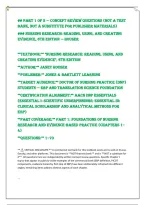
## PART 1 of 5 — ConCePT Review QuesTions (noT A TesT
BAnk, noT A suBsTiTuTe foR PuBlisheR MATeRiAls)
### nuRsing ReseARCh: ReAding, using, And CReATing
evidenCe, 6Th ediTion — houseR
**TexTBook:** *nuRsing ReseARCh: ReAding, using, And
CReATing evidenCe*, 6Th ediTion
**AuThoR:** JAneT houseR
**PuBlisheR:** Jones & BARTleTT leARning
**TARgeT AudienCe:** doCToR of nuRsing PRACTiCe (dnP)
sTudenTs — eBP And TRAnslATion sCienCe foundATion
**CeRTifiCATion AlignMenT:** AACn dnP essenTiAls
(essenTiAl i: sCienTifiC undeRPinnings; essenTiAl iii:
CliniCAl sCholARshiP And AnAlyTiCAl MeThods foR
eBP)
**PART CoveRAge:** PART 1: foundATions of nuRsing
ReseARCh And evidenCe-BAsed PRACTiCe (ChAPTeRs 1–
4)
**QuesTions:** 1–70
**⚠️ CRITICAL DISCLOSURE:** A commercial test bank for this textbook exists and is sold on Stuvia,
Docsity, and other platforms. This document is **NOT that test bank** and is **NOT a substitute for
it**. All questions here are independently written concept review questions. Specific Chapter 1
topics that appear in publicly visible examples of the commercial bank (EBP definition, PICOT
components, evidence hierarchy, first step of EBP) have been deliberately reframed into different
angles; remaining items address distinct aspects of each chapter.
---
,## CHAPTER 1: THE IMPORTANCE OF RESEARCH IN NURSING — Questions 1–18
**1. A DNP student is analyzing the role of research in nursing practice. Which statement best
describes the primary purpose of nursing research?**
A. To generate revenue for healthcare organizations
B. To generate new knowledge and translate evidence to improve patient outcomes, practice, and
policy
C. To replace clinical judgment
D. To validate existing rituals in practice
**Correct Answer: B**
**Rationale:** The primary purpose of nursing research is to generate new knowledge and
translate evidence to improve patient outcomes, practice, and policy. Option A is an administrative
goal. Option C is incorrect — research informs, but does not replace, clinical judgment. Option D is
inconsistent with research's purpose. Understanding the purpose of nursing research is foundational.
---
**2. Which term best describes the process of systematically investigating phenomena to answer
questions and generate knowledge?**
A. Quality improvement
B. Research
C. Evidence-based practice
D. Clinical audit
**Correct Answer: B**
**Rationale:** Research is the systematic investigation of phenomena to answer questions and
generate knowledge. Option A uses data to improve care. Option C integrates evidence into
,decisions. Option D reviews care against standards. Research is the foundational knowledge-
generating activity.
---
**3. Which term best describes the integration of the best available evidence with clinical expertise
and patient preferences to guide clinical decision-making?**
A. Research
B. Evidence-based practice
C. Quality improvement
D. Clinical audit
**Correct Answer: B**
**Rationale:** Evidence-based practice (EBP) integrates the best available evidence, clinical
expertise, and patient preferences. Option A generates knowledge. Option C improves care
processes. Option D reviews standards. EBP is the decision-making framework.
---
**4. Which term best describes the systematic use of data to improve care processes and
outcomes?**
A. Research
B. Evidence-based practice
C. Quality improvement
D. Clinical audit
**Correct Answer: C**
, **Rationale:** Quality improvement (QI) uses data systematically to improve care processes
and outcomes. Option A generates knowledge. Option B integrates evidence. Option D reviews
standards. QI is distinct from both research and EBP.
---
**5. Which statement best describes the relationship between research, EBP, and QI?**
A. Research, EBP, and QI are identical
B. Research generates evidence; EBP integrates evidence into decisions; QI improves care processes
using data
C. Research replaces EBP and QI
D. QI replaces research and EBP
**Correct Answer: B**
**Rationale:** Research, EBP, and QI are related but distinct: research generates evidence; EBP
integrates evidence into decisions; QI improves care processes. Options A, C, and D are inaccurate.
Understanding the distinctions is foundational for DNP practice.
---
**6. Which term best describes the gap between what is known from research and what is practiced
in clinical settings?**
A. Evidence-practice gap
B. Research question
C. Clinical inquiry
D. Practice ritual
**Correct Answer: A**
BAnk, noT A suBsTiTuTe foR PuBlisheR MATeRiAls)
### nuRsing ReseARCh: ReAding, using, And CReATing
evidenCe, 6Th ediTion — houseR
**TexTBook:** *nuRsing ReseARCh: ReAding, using, And
CReATing evidenCe*, 6Th ediTion
**AuThoR:** JAneT houseR
**PuBlisheR:** Jones & BARTleTT leARning
**TARgeT AudienCe:** doCToR of nuRsing PRACTiCe (dnP)
sTudenTs — eBP And TRAnslATion sCienCe foundATion
**CeRTifiCATion AlignMenT:** AACn dnP essenTiAls
(essenTiAl i: sCienTifiC undeRPinnings; essenTiAl iii:
CliniCAl sCholARshiP And AnAlyTiCAl MeThods foR
eBP)
**PART CoveRAge:** PART 1: foundATions of nuRsing
ReseARCh And evidenCe-BAsed PRACTiCe (ChAPTeRs 1–
4)
**QuesTions:** 1–70
**⚠️ CRITICAL DISCLOSURE:** A commercial test bank for this textbook exists and is sold on Stuvia,
Docsity, and other platforms. This document is **NOT that test bank** and is **NOT a substitute for
it**. All questions here are independently written concept review questions. Specific Chapter 1
topics that appear in publicly visible examples of the commercial bank (EBP definition, PICOT
components, evidence hierarchy, first step of EBP) have been deliberately reframed into different
angles; remaining items address distinct aspects of each chapter.
---
,## CHAPTER 1: THE IMPORTANCE OF RESEARCH IN NURSING — Questions 1–18
**1. A DNP student is analyzing the role of research in nursing practice. Which statement best
describes the primary purpose of nursing research?**
A. To generate revenue for healthcare organizations
B. To generate new knowledge and translate evidence to improve patient outcomes, practice, and
policy
C. To replace clinical judgment
D. To validate existing rituals in practice
**Correct Answer: B**
**Rationale:** The primary purpose of nursing research is to generate new knowledge and
translate evidence to improve patient outcomes, practice, and policy. Option A is an administrative
goal. Option C is incorrect — research informs, but does not replace, clinical judgment. Option D is
inconsistent with research's purpose. Understanding the purpose of nursing research is foundational.
---
**2. Which term best describes the process of systematically investigating phenomena to answer
questions and generate knowledge?**
A. Quality improvement
B. Research
C. Evidence-based practice
D. Clinical audit
**Correct Answer: B**
**Rationale:** Research is the systematic investigation of phenomena to answer questions and
generate knowledge. Option A uses data to improve care. Option C integrates evidence into
,decisions. Option D reviews care against standards. Research is the foundational knowledge-
generating activity.
---
**3. Which term best describes the integration of the best available evidence with clinical expertise
and patient preferences to guide clinical decision-making?**
A. Research
B. Evidence-based practice
C. Quality improvement
D. Clinical audit
**Correct Answer: B**
**Rationale:** Evidence-based practice (EBP) integrates the best available evidence, clinical
expertise, and patient preferences. Option A generates knowledge. Option C improves care
processes. Option D reviews standards. EBP is the decision-making framework.
---
**4. Which term best describes the systematic use of data to improve care processes and
outcomes?**
A. Research
B. Evidence-based practice
C. Quality improvement
D. Clinical audit
**Correct Answer: C**
, **Rationale:** Quality improvement (QI) uses data systematically to improve care processes
and outcomes. Option A generates knowledge. Option B integrates evidence. Option D reviews
standards. QI is distinct from both research and EBP.
---
**5. Which statement best describes the relationship between research, EBP, and QI?**
A. Research, EBP, and QI are identical
B. Research generates evidence; EBP integrates evidence into decisions; QI improves care processes
using data
C. Research replaces EBP and QI
D. QI replaces research and EBP
**Correct Answer: B**
**Rationale:** Research, EBP, and QI are related but distinct: research generates evidence; EBP
integrates evidence into decisions; QI improves care processes. Options A, C, and D are inaccurate.
Understanding the distinctions is foundational for DNP practice.
---
**6. Which term best describes the gap between what is known from research and what is practiced
in clinical settings?**
A. Evidence-practice gap
B. Research question
C. Clinical inquiry
D. Practice ritual
**Correct Answer: A**


