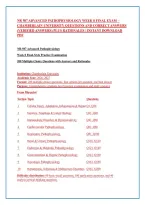
NR 507 ADVANCED PATHOPHYSIOLOGY WEEK 8 FINAL EXAM –
CHAMBERLAIN UNIVERSITY QUESTIONS AND CORRECT ANSWERS
(VERIFIED ANSWERS) PLUS RATIONALES | INSTANT DOWNLOAD
PDF
NR-507 Advanced Pathophysiology
Week 8 Final-Style Practice Examination
200 Multiple-Choice Questions with Answers and Rationales
Institution: Chamberlain University
Academic Year: 2026–2027
Format: 200 multiple-choice questions; four options per question; one best answer
Purpose: Comprehensive graduate-level practice examination and study resource
Exam Blueprint
Section Topic Questions
1 Cellular Injury, Adaptation, Inflammation & Repair Q1–Q20
2 Genetics, Neoplasia & Cancer Biology Q21–Q40
3 Immunologic Disorders & Hypersensitivity Q41–Q60
4 Cardiovascular Pathophysiology Q61–Q80
5 Respiratory Pathophysiology Q81–Q100
6 Renal & Urinary Pathophysiology Q101–Q120
7 Endocrine & Metabolic Pathophysiology Q121–Q140
8 Gastrointestinal & Hepatic Pathophysiology Q141–Q160
9 Neurologic Pathophysiology Q161–Q180
10 Hematologic, Infectious & Multisystem Disorders Q181–Q200
Difficulty distribution: 60 basic-recall questions, 100 application questions, and 40
analysis/critical-thinking questions.
,SECTION 1 — CELLULAR INJURY, ADAPTATION, INFLAMMATION & REPAIR
Questions 1–20
Question 1 — Basic
Which cellular adaptation is characterized by an increase in cell size without an increase in cell
number?
A. Hyperplasia
B. Hypertrophy
C. Atrophy
D. Metaplasia
Correct answer: B. Hypertrophy
Rationale: Hypertrophy increases the size of existing cells, often in response to increased
workload. Hyperplasia instead increases the number of cells.
Question 2 — Basic
Which process describes the programmed, energy-dependent elimination of individual cells
without provoking substantial inflammation?
A. Necrosis
B. Apoptosis
C. Autolysis
D. Ischemia
Correct answer: B. Apoptosis
Rationale: Apoptosis is regulated programmed cell death involving cellular fragmentation and
phagocytic removal. Necrosis generally results from uncontrolled cellular injury and is more
strongly associated with inflammation.
Question 3 — Basic
Which intracellular structure is primarily responsible for generating ATP through oxidative
phosphorylation?
A. Lysosome
B. Golgi apparatus
C. Mitochondrion
D. Ribosome
Correct answer: C. Mitochondrion
,Rationale: Mitochondria generate most cellular ATP through oxidative phosphorylation.
Lysosomes primarily digest cellular material, whereas ribosomes synthesize proteins.
Question 4 — Basic
What is the principal cellular consequence of prolonged severe hypoxia?
A. Increased oxidative phosphorylation
B. Decreased ATP production
C. Increased protein synthesis
D. Increased intracellular calcium sequestration
Correct answer: B. Decreased ATP production
Rationale: Hypoxia reduces oxidative phosphorylation and ATP generation. ATP depletion
impairs energy-dependent membrane pumps, producing cellular swelling and other injury.
Question 5 — Basic
Which inflammatory mediator is primarily released by mast cells and contributes to vasodilation
and increased vascular permeability?
A. Histamine
B. Insulin
C. Erythropoietin
D. Albumin
Correct answer: A. Histamine
Rationale: Histamine released from mast cells promotes vasodilation and increased vascular
permeability. Albumin primarily maintains plasma oncotic pressure.
Question 6 — Basic
Which leukocyte is typically the predominant early cellular participant in acute inflammation?
A. Neutrophil
B. Plasma cell
C. Eosinophil
D. Lymphocyte
Correct answer: A. Neutrophil
Rationale: Neutrophils are recruited rapidly during acute inflammation and perform
phagocytosis and microbial killing. Lymphocytes are more characteristic of many chronic
inflammatory responses.
Question 7 — Application
, A patient develops skeletal muscle hypertrophy after prolonged resistance training. Which
mechanism best explains this adaptation?
A. Increased size of existing muscle fibers
B. Replacement of muscle fibers by adipocytes
C. Loss of contractile proteins
D. Decreased protein synthesis
Correct answer: A. Increased size of existing muscle fibers
Rationale: Skeletal muscle hypertrophy primarily results from enlargement of existing fibers
through increased synthesis of contractile proteins. It is distinct from hyperplasia, which
increases cell number.
Question 8 — Application
A patient with prolonged severe malnutrition has markedly reduced skeletal muscle mass. Which
adaptation is most likely responsible?
A. Hyperplasia
B. Hypertrophy
C. Atrophy
D. Dysplasia
Correct answer: C. Atrophy
Rationale: Atrophy is a reduction in cell size and functional capacity associated with decreased
nutritional or metabolic support. Hypertrophy would produce increased cellular size rather than
tissue loss.
Question 9 — Application
A patient experiences transient renal ischemia followed by restoration of blood flow. Which
process can paradoxically worsen cellular injury after reperfusion?
A. Reduced oxygen exposure
B. Reactive oxygen species generation
C. Complete inhibition of inflammatory signaling
D. Increased ATP storage
Correct answer: B. Reactive oxygen species generation
Rationale: Reperfusion can generate reactive oxygen species and intensify inflammatory and
mitochondrial injury. Therefore, restoration of blood flow does not always immediately reverse
ischemic cellular damage.
Question 10 — Application
CHAMBERLAIN UNIVERSITY QUESTIONS AND CORRECT ANSWERS
(VERIFIED ANSWERS) PLUS RATIONALES | INSTANT DOWNLOAD
NR-507 Advanced Pathophysiology
Week 8 Final-Style Practice Examination
200 Multiple-Choice Questions with Answers and Rationales
Institution: Chamberlain University
Academic Year: 2026–2027
Format: 200 multiple-choice questions; four options per question; one best answer
Purpose: Comprehensive graduate-level practice examination and study resource
Exam Blueprint
Section Topic Questions
1 Cellular Injury, Adaptation, Inflammation & Repair Q1–Q20
2 Genetics, Neoplasia & Cancer Biology Q21–Q40
3 Immunologic Disorders & Hypersensitivity Q41–Q60
4 Cardiovascular Pathophysiology Q61–Q80
5 Respiratory Pathophysiology Q81–Q100
6 Renal & Urinary Pathophysiology Q101–Q120
7 Endocrine & Metabolic Pathophysiology Q121–Q140
8 Gastrointestinal & Hepatic Pathophysiology Q141–Q160
9 Neurologic Pathophysiology Q161–Q180
10 Hematologic, Infectious & Multisystem Disorders Q181–Q200
Difficulty distribution: 60 basic-recall questions, 100 application questions, and 40
analysis/critical-thinking questions.
,SECTION 1 — CELLULAR INJURY, ADAPTATION, INFLAMMATION & REPAIR
Questions 1–20
Question 1 — Basic
Which cellular adaptation is characterized by an increase in cell size without an increase in cell
number?
A. Hyperplasia
B. Hypertrophy
C. Atrophy
D. Metaplasia
Correct answer: B. Hypertrophy
Rationale: Hypertrophy increases the size of existing cells, often in response to increased
workload. Hyperplasia instead increases the number of cells.
Question 2 — Basic
Which process describes the programmed, energy-dependent elimination of individual cells
without provoking substantial inflammation?
A. Necrosis
B. Apoptosis
C. Autolysis
D. Ischemia
Correct answer: B. Apoptosis
Rationale: Apoptosis is regulated programmed cell death involving cellular fragmentation and
phagocytic removal. Necrosis generally results from uncontrolled cellular injury and is more
strongly associated with inflammation.
Question 3 — Basic
Which intracellular structure is primarily responsible for generating ATP through oxidative
phosphorylation?
A. Lysosome
B. Golgi apparatus
C. Mitochondrion
D. Ribosome
Correct answer: C. Mitochondrion
,Rationale: Mitochondria generate most cellular ATP through oxidative phosphorylation.
Lysosomes primarily digest cellular material, whereas ribosomes synthesize proteins.
Question 4 — Basic
What is the principal cellular consequence of prolonged severe hypoxia?
A. Increased oxidative phosphorylation
B. Decreased ATP production
C. Increased protein synthesis
D. Increased intracellular calcium sequestration
Correct answer: B. Decreased ATP production
Rationale: Hypoxia reduces oxidative phosphorylation and ATP generation. ATP depletion
impairs energy-dependent membrane pumps, producing cellular swelling and other injury.
Question 5 — Basic
Which inflammatory mediator is primarily released by mast cells and contributes to vasodilation
and increased vascular permeability?
A. Histamine
B. Insulin
C. Erythropoietin
D. Albumin
Correct answer: A. Histamine
Rationale: Histamine released from mast cells promotes vasodilation and increased vascular
permeability. Albumin primarily maintains plasma oncotic pressure.
Question 6 — Basic
Which leukocyte is typically the predominant early cellular participant in acute inflammation?
A. Neutrophil
B. Plasma cell
C. Eosinophil
D. Lymphocyte
Correct answer: A. Neutrophil
Rationale: Neutrophils are recruited rapidly during acute inflammation and perform
phagocytosis and microbial killing. Lymphocytes are more characteristic of many chronic
inflammatory responses.
Question 7 — Application
, A patient develops skeletal muscle hypertrophy after prolonged resistance training. Which
mechanism best explains this adaptation?
A. Increased size of existing muscle fibers
B. Replacement of muscle fibers by adipocytes
C. Loss of contractile proteins
D. Decreased protein synthesis
Correct answer: A. Increased size of existing muscle fibers
Rationale: Skeletal muscle hypertrophy primarily results from enlargement of existing fibers
through increased synthesis of contractile proteins. It is distinct from hyperplasia, which
increases cell number.
Question 8 — Application
A patient with prolonged severe malnutrition has markedly reduced skeletal muscle mass. Which
adaptation is most likely responsible?
A. Hyperplasia
B. Hypertrophy
C. Atrophy
D. Dysplasia
Correct answer: C. Atrophy
Rationale: Atrophy is a reduction in cell size and functional capacity associated with decreased
nutritional or metabolic support. Hypertrophy would produce increased cellular size rather than
tissue loss.
Question 9 — Application
A patient experiences transient renal ischemia followed by restoration of blood flow. Which
process can paradoxically worsen cellular injury after reperfusion?
A. Reduced oxygen exposure
B. Reactive oxygen species generation
C. Complete inhibition of inflammatory signaling
D. Increased ATP storage
Correct answer: B. Reactive oxygen species generation
Rationale: Reperfusion can generate reactive oxygen species and intensify inflammatory and
mitochondrial injury. Therefore, restoration of blood flow does not always immediately reverse
ischemic cellular damage.
Question 10 — Application