
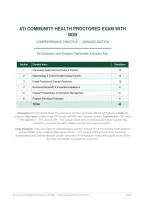
ATI COMMUNITY HEALTH PROCTORED EXAM WITH
NGN
COMPREHENSIVE PRACTICE • 2026/2027 EDITION
60 Questions with Answers, Rationales & Answer Key
Section Content Area Questions
1 Community Health Nursing Theory & Practice 12
2 Epidemiology & Communicable Disease Control 12
3 Health Promotion & Disease Prevention 12
4 Environmental Health & Vulnerable Populations 8
5 Disaster Preparedness & Emergency Management 8
6 Program Planning & Evaluation 8
TOTAL 60
Assessment: ATI Community Health Proctored Exam with Next Generation NCLEX (NGN) items • Length: 60
questions • Item types: multiple-choice, SATA-style, and NGN case-study/bow-tie items. Cognitive mix: ~30% recall
• ~50% application • ~20% analysis, with ~75% scenario-based items covering population health, epidemiology,
prevention, environmental health, disaster response, and program evaluation.
Study disclaimer. These are original AI-authored practice questions built from the ATI Community Health blueprint
and the NCSBN Clinical Judgment Measurement Model — NOT actual ATI/NCLEX exam items. Guidelines,
epidemiological data, and best practices change; verify every clinical and public-health detail against current official
ATI, CDC, and NCSBN sources before relying on it.
ATI Community Health Proctored Exam with NGN — Comprehensive Practice (2026/2027) Page 1
, Section 1: Community Health Nursing Theory & Practice — Population Health,
Community Assessment, Ethics (12 questions)
Q1. A nurse is explaining the difference between community-oriented and community-based nursing.
Which statement best describes community-oriented nursing?
A. It focuses on managing acute illness for individual clients in their homes.
B. It focuses on the health of populations and aggregates rather than only individuals.
C. It is limited to providing care in hospital outpatient departments.
D. It addresses only communicable disease outbreaks.
Correct Answer: B
Rationale: Community-oriented nursing targets the health of whole populations and aggregates.
Community-based nursing (A) focuses on illness care for individuals/families in the community; the other options
are too narrow.
Q2. A public health nurse is conducting a windshield survey of a neighborhood. Which activity is the nurse
performing?
A. Systematically observing community characteristics while driving or walking through it
B. Reviewing national vital statistics databases
C. Performing physical assessments on individual clients
D. Administering a written health-behavior questionnaire to residents
Correct Answer: A
Rationale: A windshield survey is a direct, systematic observation of a community's physical and social
environment. Reviewing databases and surveys are other data-collection methods, and physical assessment
targets individuals.
Q3. A nurse is planning care for a community aggregate. Which group best represents an aggregate?
A. A single family receiving home care
B. Older adults living in a specific senior housing complex
C. One client admitted to a clinic
D. A hospital's nursing staff on one unit
Correct Answer: B
Rationale: An aggregate is a subgroup of a population that shares common characteristics, such as older adults
in a senior complex. A single family or individual client is not an aggregate.
Q4. A community health nurse advocates for equal distribution of limited immunization resources across
all neighborhoods regardless of income. Which ethical principle is the nurse applying?
A. Justice
B. Veracity
C. Autonomy
D. Fidelity
Correct Answer: A
Rationale: Justice concerns fairness and equitable distribution of resources. Fidelity is keeping promises, veracity
is truthfulness, and autonomy is respecting self-determination.
ATI Community Health Proctored Exam with NGN — Comprehensive Practice (2026/2027) Page 2
, Q5. A public health nurse keeps a commitment to follow up with a family after promising a home visit.
Which ethical principle does this reflect?
A. Beneficence
B. Fidelity
C. Justice
D. Nonmaleficence
Correct Answer: B
Rationale: Fidelity is faithfulness to one's commitments and promises. Justice is fairness, nonmaleficence is
avoiding harm, and beneficence is doing good.
Q6. A nurse is using an assessment approach that emphasizes a community's existing strengths and
resources rather than only its deficits. Which model is the nurse using?
A. The Health Belief Model
B. An epidemiological triangle model
C. An asset-based (strengths-based) community assessment
D. A quarantine model
Correct Answer: C
Rationale: Asset-based assessment identifies and builds on a community's existing capacities and resources.
The other models address disease causation, individual behavior, or disease containment.
Q7. A community health nurse identifies that the 'client' in population-focused practice is best described
as:
A. The insurance provider
B. The physician team
C. The individual patient only
D. The population or community as a whole
Correct Answer: D
Rationale: In population-focused practice, the community or population is the unit of care ('the client'). The goal is
improving health at the population level, not only treating individuals.
Q8. A nurse gathers data from census reports, vital statistics, and local health department records for a
community assessment. These are examples of which data type?
A. Secondary data from existing sources
B. Primary data collected firsthand
C. Focus-group data
D. Windshield survey data
Correct Answer: A
Rationale: Secondary data are drawn from existing sources such as census and vital statistics. Primary data
(including windshield surveys and focus groups) are collected firsthand by the nurse.
ATI Community Health Proctored Exam with NGN — Comprehensive Practice (2026/2027) Page 3
NGN
COMPREHENSIVE PRACTICE • 2026/2027 EDITION
60 Questions with Answers, Rationales & Answer Key
Section Content Area Questions
1 Community Health Nursing Theory & Practice 12
2 Epidemiology & Communicable Disease Control 12
3 Health Promotion & Disease Prevention 12
4 Environmental Health & Vulnerable Populations 8
5 Disaster Preparedness & Emergency Management 8
6 Program Planning & Evaluation 8
TOTAL 60
Assessment: ATI Community Health Proctored Exam with Next Generation NCLEX (NGN) items • Length: 60
questions • Item types: multiple-choice, SATA-style, and NGN case-study/bow-tie items. Cognitive mix: ~30% recall
• ~50% application • ~20% analysis, with ~75% scenario-based items covering population health, epidemiology,
prevention, environmental health, disaster response, and program evaluation.
Study disclaimer. These are original AI-authored practice questions built from the ATI Community Health blueprint
and the NCSBN Clinical Judgment Measurement Model — NOT actual ATI/NCLEX exam items. Guidelines,
epidemiological data, and best practices change; verify every clinical and public-health detail against current official
ATI, CDC, and NCSBN sources before relying on it.
ATI Community Health Proctored Exam with NGN — Comprehensive Practice (2026/2027) Page 1
, Section 1: Community Health Nursing Theory & Practice — Population Health,
Community Assessment, Ethics (12 questions)
Q1. A nurse is explaining the difference between community-oriented and community-based nursing.
Which statement best describes community-oriented nursing?
A. It focuses on managing acute illness for individual clients in their homes.
B. It focuses on the health of populations and aggregates rather than only individuals.
C. It is limited to providing care in hospital outpatient departments.
D. It addresses only communicable disease outbreaks.
Correct Answer: B
Rationale: Community-oriented nursing targets the health of whole populations and aggregates.
Community-based nursing (A) focuses on illness care for individuals/families in the community; the other options
are too narrow.
Q2. A public health nurse is conducting a windshield survey of a neighborhood. Which activity is the nurse
performing?
A. Systematically observing community characteristics while driving or walking through it
B. Reviewing national vital statistics databases
C. Performing physical assessments on individual clients
D. Administering a written health-behavior questionnaire to residents
Correct Answer: A
Rationale: A windshield survey is a direct, systematic observation of a community's physical and social
environment. Reviewing databases and surveys are other data-collection methods, and physical assessment
targets individuals.
Q3. A nurse is planning care for a community aggregate. Which group best represents an aggregate?
A. A single family receiving home care
B. Older adults living in a specific senior housing complex
C. One client admitted to a clinic
D. A hospital's nursing staff on one unit
Correct Answer: B
Rationale: An aggregate is a subgroup of a population that shares common characteristics, such as older adults
in a senior complex. A single family or individual client is not an aggregate.
Q4. A community health nurse advocates for equal distribution of limited immunization resources across
all neighborhoods regardless of income. Which ethical principle is the nurse applying?
A. Justice
B. Veracity
C. Autonomy
D. Fidelity
Correct Answer: A
Rationale: Justice concerns fairness and equitable distribution of resources. Fidelity is keeping promises, veracity
is truthfulness, and autonomy is respecting self-determination.
ATI Community Health Proctored Exam with NGN — Comprehensive Practice (2026/2027) Page 2
, Q5. A public health nurse keeps a commitment to follow up with a family after promising a home visit.
Which ethical principle does this reflect?
A. Beneficence
B. Fidelity
C. Justice
D. Nonmaleficence
Correct Answer: B
Rationale: Fidelity is faithfulness to one's commitments and promises. Justice is fairness, nonmaleficence is
avoiding harm, and beneficence is doing good.
Q6. A nurse is using an assessment approach that emphasizes a community's existing strengths and
resources rather than only its deficits. Which model is the nurse using?
A. The Health Belief Model
B. An epidemiological triangle model
C. An asset-based (strengths-based) community assessment
D. A quarantine model
Correct Answer: C
Rationale: Asset-based assessment identifies and builds on a community's existing capacities and resources.
The other models address disease causation, individual behavior, or disease containment.
Q7. A community health nurse identifies that the 'client' in population-focused practice is best described
as:
A. The insurance provider
B. The physician team
C. The individual patient only
D. The population or community as a whole
Correct Answer: D
Rationale: In population-focused practice, the community or population is the unit of care ('the client'). The goal is
improving health at the population level, not only treating individuals.
Q8. A nurse gathers data from census reports, vital statistics, and local health department records for a
community assessment. These are examples of which data type?
A. Secondary data from existing sources
B. Primary data collected firsthand
C. Focus-group data
D. Windshield survey data
Correct Answer: A
Rationale: Secondary data are drawn from existing sources such as census and vital statistics. Primary data
(including windshield surveys and focus groups) are collected firsthand by the nurse.
ATI Community Health Proctored Exam with NGN — Comprehensive Practice (2026/2027) Page 3


