
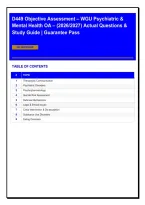
D449 Objective Assessment – WGU Psychiatric &
Mental Health OA – (2026/2027) Actual Questions &
Study Guide | Guarantee Pass
250 QUESTIONS
TABLE OF CONTENTS
# TOPIC
1 Therapeutic Communication
2 Psychiatric Disorders
3 Psychopharmacology
4 Suicide Risk Assessment
5 Defense Mechanisms
6 Legal & Ethical Issues
7 Crisis Intervention & De-escalation
8 Substance Use Disorders
9 Eating Disorders
,Q1
A client with major depressive disorder tells the nurse, "I'm a failure. I can't do anything right."
Which response is most therapeutic?
A) "You shouldn't feel that way; you have many strengths."
B) "It sounds like you're feeling really down about yourself right now." CORRECT
C) "Let's list your recent accomplishments."
D) "Why do you feel like a failure?"
Rationale
Reflection validates the client's feeling without arguing or false reassurance. Avoid "why" questions.
Q2
A client with schizophrenia tells the nurse, "The voices are telling me to hurt myself." What is the
priority nursing action?
A) Ask the client what the voices are saying in detail
B) Implement suicide precautions and notify the provider CORRECT
C) Tell the client to ignore the voices
D) Administer a PRN antipsychotic
Rationale
Command hallucinations to self-harm require immediate safety interventions (constant observation,
environment safety).
Q3
A client with bipolar disorder in a manic episode is pacing rapidly, talking loudly, and making
grandiose statements. Which intervention is most appropriate?
A) Place the client in seclusion
B) Provide a quiet, low-stimulation environment CORRECT
C) Confront the client about the grandiose statements
D) Assign a group of staff to restrain the client
2
,Rationale
Reducing environmental stimuli helps decrease agitation and manic behavior. Restraints are a last
resort.
Q4
A client with borderline personality disorder has a history of self-mutilation (cutting). The client
says, "I want to cut myself." Which intervention should the nurse implement first?
A) Restrict the client to her room
B) Assess the intensity of the urge and review the safety plan CORRECT
C) Apply soft wrist restraints
D) Administer a PRN sedative
Rationale
First, assess the risk and use de-escalation, including reviewing alternative coping strategies.
Q5
A client with alcohol use disorder is admitted for detoxification. The last drink was 8 hours ago.
Which assessment finding is most likely first?
A) Seizure activity
B) Anxiety, tremors, and diaphoresis CORRECT
C) Delirium tremens (DTs)
D) Hallucinations
Rationale
Early alcohol withdrawal (6-12 hours) includes tremors, anxiety, and tachycardia. DTs occur at 48-72
hours.
Q6
A client on a psychiatric unit tells the nurse, "I'm going to kill myself tonight." What is the nurse's
priority action?
A) Document the statement and tell the next shift
3
, B) Place the client on one-to-one observation and notify the provider CORRECT
C) Tell the client that this behavior will not be tolerated
D) Remove all sharp objects from the unit
Rationale
Immediate safety interventions include constant observation, removing means, and provider notification.
Q7
A client with social anxiety disorder is prescribed paroxetine (SSRI). Which statement indicates
understanding?
A) "I should feel better within 24 hours."
B) "It may take 4-6 weeks for the full effect." CORRECT
C) "I can stop the medication once I feel less anxious."
D) "This medication is addictive like Xanax."
Rationale
SSRIs have delayed onset; full therapeutic effect takes several weeks. They are not addictive.
Q8
A client with schizophrenia has been taking haloperidol for 2 weeks and now presents with a stiff
neck, fever, and confusion. Which condition does the nurse suspect?
A) Tardive dyskinesia
B) Neuroleptic malignant syndrome (NMS) CORRECT
C) Acute dystonia
D) Serotonin syndrome
Rationale
NMS presents with fever, rigidity, altered mental status, and autonomic instability; a medical emergency.
4
Mental Health OA – (2026/2027) Actual Questions &
Study Guide | Guarantee Pass
250 QUESTIONS
TABLE OF CONTENTS
# TOPIC
1 Therapeutic Communication
2 Psychiatric Disorders
3 Psychopharmacology
4 Suicide Risk Assessment
5 Defense Mechanisms
6 Legal & Ethical Issues
7 Crisis Intervention & De-escalation
8 Substance Use Disorders
9 Eating Disorders
,Q1
A client with major depressive disorder tells the nurse, "I'm a failure. I can't do anything right."
Which response is most therapeutic?
A) "You shouldn't feel that way; you have many strengths."
B) "It sounds like you're feeling really down about yourself right now." CORRECT
C) "Let's list your recent accomplishments."
D) "Why do you feel like a failure?"
Rationale
Reflection validates the client's feeling without arguing or false reassurance. Avoid "why" questions.
Q2
A client with schizophrenia tells the nurse, "The voices are telling me to hurt myself." What is the
priority nursing action?
A) Ask the client what the voices are saying in detail
B) Implement suicide precautions and notify the provider CORRECT
C) Tell the client to ignore the voices
D) Administer a PRN antipsychotic
Rationale
Command hallucinations to self-harm require immediate safety interventions (constant observation,
environment safety).
Q3
A client with bipolar disorder in a manic episode is pacing rapidly, talking loudly, and making
grandiose statements. Which intervention is most appropriate?
A) Place the client in seclusion
B) Provide a quiet, low-stimulation environment CORRECT
C) Confront the client about the grandiose statements
D) Assign a group of staff to restrain the client
2
,Rationale
Reducing environmental stimuli helps decrease agitation and manic behavior. Restraints are a last
resort.
Q4
A client with borderline personality disorder has a history of self-mutilation (cutting). The client
says, "I want to cut myself." Which intervention should the nurse implement first?
A) Restrict the client to her room
B) Assess the intensity of the urge and review the safety plan CORRECT
C) Apply soft wrist restraints
D) Administer a PRN sedative
Rationale
First, assess the risk and use de-escalation, including reviewing alternative coping strategies.
Q5
A client with alcohol use disorder is admitted for detoxification. The last drink was 8 hours ago.
Which assessment finding is most likely first?
A) Seizure activity
B) Anxiety, tremors, and diaphoresis CORRECT
C) Delirium tremens (DTs)
D) Hallucinations
Rationale
Early alcohol withdrawal (6-12 hours) includes tremors, anxiety, and tachycardia. DTs occur at 48-72
hours.
Q6
A client on a psychiatric unit tells the nurse, "I'm going to kill myself tonight." What is the nurse's
priority action?
A) Document the statement and tell the next shift
3
, B) Place the client on one-to-one observation and notify the provider CORRECT
C) Tell the client that this behavior will not be tolerated
D) Remove all sharp objects from the unit
Rationale
Immediate safety interventions include constant observation, removing means, and provider notification.
Q7
A client with social anxiety disorder is prescribed paroxetine (SSRI). Which statement indicates
understanding?
A) "I should feel better within 24 hours."
B) "It may take 4-6 weeks for the full effect." CORRECT
C) "I can stop the medication once I feel less anxious."
D) "This medication is addictive like Xanax."
Rationale
SSRIs have delayed onset; full therapeutic effect takes several weeks. They are not addictive.
Q8
A client with schizophrenia has been taking haloperidol for 2 weeks and now presents with a stiff
neck, fever, and confusion. Which condition does the nurse suspect?
A) Tardive dyskinesia
B) Neuroleptic malignant syndrome (NMS) CORRECT
C) Acute dystonia
D) Serotonin syndrome
Rationale
NMS presents with fever, rigidity, altered mental status, and autonomic instability; a medical emergency.
4


