
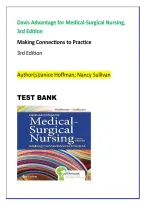
Davis Advantage for Medical-Surgical Nursing,
3rd Edition
Making Connections to Practice
3rd Edition
Author(s)Janice Hoffman; Nancy Sullivan
TEST BANK
,
,Question 1
A medical-surgical nurse begins a shift and receives report on four
patients. Which patient should the nurse assess first?
A. A patient with chronic osteoarthritis who reports pain of 6/10
B. A patient with pneumonia who has a new respiratory rate of 30/min
and oxygen saturation of 88%
C. A patient with type 2 diabetes whose blood glucose is 168 mg/dL
before breakfast
D. A patient awaiting discharge who has questions about medications
Correct Answer:
B. A patient with pneumonia who has a new respiratory rate of 30/min
and oxygen saturation of 88%
Rationale:
The patient with pneumonia has evidence of impaired oxygenation and
possible clinical deterioration, making this the priority. The nurse should
address immediate threats to airway, breathing, and circulation before
less urgent needs. Chronic pain, moderate hyperglycemia, and
discharge teaching can be addressed after the unstable patient is
assessed and managed.
Question 2
Which nursing action best demonstrates patient-centered care for a
hospitalized adult who prefers to participate in decisions about
treatment?
A. Making treatment decisions based on the nurse's clinical experience
B. Asking the patient about goals, preferences, and concerns before
developing the plan of care
, C. Providing standardized education without modifying the content
D. Asking the family to make decisions because hospitalization is
stressful
Correct Answer:
B. Asking the patient about goals, preferences, and concerns before
developing the plan of care
Rationale:
Patient-centered care incorporates the patient's values, preferences,
needs, and goals into planning and decision-making. The nurse's
expertise is important, but it should be combined with the patient's
preferences. Standardized education may need to be individualized, and
capable adults should be included in their own healthcare decisions.
Question 3
A nurse uses the nursing process to care for a patient experiencing
nausea after surgery. Which action represents the assessment phase?
A. Administering the prescribed antiemetic
B. Documenting that nausea decreased to 2/10 after treatment
C. Asking the patient to rate nausea and identifying associated
symptoms
D. Developing a plan to offer small, frequent meals
Correct Answer:
C. Asking the patient to rate nausea and identifying associated
symptoms
Rationale:
Assessment involves collecting subjective and objective data about the
patient's condition. Administering medication is an intervention,
3rd Edition
Making Connections to Practice
3rd Edition
Author(s)Janice Hoffman; Nancy Sullivan
TEST BANK
,
,Question 1
A medical-surgical nurse begins a shift and receives report on four
patients. Which patient should the nurse assess first?
A. A patient with chronic osteoarthritis who reports pain of 6/10
B. A patient with pneumonia who has a new respiratory rate of 30/min
and oxygen saturation of 88%
C. A patient with type 2 diabetes whose blood glucose is 168 mg/dL
before breakfast
D. A patient awaiting discharge who has questions about medications
Correct Answer:
B. A patient with pneumonia who has a new respiratory rate of 30/min
and oxygen saturation of 88%
Rationale:
The patient with pneumonia has evidence of impaired oxygenation and
possible clinical deterioration, making this the priority. The nurse should
address immediate threats to airway, breathing, and circulation before
less urgent needs. Chronic pain, moderate hyperglycemia, and
discharge teaching can be addressed after the unstable patient is
assessed and managed.
Question 2
Which nursing action best demonstrates patient-centered care for a
hospitalized adult who prefers to participate in decisions about
treatment?
A. Making treatment decisions based on the nurse's clinical experience
B. Asking the patient about goals, preferences, and concerns before
developing the plan of care
, C. Providing standardized education without modifying the content
D. Asking the family to make decisions because hospitalization is
stressful
Correct Answer:
B. Asking the patient about goals, preferences, and concerns before
developing the plan of care
Rationale:
Patient-centered care incorporates the patient's values, preferences,
needs, and goals into planning and decision-making. The nurse's
expertise is important, but it should be combined with the patient's
preferences. Standardized education may need to be individualized, and
capable adults should be included in their own healthcare decisions.
Question 3
A nurse uses the nursing process to care for a patient experiencing
nausea after surgery. Which action represents the assessment phase?
A. Administering the prescribed antiemetic
B. Documenting that nausea decreased to 2/10 after treatment
C. Asking the patient to rate nausea and identifying associated
symptoms
D. Developing a plan to offer small, frequent meals
Correct Answer:
C. Asking the patient to rate nausea and identifying associated
symptoms
Rationale:
Assessment involves collecting subjective and objective data about the
patient's condition. Administering medication is an intervention,



