
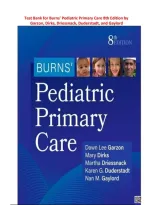
Burns' Pediatric Primary Care 8th Edition Study Resource
Burns' Pediatric Primary Care 8th Edition Study Resource Burns' Pediatric Primary Care, 8th Edition by Garzon, Dirks, Driessnack, Duderstadt, and Gaylord is a comprehensive resource for students studying pediatric healthcare, primary care, child development, health promotion, disease prevention, assessment, and management of common pediatric conditions. This study resource is designed to complement the textbook and help learners organize their preparation through focused review and practice. Pediatric primary care requires students to understand children across multiple developmental stages while recognizing that assessment, communication, diagnosis, treatment, and health education must be adapted to the child's age and individual needs. From infancy through adolescence, students encounter different developmental milestones, physical findings, nutritional requirements, behavioral considerations, and healthcare priorities. A structured question-based study resource can provide an additional way to review these concepts, test knowledge, identify areas requiring further study, and build familiarity with important pediatric primary care principles. Comprehensive Pediatric Primary Care Review This resource can be used alongside Burns' Pediatric Primary Care, 8th Edition, lecture notes, course materials, clinical learning activities, and instructor guidance. It is suitable for students who want to organize their review into manageable topic areas. Key areas of study include: Pediatric health assessment Growth and development Developmental milestones Health promotion Disease prevention Pediatric nutrition Immunization concepts Newborn and infant care Early childhood health School-age healthcare Adolescent health Pediatric pharmacology Medication safety Family-centered care Common pediatric illnesses Acute and chronic conditions Behavioral and psychosocial health Injury prevention Patient and caregiver education Pediatric clinical reasoning Organizing review around these subjects allows students to move systematically through the major concepts required for pediatric primary care coursework. Pediatric Health Assessment Assessment is one of the foundations of pediatric primary care. Students need to understand how to obtain an appropriate health history, perform age-appropriate examinations, recognize normal variations, and identify findings that may require additional evaluation. Practice questions can help reinforce concepts related to: Pediatric history taking Physical examination Vital signs Developmental assessment Growth measurements Health screening Patient communication Family interviews Age-specific findings Clinical documentation Working through questions can help learners move beyond memorizing terminology and focus on applying concepts to clinical situations. Growth and Development Growth and development are essential components of pediatric healthcare. Children change rapidly, and healthcare professionals must recognize expected developmental patterns while remaining alert to potential concerns. Students can use this study resource to review physical, cognitive, language, social, emotional, and motor development. Developmental milestones can be studied according to age and developmental stage, allowing learners to identify important concepts that may appear in coursework and assessments. Reviewing development alongside health assessment also helps students understand how communication, examination techniques, health education, and clinical interactions should be adapted for different age groups. Health Promotion and Disease Prevention Primary care places substantial emphasis on prevention. Pediatric healthcare professionals work with children and families to promote healthy lifestyles and reduce preventable illness and injury. Study topics may include: Preventive healthcare Anticipatory guidance Nutrition Physical activity Sleep Oral health Immunization Safety counseling Injury prevention Screening Family education Question-based practice can help students distinguish between different preventive-care considerations and reinforce the importance of age-appropriate health education. Common Pediatric Conditions Pediatric primary care encompasses a broad range of health concerns. Students need to recognize common signs and symptoms, understand relevant assessment considerations, and review general principles of management and patient education. The study resource can support review of pediatric conditions involving areas such as: Respiratory health Gastrointestinal disorders Dermatologic conditions Infectious diseases Neurologic concerns Musculoskeletal problems Cardiovascular conditions Endocrine disorders Behavioral health Chronic pediatric conditions Students can use practice questions to connect clinical presentations with underlying concepts and determine which topics require additional textbook review. Pediatric Pharmacology Medication use in children requires special attention because dosing and administration considerations can vary according to factors such as age, weight, developmental stage, and clinical circumstances. Students can review general principles involving pediatric medication administration, dosage considerations, safety practices, caregiver education, adverse effects, and medication-related clinical decision-making. For actual patient care, learners should always consult current medication references, prescribing information, institutional protocols, and qualified healthcare professionals. Family-Centered Care Children's healthcare is closely connected with their families and caregivers. Effective pediatric practice therefore involves communication, education, collaboration, and respect for the roles of parents, guardians, and children. Students can use practice materials to reinforce principles of family-centered care, therapeutic communication, health teaching, cultural considerations, and collaborative decision-making. These concepts are particularly important because pediatric healthcare often requires the clinician to communicate simultaneously with the child and the caregiver while maintaining developmentally appropriate interactions with the pediatric patient. Adolescent Healthcare Adolescence presents distinctive healthcare considerations. Students can review topics related to physical development, puberty, nutrition, behavioral health, health promotion, injury prevention, and other adolescent healthcare concerns. Practice questions can encourage learners to think about developmentally appropriate communication and assessment strategies. Students should also understand that privacy, confidentiality, consent, and healthcare rights can vary according to jurisdiction, age, and clinical circumstances. Clinical Reasoning and Application Pediatric primary care education is not limited to recalling definitions. Students must learn to interpret information and apply concepts to patient situations. A useful approach is to ask: What information is most important in this scenario? Which findings are expected for the child's developmental stage? Which findings may require further assessment? What additional information should be obtained? What education should be provided? What follow-up considerations are relevant? Using questions in this way can encourage active learning and strengthen clinical reasoning skills. Effective Study Strategy Students can incorporate this resource into a structured study routine. 1. Read the assigned textbook material. Begin with the appropriate chapter or topic in Burns' Pediatric Primary Care, 8th Edition. 2. Review lecture materials. Compare textbook information with instructor-provided notes, slides, and learning objectives. 3. Complete practice questions. Attempt questions without immediately checking reference material. 4. Identify knowledge gaps. Mark concepts that were difficult or unfamiliar. 5. Review the textbook again. Return to the relevant sections and clarify difficult concepts. 6. Practice again. Revisit the material later to reinforce retention. This active-recall approach can make study sessions more focused and help learners identify topics requiring additional preparation. Suitable for Nursing and Healthcare Programs This study resource may be useful for students in: Pediatric nursing Pediatric primary care Family nurse practitioner programs Pediatric nurse practitioner programs Advanced practice nursing Nursing programs Physician assistant programs Medical programs Family medicine Child health courses Allied health programs Biomedical and health sciences It can be used for independent study, study groups, classroom review, clinical preparation, and examination preparation. Product Highlights Supports review of pediatric primary care concepts Designed to complement Burns' Pediatric Primary Care, 8th Edition Covers growth and development Reviews pediatric health assessment Includes health promotion and prevention concepts Supports study of common pediatric conditions Reinforces pediatric pharmacology principles Covers family-centered and adolescent healthcare concepts Encourages active recall and self-assessment Useful for nursing and advanced healthcare students Suitable for individual and group study Final Description Preparing for pediatric primary care coursework can involve reviewing a significant amount of information across multiple developmental stages and clinical conditions. A structured study resource gives students another way to organize that information and evaluate their understanding. The Burns' Pediatric Primary Care 8th Edition Study Resource can be incorporated into a regular study schedule to reinforce important concepts, support active recall, and identify areas that deserve additional textbook or instructor-guided review. For the most effective learning experience, students should use this resource together with the textbook, current clinical references, course objectives, lecture materials, and instructor guidance. Consistent practice can help learners build a stronger foundation in pediatric assessment, development, prevention, health promotion, and primary care. Important: This is a supplementary educational study resource and should not be represented as an official publication of Garzon, Dirks, Driessnack, Duderstadt, Gaylord, or the textbook publisher. It should not be presented as containing proprietary publisher materials or actual examination questions. Students should use authorized resources and comply with applicable academic-integrity requirements.
Document information
- Uploaded on
- September 28, 2026
- Number of pages
- 135
- Written in
- 2026/2027
- Type
- Exam (elaborations)
- Contains
- Questions & answers


