
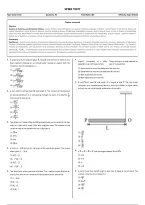
SPEED TEST7
Type: Custom Test Questions: 90 Total Marks: 360 Difficulty: Easy, Medium
Topics covered
Physics
System of Particles and Rotational Motion - Centre of Mass, Linear Momentum of a System of Particles, Explosion of Bodies , Vector Product of Two Vectors, Torque and
Angular Momentum, Center of Gravity, Moment of Inertia, Rotational Motion of Rigid Body, Rigid Body Constraints, Work, Energy & Power in Case of Rotation of a Rigid Body
about Fixed Axis, Plane Motion of a Rigid Body (Translation and Rotation), Angular Momentum and its Conservation for a Rigid Body, Angular Impulse , Collision between a
Particle and a Rigid Body or between a Group of Rigid Bodies, Miscellaneous Problems in Systems of Partticles and Rotational Motion
Chemistry
Equilibrium - General Characteristics of Equilibrium, Equilibrium in Physical Processes, Equilibrium in Chemical Processes, Equilibrium Constant, Applications of Equilibrium
Constant, Relationship between Equilibrium Constant, Reaction Quotient and Gibbs Free Energy, Degree of Dissociation from Vapour Density Measurement , Le Chatelier’s
Principle and Applications, Ionic Equilibrium, Acids and Bases, Ionization of Acids and Bases, The Ionization Constant of Water and Its Ionic Product, pH concept, Relation
between Ka and Kb , Di and Polybasic Acids and Di and Polyacidic Bases, Buffer Solutions, Hydrolysis of Salts, Acid – Base Titration Using Indicators, Solubility Equilibria of
Sparingly Soluble Salts, Ionic Equilibrium involving complex ions, Miscellaneous questions on equilibrium
1. A spherical uniform body of radius R, mass M and moment of inertia I rolls 6.
Angular momentum of a body Torque acting on a body depends on
down (without slipping) on an inclined plane making an angle θ with the
depends on axis of measurement. axis of measurement
horizontal. then its acceleration is :-
g sin θ (1) Statement A is correct but Statement B is incorrect.
(1)
1 − I /M R (2) Statement A is incorrect but Statement B is correct.
(2)
g sin θ
(3) Both statements are correct.
1 + I /M R 2
(4) Both Statements are incorrect.
g sin θ
(3)
1 − M R 2 /I 7. A rod PQ of mass M and length L is hinged at end P . The rod is kept
g sin θ
(4) horizontal by a massless string tied to a point Q as shown in figure. When
1 − I /M R
string is cut, the initial angular acceleration of the rod is
2. A thin uniform rod has mass M and length L. The moment of inertia about
L
an axis perpendicular to it and passing through the point at a distance
3
from one of its end, will be
2
ML
(1)
12
2
7M L
(2)
8
2
ML
(3)
9
2
ML
(4)
3
3. Two objects of masses 10 kg and 20 kg respectively are connected to the two
ends of a rigid rod of length 10 m with negligible mass. The distance of the
center of mass of the system from the 10 kg mass is
3g
(1) 20
3
m (1)
2L
(2) 10 m
(2)
g
L
(3) 5m 2g
(3)
(4) 10
3
m
L
2g
(4)
3L
4. A force of ^
−F K acts on O , the origin of the coordinate system. The torque
8. →
about point (1, −2) is: If A→ × B
→=B
→ × A,
→ then the angle between A→ and B is
(1) F (^
i +^
j) (1) π/2
(2) −F (2^
i +^
j) (2) π/3
(3) F (^
i −^
j) (3) π
(4) −F (2^
i −^
j) (4) π/4
5. Two discs have same mass and thickness. Their materials have densities d1
9. A rod of mass 2m and 2ℓ length is bent into L shape at its mid point. The
and d . The ratio of their moments of inertia about central axis will be
2
moment of inertia at its mid point is.
(1)
2
mℓ
(1) 1 : d1 d2 6
(2) d1 : d2
(2) 2mℓ
2
(3)
2
2mℓ
(3) d2 : d1 3
(4)
2
mℓ
(4) d1 d2 : 1 3
,10. When acrobat bends his body (assume no external torque) 13. On a smooth horizontal plane, a uniform string of mass M and length L is
lying in the state of rest. A man of the same mass M is standing next to one
end of the string. Now, the man starts collecting the string. Finally the man
collects all the string and puts it in his pocket. What is the displacement of the
man with respect to earth in the process of collection?
L
(1)
2
L
(2)
8
L
(3)
4
(4) None of these
14. The moment of inertia of a circular disc of mass M and radius R about an
axis passing through the centre of mass is I0 . The moment of inertia of
another circular disc of same mass and thickness but half the density about
the same axis is
I0
(1)
8
I0
(2)
4
(3) 8I 0
(4) 2I 0
15. A child is standing with folded hands at the centre of a platform rotating
about its central axis. The kinetic energy of the system is K . The child now
stretches his arm so that moment of inerita of the system doubles. The kinetic
energy of the system now is:
(1) 2 K
K
(2)
(1) I acrobat decrease 2
K
(2) I acrobat will increase (3)
4
(3) ω acrobat increase (4) 4 K
(4) Both (1) and (3)
16. Identify the decreasing order of moment of inertia of the following bodies of
11. Assertion: To unscrew a rusted nut, we need a wrench with longer arm. same mass and radius
I) about diameter of circular ring
Reason: Wrench with longer arm reduces the torque of the arm. II) about diameter of circular plate
III) about tangent of circular ring ⊥ to its plane
r
(1) Both Assertion and Reason are correct and Reason is the correct
explanation of the Assertion. IV) about tangent of circular plate in its plane
(2) Both Assertion and Reason are correct but Reason is not the correct (1) III, IV, II, I
explanation of the Assertion. (2) IV, III, I, II
(3) Assertion is correct but Reason is incorrect. (3) IV, III, II, I
(4) Assertion is incorrect but reason is correct. (4) III, IV, I, II
12. Two uniform rods of different materials M1 and M2 have lengths 2m and 17. CM of the given system of particles will be at
4m , respectively. The mass per unit length of rods M1 and M2 are 1 kg/m
and 2 kg/m, respectively. If the rods are arranged, as shown, the position of
the centre of mass relative to O point is
(1) 4.9m
(2) 2m
(3) 3.4m
(4) 2.2m
(1) OD
(2) OC
(3) OB
(4) AO
, 18. Assertion: A disc is rolling on a rough horizontal surface. The instantaneous 22. A uniform disc of mass M and radius R, is resting on a table on its rim. The
speed of the point of contact during perfect rolling is zero with respect to coeeficient of friction between disc and table is μ. Now the disc is pulled with
ground.
a force F as shown in the figure. What is the maximum value of F for which
Reason: The force of friction can help in achieving pure rolling condition. the disc rolls without slipping?
(1) Both Assertion and Reason are correct and Reason is the correct
explanation of the Assertion.
(2) Both Assertion and Reason are correct but Reason is not the correct
explanation of the Assertion.
(3) Assertion is correct but Reason is incorrect. (1) μM g
(4) Assertion is incorrect but reason is correct.
(2) 2μM g
19. A wheel comprises a ring of radius R and mass M and three spokes of mass (3) 3μ M g
m each. The moment of inertia of the wheel about its axis is (4) 4μ M g
23. A thin hollow sphere of mass m is completely filled with a liquid of mass m.
When the sphere rolls with a velocity v, kinetic energy of the system is
(neglect friction)
(1) (1/2)mv
2
(2) mv
2
(3) (4/3)mv
2
(4) (4/5)mv
2
24. Consider a light rod (AB) as shown in the figure. At the two ends (A and B )
(1) (M + m)R
2
of which two equal parallel forces act in two cases. Then the net force and
(2) (M +
m
)R
2 torque about point O in both cases (i) and (ii) are
4
M + m
(3) ( )R
2
2
(4) (M + 3m)R
2
20. Which of the following graphs correctly represents the variation of moment of
inertia (I ) of a thin circular ring of constant mass with its radius (R) ?
(1) (1) (i) ∑ F = 0 ∑ τc = 0
(2) (ii) ∑ F = 0 ∑ τc ≠ 0
(2) (i) ∑ F ≠ 0 ∑ τc = 0
(3)
(ii) ∑ F = 0 ∑ τc ≠ 0
(4)
(3) (i) ∑ F ≠ 0 ∑ τc ≠ 0
21. A cylinder is in pure rolling on an incline plane as shown in the figure. The (ii) ∑ F = 0 ∑ τc = 0
correct relation between the velocities of the four points shown is
(4) (i) ∑ F ≠ 0 ∑ τc ≠ 0
(ii) ∑ F ≠ 0 ∑ τc = 0
(1) All of them are same
(2) All of them are different
(3) P1 and P are same but P
2 3 & P4 are different
(4) P1 and P are same but P
3 2 & P4 are different
Type: Custom Test Questions: 90 Total Marks: 360 Difficulty: Easy, Medium
Topics covered
Physics
System of Particles and Rotational Motion - Centre of Mass, Linear Momentum of a System of Particles, Explosion of Bodies , Vector Product of Two Vectors, Torque and
Angular Momentum, Center of Gravity, Moment of Inertia, Rotational Motion of Rigid Body, Rigid Body Constraints, Work, Energy & Power in Case of Rotation of a Rigid Body
about Fixed Axis, Plane Motion of a Rigid Body (Translation and Rotation), Angular Momentum and its Conservation for a Rigid Body, Angular Impulse , Collision between a
Particle and a Rigid Body or between a Group of Rigid Bodies, Miscellaneous Problems in Systems of Partticles and Rotational Motion
Chemistry
Equilibrium - General Characteristics of Equilibrium, Equilibrium in Physical Processes, Equilibrium in Chemical Processes, Equilibrium Constant, Applications of Equilibrium
Constant, Relationship between Equilibrium Constant, Reaction Quotient and Gibbs Free Energy, Degree of Dissociation from Vapour Density Measurement , Le Chatelier’s
Principle and Applications, Ionic Equilibrium, Acids and Bases, Ionization of Acids and Bases, The Ionization Constant of Water and Its Ionic Product, pH concept, Relation
between Ka and Kb , Di and Polybasic Acids and Di and Polyacidic Bases, Buffer Solutions, Hydrolysis of Salts, Acid – Base Titration Using Indicators, Solubility Equilibria of
Sparingly Soluble Salts, Ionic Equilibrium involving complex ions, Miscellaneous questions on equilibrium
1. A spherical uniform body of radius R, mass M and moment of inertia I rolls 6.
Angular momentum of a body Torque acting on a body depends on
down (without slipping) on an inclined plane making an angle θ with the
depends on axis of measurement. axis of measurement
horizontal. then its acceleration is :-
g sin θ (1) Statement A is correct but Statement B is incorrect.
(1)
1 − I /M R (2) Statement A is incorrect but Statement B is correct.
(2)
g sin θ
(3) Both statements are correct.
1 + I /M R 2
(4) Both Statements are incorrect.
g sin θ
(3)
1 − M R 2 /I 7. A rod PQ of mass M and length L is hinged at end P . The rod is kept
g sin θ
(4) horizontal by a massless string tied to a point Q as shown in figure. When
1 − I /M R
string is cut, the initial angular acceleration of the rod is
2. A thin uniform rod has mass M and length L. The moment of inertia about
L
an axis perpendicular to it and passing through the point at a distance
3
from one of its end, will be
2
ML
(1)
12
2
7M L
(2)
8
2
ML
(3)
9
2
ML
(4)
3
3. Two objects of masses 10 kg and 20 kg respectively are connected to the two
ends of a rigid rod of length 10 m with negligible mass. The distance of the
center of mass of the system from the 10 kg mass is
3g
(1) 20
3
m (1)
2L
(2) 10 m
(2)
g
L
(3) 5m 2g
(3)
(4) 10
3
m
L
2g
(4)
3L
4. A force of ^
−F K acts on O , the origin of the coordinate system. The torque
8. →
about point (1, −2) is: If A→ × B
→=B
→ × A,
→ then the angle between A→ and B is
(1) F (^
i +^
j) (1) π/2
(2) −F (2^
i +^
j) (2) π/3
(3) F (^
i −^
j) (3) π
(4) −F (2^
i −^
j) (4) π/4
5. Two discs have same mass and thickness. Their materials have densities d1
9. A rod of mass 2m and 2ℓ length is bent into L shape at its mid point. The
and d . The ratio of their moments of inertia about central axis will be
2
moment of inertia at its mid point is.
(1)
2
mℓ
(1) 1 : d1 d2 6
(2) d1 : d2
(2) 2mℓ
2
(3)
2
2mℓ
(3) d2 : d1 3
(4)
2
mℓ
(4) d1 d2 : 1 3
,10. When acrobat bends his body (assume no external torque) 13. On a smooth horizontal plane, a uniform string of mass M and length L is
lying in the state of rest. A man of the same mass M is standing next to one
end of the string. Now, the man starts collecting the string. Finally the man
collects all the string and puts it in his pocket. What is the displacement of the
man with respect to earth in the process of collection?
L
(1)
2
L
(2)
8
L
(3)
4
(4) None of these
14. The moment of inertia of a circular disc of mass M and radius R about an
axis passing through the centre of mass is I0 . The moment of inertia of
another circular disc of same mass and thickness but half the density about
the same axis is
I0
(1)
8
I0
(2)
4
(3) 8I 0
(4) 2I 0
15. A child is standing with folded hands at the centre of a platform rotating
about its central axis. The kinetic energy of the system is K . The child now
stretches his arm so that moment of inerita of the system doubles. The kinetic
energy of the system now is:
(1) 2 K
K
(2)
(1) I acrobat decrease 2
K
(2) I acrobat will increase (3)
4
(3) ω acrobat increase (4) 4 K
(4) Both (1) and (3)
16. Identify the decreasing order of moment of inertia of the following bodies of
11. Assertion: To unscrew a rusted nut, we need a wrench with longer arm. same mass and radius
I) about diameter of circular ring
Reason: Wrench with longer arm reduces the torque of the arm. II) about diameter of circular plate
III) about tangent of circular ring ⊥ to its plane
r
(1) Both Assertion and Reason are correct and Reason is the correct
explanation of the Assertion. IV) about tangent of circular plate in its plane
(2) Both Assertion and Reason are correct but Reason is not the correct (1) III, IV, II, I
explanation of the Assertion. (2) IV, III, I, II
(3) Assertion is correct but Reason is incorrect. (3) IV, III, II, I
(4) Assertion is incorrect but reason is correct. (4) III, IV, I, II
12. Two uniform rods of different materials M1 and M2 have lengths 2m and 17. CM of the given system of particles will be at
4m , respectively. The mass per unit length of rods M1 and M2 are 1 kg/m
and 2 kg/m, respectively. If the rods are arranged, as shown, the position of
the centre of mass relative to O point is
(1) 4.9m
(2) 2m
(3) 3.4m
(4) 2.2m
(1) OD
(2) OC
(3) OB
(4) AO
, 18. Assertion: A disc is rolling on a rough horizontal surface. The instantaneous 22. A uniform disc of mass M and radius R, is resting on a table on its rim. The
speed of the point of contact during perfect rolling is zero with respect to coeeficient of friction between disc and table is μ. Now the disc is pulled with
ground.
a force F as shown in the figure. What is the maximum value of F for which
Reason: The force of friction can help in achieving pure rolling condition. the disc rolls without slipping?
(1) Both Assertion and Reason are correct and Reason is the correct
explanation of the Assertion.
(2) Both Assertion and Reason are correct but Reason is not the correct
explanation of the Assertion.
(3) Assertion is correct but Reason is incorrect. (1) μM g
(4) Assertion is incorrect but reason is correct.
(2) 2μM g
19. A wheel comprises a ring of radius R and mass M and three spokes of mass (3) 3μ M g
m each. The moment of inertia of the wheel about its axis is (4) 4μ M g
23. A thin hollow sphere of mass m is completely filled with a liquid of mass m.
When the sphere rolls with a velocity v, kinetic energy of the system is
(neglect friction)
(1) (1/2)mv
2
(2) mv
2
(3) (4/3)mv
2
(4) (4/5)mv
2
24. Consider a light rod (AB) as shown in the figure. At the two ends (A and B )
(1) (M + m)R
2
of which two equal parallel forces act in two cases. Then the net force and
(2) (M +
m
)R
2 torque about point O in both cases (i) and (ii) are
4
M + m
(3) ( )R
2
2
(4) (M + 3m)R
2
20. Which of the following graphs correctly represents the variation of moment of
inertia (I ) of a thin circular ring of constant mass with its radius (R) ?
(1) (1) (i) ∑ F = 0 ∑ τc = 0
(2) (ii) ∑ F = 0 ∑ τc ≠ 0
(2) (i) ∑ F ≠ 0 ∑ τc = 0
(3)
(ii) ∑ F = 0 ∑ τc ≠ 0
(4)
(3) (i) ∑ F ≠ 0 ∑ τc ≠ 0
21. A cylinder is in pure rolling on an incline plane as shown in the figure. The (ii) ∑ F = 0 ∑ τc = 0
correct relation between the velocities of the four points shown is
(4) (i) ∑ F ≠ 0 ∑ τc ≠ 0
(ii) ∑ F ≠ 0 ∑ τc = 0
(1) All of them are same
(2) All of them are different
(3) P1 and P are same but P
2 3 & P4 are different
(4) P1 and P are same but P
3 2 & P4 are different


