
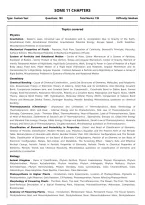
SOME 11 CHAPTERS
Type: Custom Test Questions: 180 Total Marks: 720 Difficulty: Medium
Topics covered
Physics
Gravitation - Kepler’s Laws, Universal Law of Gravitation and G, Acceleration Due to Gravity of the Earth,
Gravitational Field, Gravitational Potential, Gravitational Potential Energy, Escape Speed , Earth Satellites,
Miscellaneous Problems on Gravitation
Mechanical Properties of Fluids - Pressure, Fluid Flow, Equation of Continuity, Bernoulli’s Principle, Viscocity,
Surface Tension, Miscellaneous Problems in Mechanical Properties of Fluids
System of Particles and Rotational Motion - Centre of Mass, Linear Momentum of a System of Particles,
Explosion of Bodies , Vector Product of Two Vectors, Torque and Angular Momentum, Center of Gravity, Moment of
Inertia, Rotational Motion of Rigid Body, Rigid Body Constraints, Work, Energy & Power in Case of Rotation of a Rigid
Body about Fixed Axis, Plane Motion of a Rigid Body (Translation and Rotation), Angular Momentum and its
Conservation for a Rigid Body, Angular Impulse , Collision between a Particle and a Rigid Body or between a Group of
Rigid Bodies, Miscellaneous Problems in Systems of Partticles and Rotational Motion
Chemistry
Chemical Bonding - Cause of Chemical Combination , Lewis Dot Structures of Elements, Molecules, and Polyatomic
Ions, Kossel-Lewis Theory or Electronic Theory of Valency, Octet Rule and Its Limitations, Ionic Bonding, Covalent
Bond, Comparision between Ionic and Covalent Bond (or Compounds) , Coordinate Bond or Dative Bond, Formal
Charge, Bond Parameters, Resonance Structures, Polarity of a Covalent Bond, Polarisation and Fajans' Rules, VSEPR
Theory, Valence Bond Theory, VBT, Hybridisation, Molecular Orbital Theory (MOT), Comparision of Valence Bond
Theory and Molecular Orbital Theory, Hydrogen Bonding, Metallic Bonding, Miscellaneous questions on chemical
bonding
Thermodynamics (Chemistry) - Importance and Limitations of Thermodynamics, Basic Terminology of
Thermodynamics, Work and Heat , Internal Energy and Its Characteristics, First Law of Thermodynamics (c),
Enthalpy, Calorimeter, Joule – Thomson Effect, Thermochemistry, Heat of Reaction, Laws of Thermochemistry, Types
of Heat of Reactions, Statements of Second Law of Thermodynamics , Spontaneity, Entropy (c), Gibbs Free Energy
and Standard Free Energy Change, Gibbs Energy Change and Equilibrium, Zeroth Law of Thermodynamics, Absolute
Entropy and Third Law of Thermodynamics, Coupled reactions, Miscellaneous questions on Thermodynamics
Classification of Elements and Periodicity in Properties - Object and Need of Classification of Elements,
Genesis of Periodic Classification, Modern Periodic Law, Moseley’s Equation and the Present Form of the Periodic
Table, Nomenclature of Elements with Atomic Number Greater than 100, Electronic Configurations and The Periodic
Table, Classification of Elements on the Basis of Electronic Configurations, Position of an Element on the Basis of
Electronic Configuration, Metals, Non-metals and Metalloids, The Screening Effect , Slater’s Rule and Effective
Nuclear Charge, Periodic Trends in Periodic Properties of Elements, Periodic Trends in Chemical Properties of
Elements, Periodic Trends and Chemical Reactivity, Miscellaneous questions on classification of elements and
periodicity in properties
Biology
Animal Kingdom - Basis of Classification, Phylum Porifera, Phylum Coelenterata, Phylum Ctenophora, Phylum
Platyhelminthes, Phylum Aschelminthes, Phylum Annelida, Phylum Arthropoda, Phylum Mollusca, Phylum
Echinodermata, Phylum Hemichordata, Phylum Chordata, Class Cyclostomata, Class Chondrichthyes, Class
Osteichthyes, Class Amphibia, Class Reptilia, Class Aves, Class Mammals
Photosynthesis in Higher Plants - Introduction, Early Experiments, Location of Photosynthesis, Pigments in
Photosynthesis, Light Reaction, Dark Reaction, C4 Pathway, Photorespiration, Factors Affecting Photosynthesis
Morphology of Flowering Plants - The Root, Stem, The Leaf, The Inflorescence, The Flower, The Fruit, The Seed,
Semi-Technical Description of a Typical Flowering Plant, Fabaceae, Poaceae/Graminae, Malvaceae, Compositae,
Brassicaceae
Anatomy of Flowering Plants - Tissue - Introduction, Meristematic Tissue, Permanent Tissue, The Tissue System,
Dicotyledonous Root and Monocotyledonous Root, Dicotyledonous Stem, Monocotyledonous Stem, Dicotyledonous
, Leaf and Monocotyledonous Leaf
Structural Organisation in Animals - Introduction, Animal Tissue, Organ and Organ System, Cockroach, Frog
Respiration in Plants - Introduction, Breathing in Plants, Glycolysis, Fermentation, Aerobic Respiration, Tricarboxylic
Acid Cycle, Electron Transport System (ETS) and Oxidative Phosphorylation, The Respiratory Balance Sheet, The
Amphibolic Pathway, Respiratory Quotient
Plant Growth and Development - Growth & Phases of Growth, Growth Rates, Conditions for Growth,
Differentiation, Dedifferentiation & Redifferentiation, Development, Plant Growth Regulators, Auxins, Gibberellins,
Cytokinins, Ethylene, Abscisic Acid
1. At what distance (in metre) from the centre of the 4. The weight of an object in the coal mine, sea level
moon, the intensity of gravitational field will be and at the top of the mountain are respectively
zero? (Take, mass of earth and moon as W , W , and W . Then
1 2 3
kg and 7.35 × 10 kg respectively
24 22
5.98 × 10
(1) W1 < W2 < W3
and the distance between moon and earth is
(2) W1 = W2 = W3
3.855 × 10
8
m .)
(1) zero (3) W1 > W2 < W3
(2) 3.85 × 10
7
(4) W1 < W2 > W3
(3) 8 × 10
8
5. Read the Statement - A and Statement - B carefully
(4) 3.46 × 10
8
to mark the correct option given below:
2. Assuming that the earth is a sphere of radius A liquid that does not Non-wetting liquids
R
wet a solid surface will have angles of contact
with uniform density, the distance from its centre
form droplets with an greater than 90
at which the acceleration due to gravity is equal to
g acute angle of contact. degrees.
( g is the acceleration due to gravity on the
3
surface of earth) is (1) Both Statement A and Statement B are true.
2R (2) Statement A is true, but Statement B is false.
(1)
3 (3) Statement A is false, but Statement B is true.
R
(2) (4) Both Statement A and Statement B are false.
4
R
(3)
2
R
(4)
3
3. Read the Statement - A and Statement - B carefully
to mark the correct option given below:
A satellite's speed in its The orbital speed of a
orbit increases as its satellite is determined
altitude above Earth's by the gravitational pull
surface increases. of the Earth.
(1) Both Statement A and Statement B are true.
(2) Statement A is true, but Statement B is false.
(3) Statement A is false, but Statement B is true.
(4) Both Statement A and Statement B are false.
,6. A ring has mass M , radius . A point mass
R m is 9.
If the total force on the If the total torque on
placed at a distance x on the axial line as shown.
body is zero, then the the rigid body is zero,
Find x so that force experienced is maximum. total linear momentum the total angular
of the body does not momentum of the body
change with time. does not change with
time.
(1) Statement A is correct but Statement B is
incorrect.
(2) Statement A is incorrect but Statement B is
correct.
(3) Both statements are correct.
(4) Both Statements are incorrect.
R 10. I. Viscous force is proportional to the velocity of the
(1)
3 object.
R
(2) II. Viscous force is a dragging force which acts
2
opposite to the direction of motion.
R
(3) III. Viscous force depends on viscosity η of the
√3
R fluids and radius r of the sphere.
(4)
√2 Which of the following statements(s) is/are
correct?
7. A planet revolves in elliptical orbit around the sun.
(1) Only I
The linear speed of the planet will be maximum at
(2) Both I and II
(3) Only III
(4) I, II and III
11. A block of aluminium of mass 1 kg and volume
3.6 × 10
−4
is suspended from a string and
m
3
(1) A
then completely immersed in a container of water.
(2) B The decrease in tension in the string after
(3) C
immersion is
(1) 1.0 N
(4) D
(2) 3.6 N
8. Assertion: In the case of free fall of the lift, the
(3) 6.2 N
man will feel weightlessness.
(4) 9.8 N
Reason: In free falling, acceleration of lift is equal
to acceleration due to gravity. 12. A pendulum has a time period T in air. When it is
(1) Both Assertion and Reason are correct and made to oscillate in water its time period becomes
√ 2T . Then the relative density of the material of
Reason is the correct explanation of the
Assertion. the bob of the pendulum is (neglect damping)
(2) Both Assertion and Reason are correct but (1) √2
Reason is not the correct explanation of the
(2) 2
Assertion.
(3) 2√ 2
(3) Assertion is correct but Reason is incorrect.
(4) 3
(4) Assertion is incorrect but reason is correct.
, 13. A large open tank containing water has two holes 17. A uniform solid sphere of mass m is being pulled
to its wall. A square hole of side a is made at a on a horizontal surface with force F parallel to the
depth y and a circular hole of radius r is made at a surface and applied at its topmost point. If the
depth 16y from the surface of water. If equal acceleration of the sphere is a & it is in pure rolling
amount of water comes out through both the on the surface, the value of F is
holes per second, then the relation between r and
(1) ma
a will be
3
a (2) ma
(1) r = 2
2√π 7
a (3) ma
(2) r = 10
2π
10
2a (4) ma
(3) r = 7
π
(4) r =
2a 18. A spherical drop of water has 1 mm radius. If the
√π
surface tension of water is 70 × 10
−3
N /m , then
14. A disc of radius 2m and mass 100 kg rolls on a the difference of pressure between inside and
horizontal floor. Its centre of mass has speed of outside of the spherical drop is:
20 cm/s. How much work is needed to stop it? (1) 14 N /m
2
(1) 3J (2) 140 N /m
2
(2) 30 kJ (3) 35 N /m
2
(3) 2J (4) none of these
(4) 1J 19. If a soap bubble expands, the pressure inside the
bubble
15. The work done in blowing a soap bubble of volume
(1) increases
V is W . The work done in blowing the bubble of
(2) remains the same
volume 2 V from the same soap solution is
(3) is equal to the atmospheric pressure
W
(1) (4) decreases
2
(2) √ 2W
20. A ladder rests against a frictionless vertical wall,
(3) (2)
1/3
W with its upper end 6 m above the ground and the
(4) (4)
1/3
W lower end 4 m away from the wall. The weight of
the ladder is 500 N and its C. G . at 1/ 3 rd
16. The surface energy of a liquid drop is U . It is distance from the lower end. Wall's reaction will be,
sprayed into 1000 equal droplets. Then its surface (in newton):
energy becomes
(1) 333
(1) 10 U (2) 111
(2) U (3) 129
(3) 1000 U (4) 222
(4) 100 U
Type: Custom Test Questions: 180 Total Marks: 720 Difficulty: Medium
Topics covered
Physics
Gravitation - Kepler’s Laws, Universal Law of Gravitation and G, Acceleration Due to Gravity of the Earth,
Gravitational Field, Gravitational Potential, Gravitational Potential Energy, Escape Speed , Earth Satellites,
Miscellaneous Problems on Gravitation
Mechanical Properties of Fluids - Pressure, Fluid Flow, Equation of Continuity, Bernoulli’s Principle, Viscocity,
Surface Tension, Miscellaneous Problems in Mechanical Properties of Fluids
System of Particles and Rotational Motion - Centre of Mass, Linear Momentum of a System of Particles,
Explosion of Bodies , Vector Product of Two Vectors, Torque and Angular Momentum, Center of Gravity, Moment of
Inertia, Rotational Motion of Rigid Body, Rigid Body Constraints, Work, Energy & Power in Case of Rotation of a Rigid
Body about Fixed Axis, Plane Motion of a Rigid Body (Translation and Rotation), Angular Momentum and its
Conservation for a Rigid Body, Angular Impulse , Collision between a Particle and a Rigid Body or between a Group of
Rigid Bodies, Miscellaneous Problems in Systems of Partticles and Rotational Motion
Chemistry
Chemical Bonding - Cause of Chemical Combination , Lewis Dot Structures of Elements, Molecules, and Polyatomic
Ions, Kossel-Lewis Theory or Electronic Theory of Valency, Octet Rule and Its Limitations, Ionic Bonding, Covalent
Bond, Comparision between Ionic and Covalent Bond (or Compounds) , Coordinate Bond or Dative Bond, Formal
Charge, Bond Parameters, Resonance Structures, Polarity of a Covalent Bond, Polarisation and Fajans' Rules, VSEPR
Theory, Valence Bond Theory, VBT, Hybridisation, Molecular Orbital Theory (MOT), Comparision of Valence Bond
Theory and Molecular Orbital Theory, Hydrogen Bonding, Metallic Bonding, Miscellaneous questions on chemical
bonding
Thermodynamics (Chemistry) - Importance and Limitations of Thermodynamics, Basic Terminology of
Thermodynamics, Work and Heat , Internal Energy and Its Characteristics, First Law of Thermodynamics (c),
Enthalpy, Calorimeter, Joule – Thomson Effect, Thermochemistry, Heat of Reaction, Laws of Thermochemistry, Types
of Heat of Reactions, Statements of Second Law of Thermodynamics , Spontaneity, Entropy (c), Gibbs Free Energy
and Standard Free Energy Change, Gibbs Energy Change and Equilibrium, Zeroth Law of Thermodynamics, Absolute
Entropy and Third Law of Thermodynamics, Coupled reactions, Miscellaneous questions on Thermodynamics
Classification of Elements and Periodicity in Properties - Object and Need of Classification of Elements,
Genesis of Periodic Classification, Modern Periodic Law, Moseley’s Equation and the Present Form of the Periodic
Table, Nomenclature of Elements with Atomic Number Greater than 100, Electronic Configurations and The Periodic
Table, Classification of Elements on the Basis of Electronic Configurations, Position of an Element on the Basis of
Electronic Configuration, Metals, Non-metals and Metalloids, The Screening Effect , Slater’s Rule and Effective
Nuclear Charge, Periodic Trends in Periodic Properties of Elements, Periodic Trends in Chemical Properties of
Elements, Periodic Trends and Chemical Reactivity, Miscellaneous questions on classification of elements and
periodicity in properties
Biology
Animal Kingdom - Basis of Classification, Phylum Porifera, Phylum Coelenterata, Phylum Ctenophora, Phylum
Platyhelminthes, Phylum Aschelminthes, Phylum Annelida, Phylum Arthropoda, Phylum Mollusca, Phylum
Echinodermata, Phylum Hemichordata, Phylum Chordata, Class Cyclostomata, Class Chondrichthyes, Class
Osteichthyes, Class Amphibia, Class Reptilia, Class Aves, Class Mammals
Photosynthesis in Higher Plants - Introduction, Early Experiments, Location of Photosynthesis, Pigments in
Photosynthesis, Light Reaction, Dark Reaction, C4 Pathway, Photorespiration, Factors Affecting Photosynthesis
Morphology of Flowering Plants - The Root, Stem, The Leaf, The Inflorescence, The Flower, The Fruit, The Seed,
Semi-Technical Description of a Typical Flowering Plant, Fabaceae, Poaceae/Graminae, Malvaceae, Compositae,
Brassicaceae
Anatomy of Flowering Plants - Tissue - Introduction, Meristematic Tissue, Permanent Tissue, The Tissue System,
Dicotyledonous Root and Monocotyledonous Root, Dicotyledonous Stem, Monocotyledonous Stem, Dicotyledonous
, Leaf and Monocotyledonous Leaf
Structural Organisation in Animals - Introduction, Animal Tissue, Organ and Organ System, Cockroach, Frog
Respiration in Plants - Introduction, Breathing in Plants, Glycolysis, Fermentation, Aerobic Respiration, Tricarboxylic
Acid Cycle, Electron Transport System (ETS) and Oxidative Phosphorylation, The Respiratory Balance Sheet, The
Amphibolic Pathway, Respiratory Quotient
Plant Growth and Development - Growth & Phases of Growth, Growth Rates, Conditions for Growth,
Differentiation, Dedifferentiation & Redifferentiation, Development, Plant Growth Regulators, Auxins, Gibberellins,
Cytokinins, Ethylene, Abscisic Acid
1. At what distance (in metre) from the centre of the 4. The weight of an object in the coal mine, sea level
moon, the intensity of gravitational field will be and at the top of the mountain are respectively
zero? (Take, mass of earth and moon as W , W , and W . Then
1 2 3
kg and 7.35 × 10 kg respectively
24 22
5.98 × 10
(1) W1 < W2 < W3
and the distance between moon and earth is
(2) W1 = W2 = W3
3.855 × 10
8
m .)
(1) zero (3) W1 > W2 < W3
(2) 3.85 × 10
7
(4) W1 < W2 > W3
(3) 8 × 10
8
5. Read the Statement - A and Statement - B carefully
(4) 3.46 × 10
8
to mark the correct option given below:
2. Assuming that the earth is a sphere of radius A liquid that does not Non-wetting liquids
R
wet a solid surface will have angles of contact
with uniform density, the distance from its centre
form droplets with an greater than 90
at which the acceleration due to gravity is equal to
g acute angle of contact. degrees.
( g is the acceleration due to gravity on the
3
surface of earth) is (1) Both Statement A and Statement B are true.
2R (2) Statement A is true, but Statement B is false.
(1)
3 (3) Statement A is false, but Statement B is true.
R
(2) (4) Both Statement A and Statement B are false.
4
R
(3)
2
R
(4)
3
3. Read the Statement - A and Statement - B carefully
to mark the correct option given below:
A satellite's speed in its The orbital speed of a
orbit increases as its satellite is determined
altitude above Earth's by the gravitational pull
surface increases. of the Earth.
(1) Both Statement A and Statement B are true.
(2) Statement A is true, but Statement B is false.
(3) Statement A is false, but Statement B is true.
(4) Both Statement A and Statement B are false.
,6. A ring has mass M , radius . A point mass
R m is 9.
If the total force on the If the total torque on
placed at a distance x on the axial line as shown.
body is zero, then the the rigid body is zero,
Find x so that force experienced is maximum. total linear momentum the total angular
of the body does not momentum of the body
change with time. does not change with
time.
(1) Statement A is correct but Statement B is
incorrect.
(2) Statement A is incorrect but Statement B is
correct.
(3) Both statements are correct.
(4) Both Statements are incorrect.
R 10. I. Viscous force is proportional to the velocity of the
(1)
3 object.
R
(2) II. Viscous force is a dragging force which acts
2
opposite to the direction of motion.
R
(3) III. Viscous force depends on viscosity η of the
√3
R fluids and radius r of the sphere.
(4)
√2 Which of the following statements(s) is/are
correct?
7. A planet revolves in elliptical orbit around the sun.
(1) Only I
The linear speed of the planet will be maximum at
(2) Both I and II
(3) Only III
(4) I, II and III
11. A block of aluminium of mass 1 kg and volume
3.6 × 10
−4
is suspended from a string and
m
3
(1) A
then completely immersed in a container of water.
(2) B The decrease in tension in the string after
(3) C
immersion is
(1) 1.0 N
(4) D
(2) 3.6 N
8. Assertion: In the case of free fall of the lift, the
(3) 6.2 N
man will feel weightlessness.
(4) 9.8 N
Reason: In free falling, acceleration of lift is equal
to acceleration due to gravity. 12. A pendulum has a time period T in air. When it is
(1) Both Assertion and Reason are correct and made to oscillate in water its time period becomes
√ 2T . Then the relative density of the material of
Reason is the correct explanation of the
Assertion. the bob of the pendulum is (neglect damping)
(2) Both Assertion and Reason are correct but (1) √2
Reason is not the correct explanation of the
(2) 2
Assertion.
(3) 2√ 2
(3) Assertion is correct but Reason is incorrect.
(4) 3
(4) Assertion is incorrect but reason is correct.
, 13. A large open tank containing water has two holes 17. A uniform solid sphere of mass m is being pulled
to its wall. A square hole of side a is made at a on a horizontal surface with force F parallel to the
depth y and a circular hole of radius r is made at a surface and applied at its topmost point. If the
depth 16y from the surface of water. If equal acceleration of the sphere is a & it is in pure rolling
amount of water comes out through both the on the surface, the value of F is
holes per second, then the relation between r and
(1) ma
a will be
3
a (2) ma
(1) r = 2
2√π 7
a (3) ma
(2) r = 10
2π
10
2a (4) ma
(3) r = 7
π
(4) r =
2a 18. A spherical drop of water has 1 mm radius. If the
√π
surface tension of water is 70 × 10
−3
N /m , then
14. A disc of radius 2m and mass 100 kg rolls on a the difference of pressure between inside and
horizontal floor. Its centre of mass has speed of outside of the spherical drop is:
20 cm/s. How much work is needed to stop it? (1) 14 N /m
2
(1) 3J (2) 140 N /m
2
(2) 30 kJ (3) 35 N /m
2
(3) 2J (4) none of these
(4) 1J 19. If a soap bubble expands, the pressure inside the
bubble
15. The work done in blowing a soap bubble of volume
(1) increases
V is W . The work done in blowing the bubble of
(2) remains the same
volume 2 V from the same soap solution is
(3) is equal to the atmospheric pressure
W
(1) (4) decreases
2
(2) √ 2W
20. A ladder rests against a frictionless vertical wall,
(3) (2)
1/3
W with its upper end 6 m above the ground and the
(4) (4)
1/3
W lower end 4 m away from the wall. The weight of
the ladder is 500 N and its C. G . at 1/ 3 rd
16. The surface energy of a liquid drop is U . It is distance from the lower end. Wall's reaction will be,
sprayed into 1000 equal droplets. Then its surface (in newton):
energy becomes
(1) 333
(1) 10 U (2) 111
(2) U (3) 129
(3) 1000 U (4) 222
(4) 100 U


