
ANATOMY AND PHYSIOLOGY 2 EXAM 1 FREQUENTLY TESTED
ACTUAL QUESTIONS AND ANSWERS
Question 1.
What are the components of Blood?
Correct Answer: -Plasma (55%) -Formed elements (45%) -Erythrocytes
-Leukocytes -Thrombocytes
Question 2.
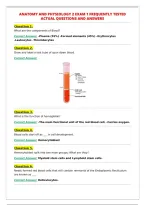
Draw and label a test tube of spun down blood.
Correct Answer:
Question 3.
What is the function of hemoglobin?
Correct Answer: -The main functional unit of the red blood cell. -Carries oxygen.
Question 4.
Blood cells start off as ___ in cell development.
Correct Answer: Hemocytoblast
Question 5.
Hemocytoblast split into two main groups; What are they?
Correct Answer: Myeloid stem cells and Lymphoid stem cells.
Question 6.
Newly formed red blood cells that still contain remnants of the Endoplasmic Recticulum
are known as ___.
Correct Answer: Reticulocytes.
, Question 7.
Monocytes differentiate into ___.
Correct Answer: Macrophages.
Question 8.
What does the body make in low oxygen environment, such as high altitudes?
Correct Answer: Erythropoietin (EPO)
Question 9.
What do Erythropoietin (EPO) do?
Correct Answer: Triggers the production of erythrocytes in the red bone marrow.
Question 10.
What nutrient is needed to prevent pernicious anemia?
Correct Answer: Vitamin b12
Question 11.
Hemoglobin is broken down into two parts, Heme and Globin. What happens to Globin
after the break down?
Correct Answer: Globin is further broken into amino acids and then metabolized
by macrophages or released to the blood stream.
Question 12.
What are the two main groups of white blood cells?
Correct Answer: -Granulocytes -Agranulocytes
Question 13.
What are the three types of Granulocytes and there functions?
Correct Answer: -Neutrophils: Phagocytic, first to arrive at site of infection.
-Eosinophils: Defends against parasites. -Basophiles: Releases histamine and
heparin, appear in allergic tissues.
Question 14.
What are the two types of Agranulocytes and there functions?
Correct Answer: -Monocytes: Releases chemokins to attract neutrophils, leaves
blood to become macrophages. -Lymphocytes: Composed of T, B, and NK cells, T
cells are important for immunity, B cells produce antibodies.
ACTUAL QUESTIONS AND ANSWERS
Question 1.
What are the components of Blood?
Correct Answer: -Plasma (55%) -Formed elements (45%) -Erythrocytes
-Leukocytes -Thrombocytes
Question 2.
Draw and label a test tube of spun down blood.
Correct Answer:
Question 3.
What is the function of hemoglobin?
Correct Answer: -The main functional unit of the red blood cell. -Carries oxygen.
Question 4.
Blood cells start off as ___ in cell development.
Correct Answer: Hemocytoblast
Question 5.
Hemocytoblast split into two main groups; What are they?
Correct Answer: Myeloid stem cells and Lymphoid stem cells.
Question 6.
Newly formed red blood cells that still contain remnants of the Endoplasmic Recticulum
are known as ___.
Correct Answer: Reticulocytes.
, Question 7.
Monocytes differentiate into ___.
Correct Answer: Macrophages.
Question 8.
What does the body make in low oxygen environment, such as high altitudes?
Correct Answer: Erythropoietin (EPO)
Question 9.
What do Erythropoietin (EPO) do?
Correct Answer: Triggers the production of erythrocytes in the red bone marrow.
Question 10.
What nutrient is needed to prevent pernicious anemia?
Correct Answer: Vitamin b12
Question 11.
Hemoglobin is broken down into two parts, Heme and Globin. What happens to Globin
after the break down?
Correct Answer: Globin is further broken into amino acids and then metabolized
by macrophages or released to the blood stream.
Question 12.
What are the two main groups of white blood cells?
Correct Answer: -Granulocytes -Agranulocytes
Question 13.
What are the three types of Granulocytes and there functions?
Correct Answer: -Neutrophils: Phagocytic, first to arrive at site of infection.
-Eosinophils: Defends against parasites. -Basophiles: Releases histamine and
heparin, appear in allergic tissues.
Question 14.
What are the two types of Agranulocytes and there functions?
Correct Answer: -Monocytes: Releases chemokins to attract neutrophils, leaves
blood to become macrophages. -Lymphocytes: Composed of T, B, and NK cells, T
cells are important for immunity, B cells produce antibodies.


