
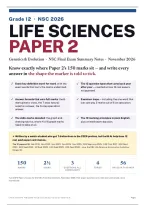
Grade 12 · NSC 2026
LIFE SCIENCES
PAPER 2
Genetics & Evolution · NSC Final Exam Summary Notes · November 2026
Know exactly where Paper 2’s 150 marks sit — and write every
answer in the shape the marker is told to tick.
✓ Every key definition word-for-word, with the ✓ The 12 question types that come back year
exact words that carry the marks underlined. after year — counted across 12 real papers,
not guessed.
✓ Answer formats that earn full marks: the 6- ✓ Examiner traps — including the one word that
mark genetic cross, the 7-step natural- can cost you 5 marks out of 6 on speciation.
selection answer, the 6-step speciation
answer.
✓ The skills marks decoded: the graph and ✓ The 19 marking principles in plain English,
drawing rubrics, where 4 of 6 graph marks plus a timed exam-day plan.
need no data at all.
★ Written by a matric student who got 7 distinctions in the 2026 prelims, built with AI help from 12
real past papers and memos.
The 12 papers:DBE Nov 2019 · Nov 2020 · Nov 2023 · Nov 2024 · Nov 2025 · DBE May/June 2025 · GDE Trial 2021 · GDE Sept
2024 · GDE Sept 2025 · EC Sept 2025 · KZN Sept 2025 · KZN Sept 2026 — plus the DBE Life Sciences Examination Guidelines
(Grade 12).
150 2½ 3 4 56
MARKS HOURS QUESTIONS, ALL TOPICS PAGES IN THIS PACK
COMPULSORY
Full CAPS Paper 2 scope for the NSC Final Examinations, November 2026. Past-paper questions are cited and summarised, never
reproduced.
Life Sciences P2 · NSC 2026 · For personal study only. Do not redistribute. Page 1
,F R E E P R E V I E W · T H E PAT T E R N
The questions that keep coming back
Counted across the 12 papers this pack was built from. The five highlighted rows turn up on every paper, or
very nearly every one — together they are worth 26 marks or more on a typical paper.
ANSWER FORMAT (THE FRAME
TOPIC / QUESTION TYPE HOW OFTEN WHERE (PAPER + Q NO.) MARKS THAT EARNS THE MARKS)
1 “Use a genetic cross to in 12 of 12 papers DBE Nov 2023 Q2.4 · DBE Nov 6 P₁ phenotypes + genotypes →
show…” 2024 Q2.3 · GDE Sept 2025 Q2.4.3 Meiosis → gametes → Fertilisation
· GDE Sept 2024 Q3.3.5 → F₁ genotypes + phenotypes →
circled answer (1 compulsory +
any 5)
2 Human evolution — in 12 of 12 papers DBE Nov 2025 Q3.1 · GDE Sept 4–16 Difference = both sides (humans
skulls, bipedalism, fossils, 2025 Q3.5 · DBE Nov 2024 Q3.4 · … / apes …). Bipedalism = 3 ×
GDE Sept 2024 Q1.4, Q1.6 (structure + reason)
Out of Africa
3 Meiosis — name the in 12 of 12 papers GDE Sept 2024 Q2.2 · GDE Sept 5–14 Tabulate: headed table (1) + 2 per
phase, describe it, Meiosis I 2025 Q2.1 · DBE Nov 2024 Q2.2 · difference, both columns filled
DBE May/June 2025 Q2.2
vs II
4 Q1.3 “A only / B only / in 8 of 8 papers counted Always Q1.3, always 3 items × 2 6 Judge A and B separately,
marks (e.g. GDE Sept 2025 Q1.3, true/false each. “None” is a real
both / none” DBE Nov 2025 Q1.3) answer
5 Name and describe in 10 of 12 papers GDE Sept 2025 Q2.2.4 · GDE Sept 5–11 Name on its own line (compulsory
transcription / translation 2024 Q2.1.1 (protein synthesis also mark) + 4 steps in order
DBE May/June 2025 Q2)
6 Natural selection in 10 of 12 papers DBE Nov 2023 Q3.2 · KZN Sept 4–7 Variation → pressure → survive /
2026 Q3.3.3 · EC Sept 2025 die → reproduce → pass on allele
applied to a real case Q3.4.3 · DBE May/June 2025 → proportion rises
Q3.4.5
7 Pedigree diagram — in 9 of 12 papers GDE Sept 2025 Q3.1 · GDE Sept 6–15 Unaffected parents + affected
2024 Q3.3 child ⇒ recessive; then test for
genotypes, inheritance sex linkage
8 Investigation — in 9 of 12 papers GDE Sept 2025 Q3.4 (17) · DBE 6–17 Validity = kept the same;
variables, validity, reliability, May/June 2025 Q3.4 (17) · DBE reliability = repeated / large
Nov 2023 Q3.3 sample; conclusion = both
conclusion
variables + direction
9 Mutation — how it in 8 of 12 papers GDE Sept 2025 Q2.3.1 · DBE Nov 3–5 DNA base → codon → anticodon →
changed the protein 2023 Q2.3.4 · GDE Sept 2024 amino acid → protein (name the
Q2.1.4 actual change)
10 Biotechnology — DNA in 8 of 12 papers GDE Sept 2025 Q1.4, Q2.5, Q3.2 · 4–6 Profiling identifies / matches — it
profiling, cloning, stem cells DBE May/June 2025 Q3.1 · GDE never “solves” or “treats”
Sept 2024 Q2.3
11 Draw a graph — nearly in 7 of 12 papers GDE Sept 2025 Q3.4.8 · same 6 T · C · L · S · P — type, caption,
always a bar graph rubric in GDE Sept 2024 labels, scale, plotting
12 Speciation — describe in 6 of 12 papers GDE Sept 2025 Q3.3.3 · GDE Sept 6–13 “Population” in every line;
it, or name isolation 2024 Q3.2.3 · GDE Trial 2021 “species” only in the last
Q3.3.2
mechanisms
★ REPEATED QUESTION The one that never misses
The genetic cross has been set on every paper counted, always for 6 marks, always marked the same way — and
most of its marks are for layout, not genetics. Part 07 lays out every line and what it earns.
How the counts were made: “in X of 12” comes from this pack’s own frequency count across the 12 papers listed on the cover (Part 13). The
Q1.3 count comes from the 8 papers whose Section A was tallied item by item (Part 01). Marks are the range seen across those papers.
Formats are shown here in outline only — the full mark-by-mark versions are inside.
Life Sciences P2 · NSC 2026 · For personal study only. Do not redistribute. Page 2
,CONTENTS
What’s inside
01 The full Paper 2 breakdown — format, official topic weighting, the Question 1 skeleton 150 marks p. 4
counted off 8 papers, what sits in Q2 vs Q3, and what is NOT in P2. READ FIRST
02 Is there a Section C? + the long-answer template — the essay was dropped after 30–45 marks p. 8
2020; where its 20 marks went, and the line-by-line shape of every 4–7 mark answer.
★ ASKED EVERY YEAR HIGH MARKS
03 How marks are actually awarded — the 19 marking principles in plain English, a ~20 marks p. 12
provincial moderator’s do-not-accept list, and the wordings that get refused.
EXAMINER TRAP
04 DNA: The Code of Life — structure, replication, transcription, translation, mutation, the 27 marks · 18% p. 15
counting questions, DNA profiling, cloning, stem cells. ★ ASKED EVERY YEAR
05 Meiosis — the phases, Meiosis I vs II table, crossing over, non-disjunction and Down 21 marks · 14% p. 21
syndrome, the 5-mark drawing rubric. ★ ASKED EVERY YEAR EXAMINER TRAP
06 Genetics I — the language and the laws — every definition word-for-word, Mendel’s 48 marks · 32% p. 25
two laws, the three types of dominance, blood groups. HIGH MARKS
07 Genetics II — the genetic cross — the 6-mark template line by line, Punnett version, sex 6–12 marks p. 28
linkage, pedigrees, monohybrid and dihybrid in full. ★ ASKED EVERY YEAR HIGH MARKS
08 Evolution I — theories and mechanism — definitions, Darwin in 7 steps (and the 54 marks · 36% p. 35
applied version), Lamarck and his rejection, natural vs artificial selection.
★ ASKED EVERY YEAR HIGH MARKS
09 Evolution II — speciation and evidence — geographic isolation step by step, 6–13 marks p. 38
reproductive isolation, the six lines of evidence, the “population” trap. EXAMINER TRAP
10 Evolution III — human evolution — human vs ape table, bipedalism 3 × 2, hominin brain 4–16 marks p. 40
volumes, the SA fossils and who found them, Out of Africa. ★ ASKED EVERY YEAR
11 The skills marks — anatomy of the 13–17 mark investigation, the TCLSP graph rubric, 13–17 marks p. 43
validity vs reliability, calculations. HIGH MARKS
12 The tricky questions — real questions with a hidden hinge, and the format traps that 2–6 each p. 46
cost more marks than any content gap. EXAMINER TRAP
13 The common questions + Section A rapid-fire — 21 question types ranked by Q1 = 50 marks p. 50
frequency, and 32 one-mark terms to self-test. ★ ASKED EVERY YEAR
14 Answer shapes and the phrase bank — what a 1, 2, 3, 4, 5, 6 and 7-mark answer looks every question p. 53
like, the command verbs, and the sentences that earn ticks.
15 Exam-day plan — timing, order of attack, the last-five-minutes checklist, and the old 150 minutes p. 55
Section C rubric for internal exams.
HOW TO READ THIS PACK Four callouts, one meaning each
★ REPEATED QUESTION a question type that keeps coming back, with citations · ANSWER FORMAT the mark-
earning structure · EXAMINER TRAP where marks are lost · KEY DEFINITION learn word for word.
Citations use the form DBE Nov 2024 Q3.2 (national) or GDE / EC / KZN Sept (provincial preparatory papers).
Questions are summarised in one line, never reproduced — find the full paper and try it yourself after reading
the matching Part.
Life Sciences P2 · NSC 2026 · For personal study only. Do not redistribute. Page 3
, PA R T 0 1
150
The Full Paper 2 Breakdown
This is the map. Read it before you revise anything, because Paper 2 is the more predictable of the two Life
Sciences papers — the same four topics, in almost the same order, carrying almost the same marks, every single
year. Once you know where the 150 marks sit, you know what is worth your evening.
1.1 The shape of the paper
SECTION MARKS RULE WHAT IT LOOKS LIKE
A 50 Compulsory Short answers only. Multiple choice, one-word biological terms, a
Question 1 answer all columns item, then three or four short data or diagram items. Marks
arrive in 1s and 2s, never more than 4 for a single part.
B 100 Compulsory Two 50-mark questions, each broken into four or five subquestions of
Questions 2 & 3 50 + 50 answer both 4 to 17 marks. This is where the long answers, the genetic crosses, the
graphs and the drawings live.
C — Does not exist Removed after 2020. Part 02 shows the evidence, and where those
essay marks went.
CHECKED Counted, not assumed
Section A totals exactly 50 and Section B totals exactly 100 on every paper from 2021 onwards in the source
set. Question 2 and Question 3 are each printed [50] at their end on every one. The GDE Sept 2026
preparatory P2, checked after it was written, kept exactly this shape. There is no optional question anywhere in
Paper 2 — you answer everything.
1.2 Where the marks live — the official weighting
From the Paper 2 weighting table in the DBE Examination Guidelines (§3.6):
TOPIC % MARKS WHAT THAT MEANS FOR YOUR TIME
Evolution 36 54 The biggest topic in the paper by a clear
margin. More than a third. Includes human
evolution.
Genetics and Inheritance 32 48 Second biggest. The crosses alone are usually
6–12 marks.
DNA: The Code of Life 18 27 Structure, replication, protein synthesis,
mutations, biotechnology.
Meiosis 14 21 Smallest, but the most reliably examined — it
turns up in Question 1 and Question 2.
★ KE Y NUMB ER Where the paper is won
Evolution + Genetics = 102 of 150 marks. That is 68% of the paper. If you are short of time, those two topics
are where the paper is won. DNA and Meiosis together are 48 marks — worth knowing cold, because they are
almost pure recall, but they are not where the paper is decided.
1.3 The cognitive-level split — why Paper 2 is winnable
LEVEL CATEGORY % MEANING
Life Sciences P2 · NSC 2026 · For personal study only. Do not redistribute. Page 4
LIFE SCIENCES
PAPER 2
Genetics & Evolution · NSC Final Exam Summary Notes · November 2026
Know exactly where Paper 2’s 150 marks sit — and write every
answer in the shape the marker is told to tick.
✓ Every key definition word-for-word, with the ✓ The 12 question types that come back year
exact words that carry the marks underlined. after year — counted across 12 real papers,
not guessed.
✓ Answer formats that earn full marks: the 6- ✓ Examiner traps — including the one word that
mark genetic cross, the 7-step natural- can cost you 5 marks out of 6 on speciation.
selection answer, the 6-step speciation
answer.
✓ The skills marks decoded: the graph and ✓ The 19 marking principles in plain English,
drawing rubrics, where 4 of 6 graph marks plus a timed exam-day plan.
need no data at all.
★ Written by a matric student who got 7 distinctions in the 2026 prelims, built with AI help from 12
real past papers and memos.
The 12 papers:DBE Nov 2019 · Nov 2020 · Nov 2023 · Nov 2024 · Nov 2025 · DBE May/June 2025 · GDE Trial 2021 · GDE Sept
2024 · GDE Sept 2025 · EC Sept 2025 · KZN Sept 2025 · KZN Sept 2026 — plus the DBE Life Sciences Examination Guidelines
(Grade 12).
150 2½ 3 4 56
MARKS HOURS QUESTIONS, ALL TOPICS PAGES IN THIS PACK
COMPULSORY
Full CAPS Paper 2 scope for the NSC Final Examinations, November 2026. Past-paper questions are cited and summarised, never
reproduced.
Life Sciences P2 · NSC 2026 · For personal study only. Do not redistribute. Page 1
,F R E E P R E V I E W · T H E PAT T E R N
The questions that keep coming back
Counted across the 12 papers this pack was built from. The five highlighted rows turn up on every paper, or
very nearly every one — together they are worth 26 marks or more on a typical paper.
ANSWER FORMAT (THE FRAME
TOPIC / QUESTION TYPE HOW OFTEN WHERE (PAPER + Q NO.) MARKS THAT EARNS THE MARKS)
1 “Use a genetic cross to in 12 of 12 papers DBE Nov 2023 Q2.4 · DBE Nov 6 P₁ phenotypes + genotypes →
show…” 2024 Q2.3 · GDE Sept 2025 Q2.4.3 Meiosis → gametes → Fertilisation
· GDE Sept 2024 Q3.3.5 → F₁ genotypes + phenotypes →
circled answer (1 compulsory +
any 5)
2 Human evolution — in 12 of 12 papers DBE Nov 2025 Q3.1 · GDE Sept 4–16 Difference = both sides (humans
skulls, bipedalism, fossils, 2025 Q3.5 · DBE Nov 2024 Q3.4 · … / apes …). Bipedalism = 3 ×
GDE Sept 2024 Q1.4, Q1.6 (structure + reason)
Out of Africa
3 Meiosis — name the in 12 of 12 papers GDE Sept 2024 Q2.2 · GDE Sept 5–14 Tabulate: headed table (1) + 2 per
phase, describe it, Meiosis I 2025 Q2.1 · DBE Nov 2024 Q2.2 · difference, both columns filled
DBE May/June 2025 Q2.2
vs II
4 Q1.3 “A only / B only / in 8 of 8 papers counted Always Q1.3, always 3 items × 2 6 Judge A and B separately,
marks (e.g. GDE Sept 2025 Q1.3, true/false each. “None” is a real
both / none” DBE Nov 2025 Q1.3) answer
5 Name and describe in 10 of 12 papers GDE Sept 2025 Q2.2.4 · GDE Sept 5–11 Name on its own line (compulsory
transcription / translation 2024 Q2.1.1 (protein synthesis also mark) + 4 steps in order
DBE May/June 2025 Q2)
6 Natural selection in 10 of 12 papers DBE Nov 2023 Q3.2 · KZN Sept 4–7 Variation → pressure → survive /
2026 Q3.3.3 · EC Sept 2025 die → reproduce → pass on allele
applied to a real case Q3.4.3 · DBE May/June 2025 → proportion rises
Q3.4.5
7 Pedigree diagram — in 9 of 12 papers GDE Sept 2025 Q3.1 · GDE Sept 6–15 Unaffected parents + affected
2024 Q3.3 child ⇒ recessive; then test for
genotypes, inheritance sex linkage
8 Investigation — in 9 of 12 papers GDE Sept 2025 Q3.4 (17) · DBE 6–17 Validity = kept the same;
variables, validity, reliability, May/June 2025 Q3.4 (17) · DBE reliability = repeated / large
Nov 2023 Q3.3 sample; conclusion = both
conclusion
variables + direction
9 Mutation — how it in 8 of 12 papers GDE Sept 2025 Q2.3.1 · DBE Nov 3–5 DNA base → codon → anticodon →
changed the protein 2023 Q2.3.4 · GDE Sept 2024 amino acid → protein (name the
Q2.1.4 actual change)
10 Biotechnology — DNA in 8 of 12 papers GDE Sept 2025 Q1.4, Q2.5, Q3.2 · 4–6 Profiling identifies / matches — it
profiling, cloning, stem cells DBE May/June 2025 Q3.1 · GDE never “solves” or “treats”
Sept 2024 Q2.3
11 Draw a graph — nearly in 7 of 12 papers GDE Sept 2025 Q3.4.8 · same 6 T · C · L · S · P — type, caption,
always a bar graph rubric in GDE Sept 2024 labels, scale, plotting
12 Speciation — describe in 6 of 12 papers GDE Sept 2025 Q3.3.3 · GDE Sept 6–13 “Population” in every line;
it, or name isolation 2024 Q3.2.3 · GDE Trial 2021 “species” only in the last
Q3.3.2
mechanisms
★ REPEATED QUESTION The one that never misses
The genetic cross has been set on every paper counted, always for 6 marks, always marked the same way — and
most of its marks are for layout, not genetics. Part 07 lays out every line and what it earns.
How the counts were made: “in X of 12” comes from this pack’s own frequency count across the 12 papers listed on the cover (Part 13). The
Q1.3 count comes from the 8 papers whose Section A was tallied item by item (Part 01). Marks are the range seen across those papers.
Formats are shown here in outline only — the full mark-by-mark versions are inside.
Life Sciences P2 · NSC 2026 · For personal study only. Do not redistribute. Page 2
,CONTENTS
What’s inside
01 The full Paper 2 breakdown — format, official topic weighting, the Question 1 skeleton 150 marks p. 4
counted off 8 papers, what sits in Q2 vs Q3, and what is NOT in P2. READ FIRST
02 Is there a Section C? + the long-answer template — the essay was dropped after 30–45 marks p. 8
2020; where its 20 marks went, and the line-by-line shape of every 4–7 mark answer.
★ ASKED EVERY YEAR HIGH MARKS
03 How marks are actually awarded — the 19 marking principles in plain English, a ~20 marks p. 12
provincial moderator’s do-not-accept list, and the wordings that get refused.
EXAMINER TRAP
04 DNA: The Code of Life — structure, replication, transcription, translation, mutation, the 27 marks · 18% p. 15
counting questions, DNA profiling, cloning, stem cells. ★ ASKED EVERY YEAR
05 Meiosis — the phases, Meiosis I vs II table, crossing over, non-disjunction and Down 21 marks · 14% p. 21
syndrome, the 5-mark drawing rubric. ★ ASKED EVERY YEAR EXAMINER TRAP
06 Genetics I — the language and the laws — every definition word-for-word, Mendel’s 48 marks · 32% p. 25
two laws, the three types of dominance, blood groups. HIGH MARKS
07 Genetics II — the genetic cross — the 6-mark template line by line, Punnett version, sex 6–12 marks p. 28
linkage, pedigrees, monohybrid and dihybrid in full. ★ ASKED EVERY YEAR HIGH MARKS
08 Evolution I — theories and mechanism — definitions, Darwin in 7 steps (and the 54 marks · 36% p. 35
applied version), Lamarck and his rejection, natural vs artificial selection.
★ ASKED EVERY YEAR HIGH MARKS
09 Evolution II — speciation and evidence — geographic isolation step by step, 6–13 marks p. 38
reproductive isolation, the six lines of evidence, the “population” trap. EXAMINER TRAP
10 Evolution III — human evolution — human vs ape table, bipedalism 3 × 2, hominin brain 4–16 marks p. 40
volumes, the SA fossils and who found them, Out of Africa. ★ ASKED EVERY YEAR
11 The skills marks — anatomy of the 13–17 mark investigation, the TCLSP graph rubric, 13–17 marks p. 43
validity vs reliability, calculations. HIGH MARKS
12 The tricky questions — real questions with a hidden hinge, and the format traps that 2–6 each p. 46
cost more marks than any content gap. EXAMINER TRAP
13 The common questions + Section A rapid-fire — 21 question types ranked by Q1 = 50 marks p. 50
frequency, and 32 one-mark terms to self-test. ★ ASKED EVERY YEAR
14 Answer shapes and the phrase bank — what a 1, 2, 3, 4, 5, 6 and 7-mark answer looks every question p. 53
like, the command verbs, and the sentences that earn ticks.
15 Exam-day plan — timing, order of attack, the last-five-minutes checklist, and the old 150 minutes p. 55
Section C rubric for internal exams.
HOW TO READ THIS PACK Four callouts, one meaning each
★ REPEATED QUESTION a question type that keeps coming back, with citations · ANSWER FORMAT the mark-
earning structure · EXAMINER TRAP where marks are lost · KEY DEFINITION learn word for word.
Citations use the form DBE Nov 2024 Q3.2 (national) or GDE / EC / KZN Sept (provincial preparatory papers).
Questions are summarised in one line, never reproduced — find the full paper and try it yourself after reading
the matching Part.
Life Sciences P2 · NSC 2026 · For personal study only. Do not redistribute. Page 3
, PA R T 0 1
150
The Full Paper 2 Breakdown
This is the map. Read it before you revise anything, because Paper 2 is the more predictable of the two Life
Sciences papers — the same four topics, in almost the same order, carrying almost the same marks, every single
year. Once you know where the 150 marks sit, you know what is worth your evening.
1.1 The shape of the paper
SECTION MARKS RULE WHAT IT LOOKS LIKE
A 50 Compulsory Short answers only. Multiple choice, one-word biological terms, a
Question 1 answer all columns item, then three or four short data or diagram items. Marks
arrive in 1s and 2s, never more than 4 for a single part.
B 100 Compulsory Two 50-mark questions, each broken into four or five subquestions of
Questions 2 & 3 50 + 50 answer both 4 to 17 marks. This is where the long answers, the genetic crosses, the
graphs and the drawings live.
C — Does not exist Removed after 2020. Part 02 shows the evidence, and where those
essay marks went.
CHECKED Counted, not assumed
Section A totals exactly 50 and Section B totals exactly 100 on every paper from 2021 onwards in the source
set. Question 2 and Question 3 are each printed [50] at their end on every one. The GDE Sept 2026
preparatory P2, checked after it was written, kept exactly this shape. There is no optional question anywhere in
Paper 2 — you answer everything.
1.2 Where the marks live — the official weighting
From the Paper 2 weighting table in the DBE Examination Guidelines (§3.6):
TOPIC % MARKS WHAT THAT MEANS FOR YOUR TIME
Evolution 36 54 The biggest topic in the paper by a clear
margin. More than a third. Includes human
evolution.
Genetics and Inheritance 32 48 Second biggest. The crosses alone are usually
6–12 marks.
DNA: The Code of Life 18 27 Structure, replication, protein synthesis,
mutations, biotechnology.
Meiosis 14 21 Smallest, but the most reliably examined — it
turns up in Question 1 and Question 2.
★ KE Y NUMB ER Where the paper is won
Evolution + Genetics = 102 of 150 marks. That is 68% of the paper. If you are short of time, those two topics
are where the paper is won. DNA and Meiosis together are 48 marks — worth knowing cold, because they are
almost pure recall, but they are not where the paper is decided.
1.3 The cognitive-level split — why Paper 2 is winnable
LEVEL CATEGORY % MEANING
Life Sciences P2 · NSC 2026 · For personal study only. Do not redistribute. Page 4


