
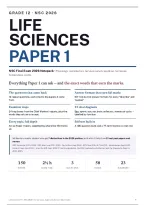
GRADE 12 · NSC 2026
LIFE
SCIENCES
PAPER 1
NSC Final Exam 2026 Notepack · Physiology: reproduction, nervous system, eye & ear, hormones,
homeostasis, plants
Everything Paper 1 can ask — and the exact words that earn the marks.
The questions that come back Answer formats that earn full marks
12 repeat questions, each cited to the papers it came 60+ tick-by-tick answer formats for every “describe” and
from. “explain”.
Examiner traps 23 clear diagrams
24 trap boxes from the Chief Markers’ reports, plus the Egg, sperm, eye, ear, brain, reflex arc, menstrual cycle —
words they refuse to accept. labelled by function.
Every topic, full depth Self-test built in
All six Paper 1 topics, weighted by where the 150 marks A 128-question bank and a 77-term Section A cram list.
sit.
Written by a matric student who got 7 distinctions in the 2026 prelims, built with AI help from 21 real past papers and
memos.
DBE November 2015–2025 · DBE May/June 2021–2025 · North West Sept 2024 · KZN Sept 2024 & Trial 2021 · Mpumalanga Sept 2022 ·
Eastern Cape June 2024 — plus the GDE Sept 2026 P1 marking guideline, the DBE Examination Guidelines and the Diagnostic Reports
2018–2025.
150 2½ h 3 58 23
MARKS EXAM TIME QUESTIONS PAGES DIAGRAMS
Life Sciences P1 · NSC 2026 · For personal study only. Do not redistribute. 1
,F R E E P R E V I E W · PAG E 2
The questions that keep coming back
Paper 1 recycles its long answers. These are the twelve that the source papers keep asking — where they appeared,
what they are worth, and the shape of the answer that earns the marks. The full tick-by-tick answers are inside.
TOPIC / QUESTION ANSWER FORMAT (THE FRAME THAT EARNS THE
TYPE HOW OFTEN WHERE MARKS MARKS)
★Describe hearing / Top long answer DBE Nov 2021 Q2.4 · GDE 4–7 Region by region: sound waves → vibrations →
explain hearing loss in the ear topic Sept 2026 Q3.2.5 pressure waves → organ of Corti → impulse →
auditory nerve* → cerebrum* → interpreted*
★Impulse pathway in The highest-value DBE Nov 2025 Q3.2.3 6 Receptor → sensory neuron → dorsal root of the
a reflex arc nervous-system spinal NERVE → interneuron → synapse → motor
item neuron → ventral root → effector
★Zygote to Most-repeated GDE Sept 2026 Q2.2.3– 3–6 Zygote → mitosis → SOLID ball = morula →
implantation long answer in 2.2.4 · source-paper bank HOLLOW ball = blastocyst → embeds in the
human endometrium
reproduction
★Oogenesis / Spermatogenesis: DBE Nov 2024 Q2.1.3 · 4–6 Name the process* → hormone → cell + ploidy →
spermatogenesis 5+ source papers GDE Sept 2026 Q2.2.2 location → mitosis then meiosis (ova) → haploid
product
★Menstrual-cycle Cited in 4 papers GDE Sept 2026 Q2.1 · DBE 1–11 Read the axis label (pituitary or ovarian?) →
hormone graph May/June 2023, 2024, hormone → its source → its effect on the
2025 endometrium / next hormone
Accommodation Cited in 3 papers DBE May/June 2023 5–6 Ciliary muscle → ligaments → tension → lens
(near / distant) Q3.5.6 · Nov 2020 Q2.2 · convexity → refraction → image on the retina
Nov 2025 Q3.3
Thyroxin negative Cited in 2 papers DBE Nov 2021 Q3.3.1 · Nov 4–5 Level → pituitary inhibited / stimulated → less /
feedback 2024 Q3.4.3 more TSH → thyroid → less / more thyroxin →
normal
Precocial vs altricial; Cited in 4 papers DBE Nov 2025 Q2.1 · Nov 2–3 % yolk → energy / nutrients → how developed at
internal fertilisation 2024 Q3.1 · Nov 2019 hatching → parental care
Q2.2.3 · GDE Sept 2026
Q1.4
Pupillary mechanism Cited in 1 paper + GDE Sept 2026 Q2.4.4 3–4 Which muscles contract / relax → pupil constricts
bank / dilates → less / more light
Draw a graph Most papers e.g. GDE Sept 2026 Q2.3.4 6–7 Fixed checklist: Type · Caption with both
(pack analysis) variables · Labels + units · Scale · Plotting
Balance restored Cited in 1 paper + GDE Sept 2026 Q3.1 4–5 Endolymph → cristae → impulse → auditory nerve
bank → cerebellum → skeletal muscles
Geotropism / Cited in 1 paper + GDE Sept 2026 Q3.5.3 4–5 Where auxins collect → stimulate (stem) / inhibit
phototropism bank (root) → one side grows faster → direction of
bend
★ = the five to learn first. * = a compulsory mark in the marking guideline. “How often” is honest about the evidence: where we could count the papers
a question was cited in, we give that number; where the frequency comes from the pack’s own analysis of its source papers, we say so. No frequency
on this page is estimated.
Life Sciences P1 · NSC 2026 · For personal study only. Do not redistribute. 2
,Contents
01 The full Paper 1 breakdown — structure, topic weighting, all 150 READ FIRST 4
cognitive levels, how the marking guideline awards marks,
command words, time plan.
02 Reproductive strategies in vertebrates — fertilisation, 8 marks ★ ASKED EVERY YEAR 8
ovipary / ovovivipary / vivipary, the amniotic egg, precocial vs
altricial.
03 Human reproduction — male and female systems, 41 marks ★ ASKED EVERY YEAR 11
gametogenesis, the menstrual cycle graph, fertilisation to HIGH MARKS
implantation, the placenta.
04 The nervous system — divisions, neurons, the synapse, the 54 marks ★ ASKED EVERY YEAR 20
reflex arc, the brain, MS and Alzheimer’s. with 05–06 HIGH MARKS
05 The human eye — structure, accommodation, the pupillary ★ ASKED EVERY YEAR 26
mechanism, visual defects. EXAMINER TRAP
06 The human ear — hearing, the Eustachian tube, the hearing- ★ ASKED EVERY YEAR 30
loss template, balance. HIGH MARKS
07 The endocrine system — every gland and hormone, adrenalin, 34 marks ★ ASKED EVERY YEAR 34
thyroxin feedback, goitre and diabetes. with 08 HIGH MARKS
08 Homeostasis & negative feedback — temperature, glucose, ★ ASKED EVERY YEAR 37
water (ADH), salt (aldosterone), CO₂: six chains in both EXAMINER TRAP
directions.
09 Plant responses — plant hormones, phototropism, geotropism, 13 marks ★ ASKED EVERY YEAR 41
apical dominance, the agar-block experiment, plant defences. EXAMINER TRAP
10 Investigations, graphs & calculations — variables, validity vs ~20–25 HIGH MARKS 44
reliability, the graph rubric, the calculations that appear. EXAMINER TRAP
11 The question bank — 128 recurring questions with what earns Q&A ★ RECURRING 47
the marks. Cover and self-test.
12 Section A terminology master list — 77 terms for Question 1 mark each EXAMINER TRAP 53
1.2, with the half-terms that score zero.
13 The examiner’s trap list — word pairs, banned phrases, final EXAMINER TRAP 56
behavioural traps, the night-before checklist.
HOW TO USE THE CALLOUT BOXE S
★ REPEATED QUESTION — asked in more than one paper; the citations are on the label. · ANSWER FORMAT —
the tick-by-tick structure that earns the marks. · EXAMINER TRAP — what the Chief Markers’ reports say
candidates get wrong. · KEY DEFINITION — learn word for word. Bold words carry the marks; ✓* marks a
compulsory point.
Life Sciences P1 · NSC 2026 · For personal study only. Do not redistribute. 3
, SECTION 01 · READ FIRST
150
The Full Paper 1 Breakdown
This page is the map; everything after it is the territory. Read it before you touch a single note — knowing where
the marks live is worth more than knowing one extra fact.
1.1 The shape of the paper
SECTION QUESTION(S) WHAT IT LOOKS LIKE MARKS
A Question 1 only Short-answer items: multiple choice, “give the biological term”, the A ONLY / B 50
ONLY / BOTH A AND B / NONE column item, and one or two diagram-based
letter-and-name blocks.
B Question 2 Two long questions, each broken into about four clusters of sub-questions worth 50
Question 3 1–7 marks each. Numbering goes three levels deep (e.g. 2.1.1(a)). This is where + 50
the data-response, diagram-interpretation, investigation and graph-drawing
items live.
GRAND TOTAL 150
E X AMINE R TR AP · THE SINGLE MO ST IMP ORTANT STRUCTUR AL FACT
There is no Section C and no 20-mark essay. The essay (17 content + 3 synthesis) was removed after the
November 2020 exam and has not returned — it is absent from every NSC paper from November 2021 to
November 2025 and from the provincial preliminary papers used for this pack. If a study guide tells you to
prepare “the essay”, it is preparing you for a paper that no longer exists.
The content did not disappear — it was re-cut into 4-, 5-, 6- and 7-mark “Describe…” sub-questions inside
Section B. The old essay bullet lists are still exactly what you must learn; you just write six points instead of
seventeen. This pack gives you those lists in the compressed form the paper now uses.
1.2 Topic weighting — where the 150 marks actually sit
TOPIC TAUGHT IN % MARKS WHAT THAT MEANS FOR YOU
Reproduction in Vertebrates Term 1 5 8 Small but nearly free. Never skip it — it is almost always a
short, predictable cluster.
Human Reproduction Term 1 27 41 Roughly a quarter of the paper — usually most of one
Section B question plus several Section A items.
Gametogenesis, the menstrual-cycle graph and zygote →
implantation are near-guaranteed.
Responding to the Environment Term 2 36 54 The biggest block in the paper. If you master only one
(Humans) part of this pack, master this one.
Nervous system · eye · ear
Endocrine System & Terms 2–3 23 34 Almost entirely negative-feedback chains. Six chains,
Homeostasis learned in both directions, buy most of these marks.
Responding to the Environment Term 3 9 13 Auxins, phototropism, geotropism, apical dominance,
(Plants) plant defences — plus an agar-block investigation.
Historically the worst-answered topic in the paper (a 29%
national average in 2022).
TOTAL 150
Life Sciences P1 · NSC 2026 · For personal study only. Do not redistribute. 4
LIFE
SCIENCES
PAPER 1
NSC Final Exam 2026 Notepack · Physiology: reproduction, nervous system, eye & ear, hormones,
homeostasis, plants
Everything Paper 1 can ask — and the exact words that earn the marks.
The questions that come back Answer formats that earn full marks
12 repeat questions, each cited to the papers it came 60+ tick-by-tick answer formats for every “describe” and
from. “explain”.
Examiner traps 23 clear diagrams
24 trap boxes from the Chief Markers’ reports, plus the Egg, sperm, eye, ear, brain, reflex arc, menstrual cycle —
words they refuse to accept. labelled by function.
Every topic, full depth Self-test built in
All six Paper 1 topics, weighted by where the 150 marks A 128-question bank and a 77-term Section A cram list.
sit.
Written by a matric student who got 7 distinctions in the 2026 prelims, built with AI help from 21 real past papers and
memos.
DBE November 2015–2025 · DBE May/June 2021–2025 · North West Sept 2024 · KZN Sept 2024 & Trial 2021 · Mpumalanga Sept 2022 ·
Eastern Cape June 2024 — plus the GDE Sept 2026 P1 marking guideline, the DBE Examination Guidelines and the Diagnostic Reports
2018–2025.
150 2½ h 3 58 23
MARKS EXAM TIME QUESTIONS PAGES DIAGRAMS
Life Sciences P1 · NSC 2026 · For personal study only. Do not redistribute. 1
,F R E E P R E V I E W · PAG E 2
The questions that keep coming back
Paper 1 recycles its long answers. These are the twelve that the source papers keep asking — where they appeared,
what they are worth, and the shape of the answer that earns the marks. The full tick-by-tick answers are inside.
TOPIC / QUESTION ANSWER FORMAT (THE FRAME THAT EARNS THE
TYPE HOW OFTEN WHERE MARKS MARKS)
★Describe hearing / Top long answer DBE Nov 2021 Q2.4 · GDE 4–7 Region by region: sound waves → vibrations →
explain hearing loss in the ear topic Sept 2026 Q3.2.5 pressure waves → organ of Corti → impulse →
auditory nerve* → cerebrum* → interpreted*
★Impulse pathway in The highest-value DBE Nov 2025 Q3.2.3 6 Receptor → sensory neuron → dorsal root of the
a reflex arc nervous-system spinal NERVE → interneuron → synapse → motor
item neuron → ventral root → effector
★Zygote to Most-repeated GDE Sept 2026 Q2.2.3– 3–6 Zygote → mitosis → SOLID ball = morula →
implantation long answer in 2.2.4 · source-paper bank HOLLOW ball = blastocyst → embeds in the
human endometrium
reproduction
★Oogenesis / Spermatogenesis: DBE Nov 2024 Q2.1.3 · 4–6 Name the process* → hormone → cell + ploidy →
spermatogenesis 5+ source papers GDE Sept 2026 Q2.2.2 location → mitosis then meiosis (ova) → haploid
product
★Menstrual-cycle Cited in 4 papers GDE Sept 2026 Q2.1 · DBE 1–11 Read the axis label (pituitary or ovarian?) →
hormone graph May/June 2023, 2024, hormone → its source → its effect on the
2025 endometrium / next hormone
Accommodation Cited in 3 papers DBE May/June 2023 5–6 Ciliary muscle → ligaments → tension → lens
(near / distant) Q3.5.6 · Nov 2020 Q2.2 · convexity → refraction → image on the retina
Nov 2025 Q3.3
Thyroxin negative Cited in 2 papers DBE Nov 2021 Q3.3.1 · Nov 4–5 Level → pituitary inhibited / stimulated → less /
feedback 2024 Q3.4.3 more TSH → thyroid → less / more thyroxin →
normal
Precocial vs altricial; Cited in 4 papers DBE Nov 2025 Q2.1 · Nov 2–3 % yolk → energy / nutrients → how developed at
internal fertilisation 2024 Q3.1 · Nov 2019 hatching → parental care
Q2.2.3 · GDE Sept 2026
Q1.4
Pupillary mechanism Cited in 1 paper + GDE Sept 2026 Q2.4.4 3–4 Which muscles contract / relax → pupil constricts
bank / dilates → less / more light
Draw a graph Most papers e.g. GDE Sept 2026 Q2.3.4 6–7 Fixed checklist: Type · Caption with both
(pack analysis) variables · Labels + units · Scale · Plotting
Balance restored Cited in 1 paper + GDE Sept 2026 Q3.1 4–5 Endolymph → cristae → impulse → auditory nerve
bank → cerebellum → skeletal muscles
Geotropism / Cited in 1 paper + GDE Sept 2026 Q3.5.3 4–5 Where auxins collect → stimulate (stem) / inhibit
phototropism bank (root) → one side grows faster → direction of
bend
★ = the five to learn first. * = a compulsory mark in the marking guideline. “How often” is honest about the evidence: where we could count the papers
a question was cited in, we give that number; where the frequency comes from the pack’s own analysis of its source papers, we say so. No frequency
on this page is estimated.
Life Sciences P1 · NSC 2026 · For personal study only. Do not redistribute. 2
,Contents
01 The full Paper 1 breakdown — structure, topic weighting, all 150 READ FIRST 4
cognitive levels, how the marking guideline awards marks,
command words, time plan.
02 Reproductive strategies in vertebrates — fertilisation, 8 marks ★ ASKED EVERY YEAR 8
ovipary / ovovivipary / vivipary, the amniotic egg, precocial vs
altricial.
03 Human reproduction — male and female systems, 41 marks ★ ASKED EVERY YEAR 11
gametogenesis, the menstrual cycle graph, fertilisation to HIGH MARKS
implantation, the placenta.
04 The nervous system — divisions, neurons, the synapse, the 54 marks ★ ASKED EVERY YEAR 20
reflex arc, the brain, MS and Alzheimer’s. with 05–06 HIGH MARKS
05 The human eye — structure, accommodation, the pupillary ★ ASKED EVERY YEAR 26
mechanism, visual defects. EXAMINER TRAP
06 The human ear — hearing, the Eustachian tube, the hearing- ★ ASKED EVERY YEAR 30
loss template, balance. HIGH MARKS
07 The endocrine system — every gland and hormone, adrenalin, 34 marks ★ ASKED EVERY YEAR 34
thyroxin feedback, goitre and diabetes. with 08 HIGH MARKS
08 Homeostasis & negative feedback — temperature, glucose, ★ ASKED EVERY YEAR 37
water (ADH), salt (aldosterone), CO₂: six chains in both EXAMINER TRAP
directions.
09 Plant responses — plant hormones, phototropism, geotropism, 13 marks ★ ASKED EVERY YEAR 41
apical dominance, the agar-block experiment, plant defences. EXAMINER TRAP
10 Investigations, graphs & calculations — variables, validity vs ~20–25 HIGH MARKS 44
reliability, the graph rubric, the calculations that appear. EXAMINER TRAP
11 The question bank — 128 recurring questions with what earns Q&A ★ RECURRING 47
the marks. Cover and self-test.
12 Section A terminology master list — 77 terms for Question 1 mark each EXAMINER TRAP 53
1.2, with the half-terms that score zero.
13 The examiner’s trap list — word pairs, banned phrases, final EXAMINER TRAP 56
behavioural traps, the night-before checklist.
HOW TO USE THE CALLOUT BOXE S
★ REPEATED QUESTION — asked in more than one paper; the citations are on the label. · ANSWER FORMAT —
the tick-by-tick structure that earns the marks. · EXAMINER TRAP — what the Chief Markers’ reports say
candidates get wrong. · KEY DEFINITION — learn word for word. Bold words carry the marks; ✓* marks a
compulsory point.
Life Sciences P1 · NSC 2026 · For personal study only. Do not redistribute. 3
, SECTION 01 · READ FIRST
150
The Full Paper 1 Breakdown
This page is the map; everything after it is the territory. Read it before you touch a single note — knowing where
the marks live is worth more than knowing one extra fact.
1.1 The shape of the paper
SECTION QUESTION(S) WHAT IT LOOKS LIKE MARKS
A Question 1 only Short-answer items: multiple choice, “give the biological term”, the A ONLY / B 50
ONLY / BOTH A AND B / NONE column item, and one or two diagram-based
letter-and-name blocks.
B Question 2 Two long questions, each broken into about four clusters of sub-questions worth 50
Question 3 1–7 marks each. Numbering goes three levels deep (e.g. 2.1.1(a)). This is where + 50
the data-response, diagram-interpretation, investigation and graph-drawing
items live.
GRAND TOTAL 150
E X AMINE R TR AP · THE SINGLE MO ST IMP ORTANT STRUCTUR AL FACT
There is no Section C and no 20-mark essay. The essay (17 content + 3 synthesis) was removed after the
November 2020 exam and has not returned — it is absent from every NSC paper from November 2021 to
November 2025 and from the provincial preliminary papers used for this pack. If a study guide tells you to
prepare “the essay”, it is preparing you for a paper that no longer exists.
The content did not disappear — it was re-cut into 4-, 5-, 6- and 7-mark “Describe…” sub-questions inside
Section B. The old essay bullet lists are still exactly what you must learn; you just write six points instead of
seventeen. This pack gives you those lists in the compressed form the paper now uses.
1.2 Topic weighting — where the 150 marks actually sit
TOPIC TAUGHT IN % MARKS WHAT THAT MEANS FOR YOU
Reproduction in Vertebrates Term 1 5 8 Small but nearly free. Never skip it — it is almost always a
short, predictable cluster.
Human Reproduction Term 1 27 41 Roughly a quarter of the paper — usually most of one
Section B question plus several Section A items.
Gametogenesis, the menstrual-cycle graph and zygote →
implantation are near-guaranteed.
Responding to the Environment Term 2 36 54 The biggest block in the paper. If you master only one
(Humans) part of this pack, master this one.
Nervous system · eye · ear
Endocrine System & Terms 2–3 23 34 Almost entirely negative-feedback chains. Six chains,
Homeostasis learned in both directions, buy most of these marks.
Responding to the Environment Term 3 9 13 Auxins, phototropism, geotropism, apical dominance,
(Plants) plant defences — plus an agar-block investigation.
Historically the worst-answered topic in the paper (a 29%
national average in 2022).
TOTAL 150
Life Sciences P1 · NSC 2026 · For personal study only. Do not redistribute. 4


