
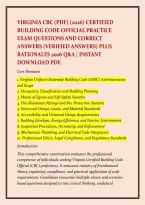
VIRGINIA CBC (PDF) (2026) CERTIFIED
BUILDING CODE OFFICIAL PRACTICE
EXAM QUESTIONS AND CORRECT
ANSWERS (VERIFIED ANSWERS) PLUS
RATIONALES 2026 Q&A | INSTANT
DOWNLOAD PDF.
Core Domains
1. Virginia Uniform Statewide Building Code (USBC) Administration
and Scope
2. Occupancy Classification and Building Planning
3. Means of Egress and Life Safety Systems
4. Fire-Resistance Ratings and Fire Protection Systems
5. Structural Design, Loads, and Material Standards
6. Accessibility and Universal Design Requirements
7. Building Envelope, Energy Efficiency, and Interior Environment
8. Inspection Procedures, Permitting, and Enforcement
9. Mechanical, Plumbing, and Electrical Code Integration
10. Professional Ethics, Legal Compliance, and Regulatory Standards
Introduction
This comprehensive examination evaluates the professional
competence of individuals seeking Virginia Certified Building Code
Official (CBC) proficiency. It measures mastery of foundational
theory, regulatory compliance, and practical application of code
requirements. Candidates encounter multiple-choice and scenario-
based questions designed to test critical thinking, analytical
,decision-making, and the ability to interpret code provisions in real-
world construction environments. Success indicates comprehensive
understanding of life safety standards, structural integrity, and the
ethical responsibilities inherent in code enforcement and
administration.
SECTION ONE: QUESTIONS 1–100
1. Which of the following is the primary objective of the
Virginia Uniform Statewide Building Code (USBC)?
A. To standardize architectural design styles for new construction
B. To protect the public health, safety, and welfare of residents
C. To regulate the financial cost of construction materials in the
state
D. To establish design trends for architectural aesthetics
B. To protect the public health, safety, and welfare of residents
RATIONALE: The USBC is enacted to protect public safety,
health, and welfare by establishing minimum standards for building
design, construction, and maintenance. Its primary purpose is life
safety, not cost regulation or aesthetic standardization.
2. A building's "Occupancy Classification" is primarily
determined by:
A. The number of floors in the structure
B. The total height of the building in feet
,C. The intended use or character of the occupancy of the building
D. The zoning district where the building is located
C. The intended use or character of the occupancy of the
building
RATIONALE: Occupancy classification is based on the nature of
the use or the character of the occupancy of the building or portion
thereof, not on physical dimensions or zoning.
3. When a conflict exists between a general requirement and a
specific requirement in the code, which takes precedence?
A. The general requirement
B. The specific requirement
C. The oldest requirement
D. The most restrictive requirement
B. The specific requirement
RATIONALE: Code provisions dictate that where there is a
conflict between a general requirement and a specific requirement,
the specific requirement shall be applicable.
4. What is the maximum allowable travel distance for a non-
sprinklered Group B occupancy?
A. 150 feet
B. 200 feet
, C. 250 feet
D. 300 feet
B. 200 feet
RATIONALE: For Group B occupancies not equipped with an
automatic sprinkler system, the maximum total travel distance is
limited to 200 feet. Sprinklered buildings may have extended travel
distances.
5. Which entity has the primary authority to issue a building
permit under the Virginia USBC?
A. The State Fire Marshal
B. The Department of Housing and Community Development
C. The local building official
D. The municipal planning commission
C. The local building official
RATIONALE: The building official is the designated officer in
charge of the administration and enforcement of the USBC in the
local jurisdiction, including the issuance of building permits.
6. Under the International Building Code provisions as
adopted by the USBC, what is the minimum required width for
a corridor serving an occupant load of 50 or more?
A. 36 inches
B. 44 inches
BUILDING CODE OFFICIAL PRACTICE
EXAM QUESTIONS AND CORRECT
ANSWERS (VERIFIED ANSWERS) PLUS
RATIONALES 2026 Q&A | INSTANT
DOWNLOAD PDF.
Core Domains
1. Virginia Uniform Statewide Building Code (USBC) Administration
and Scope
2. Occupancy Classification and Building Planning
3. Means of Egress and Life Safety Systems
4. Fire-Resistance Ratings and Fire Protection Systems
5. Structural Design, Loads, and Material Standards
6. Accessibility and Universal Design Requirements
7. Building Envelope, Energy Efficiency, and Interior Environment
8. Inspection Procedures, Permitting, and Enforcement
9. Mechanical, Plumbing, and Electrical Code Integration
10. Professional Ethics, Legal Compliance, and Regulatory Standards
Introduction
This comprehensive examination evaluates the professional
competence of individuals seeking Virginia Certified Building Code
Official (CBC) proficiency. It measures mastery of foundational
theory, regulatory compliance, and practical application of code
requirements. Candidates encounter multiple-choice and scenario-
based questions designed to test critical thinking, analytical
,decision-making, and the ability to interpret code provisions in real-
world construction environments. Success indicates comprehensive
understanding of life safety standards, structural integrity, and the
ethical responsibilities inherent in code enforcement and
administration.
SECTION ONE: QUESTIONS 1–100
1. Which of the following is the primary objective of the
Virginia Uniform Statewide Building Code (USBC)?
A. To standardize architectural design styles for new construction
B. To protect the public health, safety, and welfare of residents
C. To regulate the financial cost of construction materials in the
state
D. To establish design trends for architectural aesthetics
B. To protect the public health, safety, and welfare of residents
RATIONALE: The USBC is enacted to protect public safety,
health, and welfare by establishing minimum standards for building
design, construction, and maintenance. Its primary purpose is life
safety, not cost regulation or aesthetic standardization.
2. A building's "Occupancy Classification" is primarily
determined by:
A. The number of floors in the structure
B. The total height of the building in feet
,C. The intended use or character of the occupancy of the building
D. The zoning district where the building is located
C. The intended use or character of the occupancy of the
building
RATIONALE: Occupancy classification is based on the nature of
the use or the character of the occupancy of the building or portion
thereof, not on physical dimensions or zoning.
3. When a conflict exists between a general requirement and a
specific requirement in the code, which takes precedence?
A. The general requirement
B. The specific requirement
C. The oldest requirement
D. The most restrictive requirement
B. The specific requirement
RATIONALE: Code provisions dictate that where there is a
conflict between a general requirement and a specific requirement,
the specific requirement shall be applicable.
4. What is the maximum allowable travel distance for a non-
sprinklered Group B occupancy?
A. 150 feet
B. 200 feet
, C. 250 feet
D. 300 feet
B. 200 feet
RATIONALE: For Group B occupancies not equipped with an
automatic sprinkler system, the maximum total travel distance is
limited to 200 feet. Sprinklered buildings may have extended travel
distances.
5. Which entity has the primary authority to issue a building
permit under the Virginia USBC?
A. The State Fire Marshal
B. The Department of Housing and Community Development
C. The local building official
D. The municipal planning commission
C. The local building official
RATIONALE: The building official is the designated officer in
charge of the administration and enforcement of the USBC in the
local jurisdiction, including the issuance of building permits.
6. Under the International Building Code provisions as
adopted by the USBC, what is the minimum required width for
a corridor serving an occupant load of 50 or more?
A. 36 inches
B. 44 inches


