
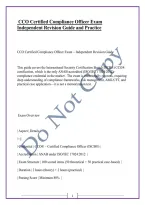
CCO Certified Compliance Officer Exam
Independent Revision Guide and Practice
CCO Certified Compliance Officer Exam – Independent Revision Guide
This guide covers the International Security Certification Board (ISCB®) CCO®
certification, which is the only ANAB-accredited (ISO/IEC 17024:2012)
compliance credential in the market . The exam is intentionally rigorous, requiring
deep understanding of compliance frameworks, risk management, AML/CFT, and
practical case application—it is not a memorization test.
Exam Overview
| Aspect | Details |
|--||
| Credential | CCO® – Certified Compliance Officer (ISCB®) |
| Accreditation | ANAB under ISO/IEC 17024:2012 |
| Exam Structure | 100 scored items (50 theoretical + 50 practical case-based) |
| Duration | 2 hours (theory) + 2 hours (practical) |
| Passing Score | Minimum 80% |
1
,| Validity | 2 years (renewable) |
Eligibility Requirements
- Education: University degree in law, business, accounting, audit, economics,
engineering, or related field
- Experience: Minimum 3 years leading or actively participating in compliance
programs
- Training: 80 hours of formal training across AML, corporate ethics, audit, or data
privacy
- References: Two professional reference letters from certified compliance officers
or direct supervisors
Body of Knowledge (10 Domains)
| | Domain | Weight |
||--|--|
| 1 | Legal & Regulatory Frameworks | 15% |
| 2 | Compliance Management Systems | 12% |
| 3 | Functions of the Compliance Officer | 8% |
| 4 | AML/CFT and Anti-Corruption Programs | 20% |
2
,| 5 | Risk-Based Approach & Assessment | 18% |
| 6 | Data Privacy & Information Security | 10% |
| 7 | Compliance Auditing & Monitoring | 6% |
| 8 | Ethics & Corporate Governance | 5% |
| 9 | Technology in Compliance | 3% |
| 10 | Investigations & Enforcement | 3% |
Practice Questions
Domain 1: Legal & Regulatory Frameworks
QUESTION 1
The FATF 40 Recommendations primarily focus on which area of compliance?
A) Corporate governance
B) Anti-money laundering and counter-terrorist financing
C) Data privacy
D) Environmental regulations
3
, Correct Answer: B
Rationale: The FATF 40 Recommendations are the international standard for
AML/CFT compliance. They form a core part of the CCO Body of Knowledge .
QUESTION 2
What does the "exclusive remedy" doctrine in workers' compensation law mean?
A) Injured employees can choose between workers' comp and a lawsuit
B) Workers' comp benefits are the sole recourse for occupational injuries
C) Employers can deny all claims
D) Employees must prove negligence to collect
Correct Answer: B
Rationale: The exclusive remedy doctrine bars employees from pursuing separate
tort actions for workplace injuries—workers' comp is the only avenue .
4
Independent Revision Guide and Practice
CCO Certified Compliance Officer Exam – Independent Revision Guide
This guide covers the International Security Certification Board (ISCB®) CCO®
certification, which is the only ANAB-accredited (ISO/IEC 17024:2012)
compliance credential in the market . The exam is intentionally rigorous, requiring
deep understanding of compliance frameworks, risk management, AML/CFT, and
practical case application—it is not a memorization test.
Exam Overview
| Aspect | Details |
|--||
| Credential | CCO® – Certified Compliance Officer (ISCB®) |
| Accreditation | ANAB under ISO/IEC 17024:2012 |
| Exam Structure | 100 scored items (50 theoretical + 50 practical case-based) |
| Duration | 2 hours (theory) + 2 hours (practical) |
| Passing Score | Minimum 80% |
1
,| Validity | 2 years (renewable) |
Eligibility Requirements
- Education: University degree in law, business, accounting, audit, economics,
engineering, or related field
- Experience: Minimum 3 years leading or actively participating in compliance
programs
- Training: 80 hours of formal training across AML, corporate ethics, audit, or data
privacy
- References: Two professional reference letters from certified compliance officers
or direct supervisors
Body of Knowledge (10 Domains)
| | Domain | Weight |
||--|--|
| 1 | Legal & Regulatory Frameworks | 15% |
| 2 | Compliance Management Systems | 12% |
| 3 | Functions of the Compliance Officer | 8% |
| 4 | AML/CFT and Anti-Corruption Programs | 20% |
2
,| 5 | Risk-Based Approach & Assessment | 18% |
| 6 | Data Privacy & Information Security | 10% |
| 7 | Compliance Auditing & Monitoring | 6% |
| 8 | Ethics & Corporate Governance | 5% |
| 9 | Technology in Compliance | 3% |
| 10 | Investigations & Enforcement | 3% |
Practice Questions
Domain 1: Legal & Regulatory Frameworks
QUESTION 1
The FATF 40 Recommendations primarily focus on which area of compliance?
A) Corporate governance
B) Anti-money laundering and counter-terrorist financing
C) Data privacy
D) Environmental regulations
3
, Correct Answer: B
Rationale: The FATF 40 Recommendations are the international standard for
AML/CFT compliance. They form a core part of the CCO Body of Knowledge .
QUESTION 2
What does the "exclusive remedy" doctrine in workers' compensation law mean?
A) Injured employees can choose between workers' comp and a lawsuit
B) Workers' comp benefits are the sole recourse for occupational injuries
C) Employers can deny all claims
D) Employees must prove negligence to collect
Correct Answer: B
Rationale: The exclusive remedy doctrine bars employees from pursuing separate
tort actions for workplace injuries—workers' comp is the only avenue .
4


