
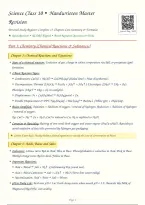
Science Class 10 • Handwritten Master
Revision
Personal Study Register: Complete 13 Chapters Core Summary & Formulae Scan & Pay / UPI
★ Quick Revision • NCERT Aligned • Board Repeated Questions & Tricks
Part I: Chemistry (Chemical Reactions & Substances)
Chapter 1: Chemical Reactions and Equations
• Signs of a chemical reaction: Evolution of gas, change in colour, temperature rise/fall, or precipitate (ppt)
formation.
• 4 Basic Reaction Types:
• Combination: CaO(s) + H₂O(l) → Ca(OH)₂(aq) (Slaked lime) + Heat (Exothermic).
• Decomposition: Thermal (2FeSO₄ → Fe₂O₃ + SO₂↑ + SO₃↑); Electrolytic (2H₂O → 2H₂ + O₂);
Photolytic (2AgCl → 2Ag + Cl₂ in sunlight).
• Displacement: Fe + CuSO₄(blue) → FeSO₄(green) + Cu.
• Double Displacement & PPT: Na₂SO₄(aq) + BaCl₂(aq) → BaSO₄↓ (White ppt) + 2NaCl(aq).
• Redox simplified: Oxidation = Addition of oxygen / removal of hydrogen. Reduction = Addition of hydrogen
/ removal of oxygen.
Eg: CuO + H₂ → Cu + H₂O (CuO is reduced to Cu; H₂ is oxidized to H₂O).
• Corrosion & Rancidity: Rusting of iron needs both oxygen and water vapour (Fe₂O₃·xH₂O). Rancidity is
aerial oxidation of fats/oils; prevented by Nitrogen gas packaging.
★ Golden Exam Rule: Always balance skeletal equations to satisfy the Law of Conservation of Mass!
Chapter 2: Acids, Bases and Salts
• Indicators: Litmus turns Red in Acid, Blue in Base. Phenolphthalein is colourless in Acid, Pink in Base.
Methyl Orange turns Red in Acid, Yellow in Base.
• Important Reactions:
• Acid + Metal → Salt + H₂↑ (Confirmatory Pop Sound test).
• Acid + Metal Carbonate → Salt + CO₂↑ + H₂O (Turns lime water milky).
• Neutralization: Acid + Base → Salt + Water.
• pH in Daily Life: Acid rain pH < 5.6; Tooth decay starts when mouth pH < 5.5; Antacids like Milk of
Magnesia [Mg(OH)₂] cure acidity.
~ Page 1 ~
, • Core Salts & Formulae:
• Bleaching Powder: Ca(OH)₂ + Cl₂ → CaOCl₂ + H₂O (Water disinfectant, laundry bleach).
• Baking Soda: NaHCO₃ (Heated: 2NaHCO₃ → Na₂CO₃ + H₂O + CO₂↑, makes cakes soft & spongy).
• Washing Soda: Na₂CO₃·10H₂O (Softens permanent hard water, soap manufacture).
• Plaster of Paris: CaSO₄·½H₂O (Heating gypsum CaSO₄·2H₂O at 373 K).
Chapter 3: Metals and Non-Metals
• Exceptions: Mercury (liquid metal), Bromine (liquid non-metal), Iodine (lustrous non-metal), Diamond
(hardest allotrope), Gallium & Caesium (melt on palm).
• Amphoteric Oxides: Oxides that react with both acids and bases to yield salt + water (Al₂O₃ & ZnO).
Reaction: Al₂O₃ + 2NaOH → 2NaAlO₂ (Sodium aluminate) + H₂O.
• Aqua Regia: 3:1 mixture of Conc. HCl and Conc. HNO₃ (can dissolve Gold & Platinum).
• Reactivity Series: K > Na > Ca > Mg > Al > Zn > Fe > Pb > [H] > Cu > Hg > Ag > Au.
• Metallurgy Hacks: Roasting = heating sulfide ores in excess air; Calcination = heating carbonate ores in
limited air. Thermit process: Fe₂O₃ + 2Al → 2Fe(l) + Al₂O₃ + Heat.
Chapter 4: Carbon and Its Compounds
• Versatile Nature of Carbon:
1. Catenation: Self-linking property to form long C-C covalent chains.
2. Tetravalency: Has 4 valence electrons, forms 4 covalent bonds.
• Homologous Series: Compounds having identical functional groups where successive members differ by -
CH₂- unit (14 u molecular mass).
• Alkanes: CnH2n+2 | Alkenes: CnH2n | Alkynes: CnH2n-2.
• Key Reactions:
• Esterification: Ethanoic acid + Ethanol + conc. H₂SO₄ → CH₃COOC₂H₅ (Sweet smelling ester) + H₂O.
• Saponification: Ester + NaOH → Soap (CH₃COONa) + Alcohol.
• Micelle Formation: Soap has hydrophilic ionic head (faces water) and hydrophobic carbon tail (traps oily
dirt). Soaps form scum with hard water; synthetic detergents work in hard water.
Part II: Biology (Life Processes & Genetics)
Chapter 5: Life Processes
• Digestive Enzymes: • Double Circulation:
• Mouth: Salivary amylase (Starch → Maltose). Blood flows through heart twice in one complete
~ Page 2 ~
Revision
Personal Study Register: Complete 13 Chapters Core Summary & Formulae Scan & Pay / UPI
★ Quick Revision • NCERT Aligned • Board Repeated Questions & Tricks
Part I: Chemistry (Chemical Reactions & Substances)
Chapter 1: Chemical Reactions and Equations
• Signs of a chemical reaction: Evolution of gas, change in colour, temperature rise/fall, or precipitate (ppt)
formation.
• 4 Basic Reaction Types:
• Combination: CaO(s) + H₂O(l) → Ca(OH)₂(aq) (Slaked lime) + Heat (Exothermic).
• Decomposition: Thermal (2FeSO₄ → Fe₂O₃ + SO₂↑ + SO₃↑); Electrolytic (2H₂O → 2H₂ + O₂);
Photolytic (2AgCl → 2Ag + Cl₂ in sunlight).
• Displacement: Fe + CuSO₄(blue) → FeSO₄(green) + Cu.
• Double Displacement & PPT: Na₂SO₄(aq) + BaCl₂(aq) → BaSO₄↓ (White ppt) + 2NaCl(aq).
• Redox simplified: Oxidation = Addition of oxygen / removal of hydrogen. Reduction = Addition of hydrogen
/ removal of oxygen.
Eg: CuO + H₂ → Cu + H₂O (CuO is reduced to Cu; H₂ is oxidized to H₂O).
• Corrosion & Rancidity: Rusting of iron needs both oxygen and water vapour (Fe₂O₃·xH₂O). Rancidity is
aerial oxidation of fats/oils; prevented by Nitrogen gas packaging.
★ Golden Exam Rule: Always balance skeletal equations to satisfy the Law of Conservation of Mass!
Chapter 2: Acids, Bases and Salts
• Indicators: Litmus turns Red in Acid, Blue in Base. Phenolphthalein is colourless in Acid, Pink in Base.
Methyl Orange turns Red in Acid, Yellow in Base.
• Important Reactions:
• Acid + Metal → Salt + H₂↑ (Confirmatory Pop Sound test).
• Acid + Metal Carbonate → Salt + CO₂↑ + H₂O (Turns lime water milky).
• Neutralization: Acid + Base → Salt + Water.
• pH in Daily Life: Acid rain pH < 5.6; Tooth decay starts when mouth pH < 5.5; Antacids like Milk of
Magnesia [Mg(OH)₂] cure acidity.
~ Page 1 ~
, • Core Salts & Formulae:
• Bleaching Powder: Ca(OH)₂ + Cl₂ → CaOCl₂ + H₂O (Water disinfectant, laundry bleach).
• Baking Soda: NaHCO₃ (Heated: 2NaHCO₃ → Na₂CO₃ + H₂O + CO₂↑, makes cakes soft & spongy).
• Washing Soda: Na₂CO₃·10H₂O (Softens permanent hard water, soap manufacture).
• Plaster of Paris: CaSO₄·½H₂O (Heating gypsum CaSO₄·2H₂O at 373 K).
Chapter 3: Metals and Non-Metals
• Exceptions: Mercury (liquid metal), Bromine (liquid non-metal), Iodine (lustrous non-metal), Diamond
(hardest allotrope), Gallium & Caesium (melt on palm).
• Amphoteric Oxides: Oxides that react with both acids and bases to yield salt + water (Al₂O₃ & ZnO).
Reaction: Al₂O₃ + 2NaOH → 2NaAlO₂ (Sodium aluminate) + H₂O.
• Aqua Regia: 3:1 mixture of Conc. HCl and Conc. HNO₃ (can dissolve Gold & Platinum).
• Reactivity Series: K > Na > Ca > Mg > Al > Zn > Fe > Pb > [H] > Cu > Hg > Ag > Au.
• Metallurgy Hacks: Roasting = heating sulfide ores in excess air; Calcination = heating carbonate ores in
limited air. Thermit process: Fe₂O₃ + 2Al → 2Fe(l) + Al₂O₃ + Heat.
Chapter 4: Carbon and Its Compounds
• Versatile Nature of Carbon:
1. Catenation: Self-linking property to form long C-C covalent chains.
2. Tetravalency: Has 4 valence electrons, forms 4 covalent bonds.
• Homologous Series: Compounds having identical functional groups where successive members differ by -
CH₂- unit (14 u molecular mass).
• Alkanes: CnH2n+2 | Alkenes: CnH2n | Alkynes: CnH2n-2.
• Key Reactions:
• Esterification: Ethanoic acid + Ethanol + conc. H₂SO₄ → CH₃COOC₂H₅ (Sweet smelling ester) + H₂O.
• Saponification: Ester + NaOH → Soap (CH₃COONa) + Alcohol.
• Micelle Formation: Soap has hydrophilic ionic head (faces water) and hydrophobic carbon tail (traps oily
dirt). Soaps form scum with hard water; synthetic detergents work in hard water.
Part II: Biology (Life Processes & Genetics)
Chapter 5: Life Processes
• Digestive Enzymes: • Double Circulation:
• Mouth: Salivary amylase (Starch → Maltose). Blood flows through heart twice in one complete
~ Page 2 ~



