
1|Page
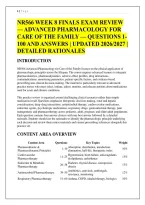
NR566 WEEK 8 FINALS EXAM REVIEW
— ADVANCED PHARMACOLOGY FOR
CARE OF THE FAMILY — QUESTIONS 1-
100 AND ANSWERS | UPDATED 2026/2027 |
DETAILED RATIONALES
INTRODUCTION
NR566 Advanced Pharmacology for Care of the Family focuses on the clinical application of
pharmacologic principles across the lifespan. The course requires advanced learners to integrate
pharmacokinetics, pharmacodynamics, adverse-effect profiles, drug interactions,
contraindications, monitoring parameters, patient-specific factors, and evidence-based
prescribing into clinical decision-making. The material is particularly relevant to advanced
practice nurses who must select, initiate, adjust, monitor, and educate patients about medications
used for acute and chronic conditions.
This practice review is organized around challenging clinical scenarios rather than simple
medication recall. Questions emphasize therapeutic decision-making, renal and hepatic
considerations, drug–drug interactions, antimicrobial therapy, cardiovascular medications,
endocrine agents, psychotropic medications, respiratory drugs, gastrointestinal therapy, pain
management, and pharmacotherapy across pediatric, adult, pregnant, and older-adult populations.
Each question contains four answer choices with one best answer followed by a detailed
rationale. Students should use the rationales to identify the pharmacologic principle underlying
each decision and review their course materials and current prescribing references alongside this
practice set.
CONTENT AREA OVERVIEW
Content Area Questions Key Topics Weight
Pharmacokinetic & Absorption, distribution, metabolism,
1–10 10%
Pharmacodynamic Principles elimination, half-life, therapeutic index
Cardiovascular Hypertension, heart failure, anticoagulants,
11–25 15%
Pharmacotherapy dyslipidemia, arrhythmias
Endocrine & Metabolic Diabetes, thyroid disease, osteoporosis,
26–38 13%
Pharmacotherapy obesity
Antibiotics, antivirals, antifungals,
Antimicrobial Pharmacotherapy 39–50 12%
resistance, monitoring
Respiratory Pharmacotherapy 51–60 Asthma, COPD, inhaled therapy, biologics 10%
,2|Page
Content Area Questions Key Topics Weight
CNS & Psychiatric Antidepressants, anxiolytics,
61–73 13%
Pharmacotherapy antipsychotics, seizures, dementia
Gastrointestinal GERD, ulcers, nausea, constipation,
74–80 7%
Pharmacotherapy inflammatory disorders
Pain, Musculoskeletal & NSAIDs, opioids, gout, arthritis,
81–87 7%
Rheumatologic Therapy osteoporosis
Women's, Men's & Contraception, pregnancy, menopause,
88–94 7%
Reproductive Health BPH
Geriatric, Pediatric & Safety Polypharmacy, high-risk medications, age-
95–100 6%
Considerations specific prescribing
This allocation is a study-oriented organization of major advanced-pharmacology domains and
is not an official NR566 examination blueprint.
QUESTIONS 1–100
PHARMACOKINETIC & PHARMACODYNAMIC
PRINCIPLES
Q1:
A 72-year-old patient with chronic kidney disease is prescribed a medication that is primarily
eliminated unchanged through the kidneys. After several weeks of therapy, the patient develops
increasing fatigue, confusion, and excessive sedation despite taking the medication exactly as
prescribed. Which pharmacologic principle best explains this presentation?
A) Increased first-pass hepatic metabolism
B) Reduced renal clearance causing drug accumulation
C) Increased gastrointestinal absorption
D) Reduced plasma protein binding
Rationale: The correct answer is B because reduced renal function decreases clearance of
medications substantially eliminated by the kidneys, increasing serum concentrations and the
risk of toxicity. Option A is incorrect because increased first-pass metabolism would generally
decrease systemic exposure. Option C is incorrect because increased absorption would not
explain the pattern associated with chronic kidney disease. Option D is incorrect because
reduced protein binding generally increases the free fraction of a medication but does not by
itself explain the classic accumulation caused by impaired renal elimination.
Q2:
,3|Page
A patient begins a medication with a half-life of approximately 24 hours. The patient asks why
the clinician does not increase the dose after the first day even though the therapeutic effect is
not yet maximal. Which response best reflects the pharmacokinetic principle involved?
A) The medication requires complete gastrointestinal absorption before working
B) Several half-lives are generally required to approach steady-state concentration
C) The medication must undergo first-pass metabolism for several days
D) The medication cannot cross the blood-brain barrier during the first week
Rationale: The correct answer is B because medications administered at regular intervals
generally require approximately four to five half-lives to approach steady-state concentrations.
Option A is incorrect because gastrointestinal absorption is not normally delayed for several
days. Option C is incorrect because first-pass metabolism occurs during initial dosing rather
than gradually beginning days later. Option D is incorrect because blood-brain-barrier
penetration is not the general explanation for delayed attainment of steady state.
Q3:
A patient taking warfarin starts another medication that strongly inhibits hepatic CYP
metabolism. Several days later, the patient's INR is substantially above the therapeutic range.
Which mechanism most likely explains the change?
A) Increased renal elimination of warfarin
B) Reduced hepatic metabolism resulting in increased warfarin exposure
C) Increased gastrointestinal destruction of warfarin
D) Reduced anticoagulant activity caused by enzyme inhibition
Rationale: The correct answer is B because inhibition of hepatic metabolism can decrease
warfarin clearance and increase anticoagulant exposure, producing an elevated INR and
bleeding risk. Option A is incorrect because enzyme inhibition does not increase renal
elimination. Option C is incorrect because the interaction occurs primarily through metabolism
rather than gastrointestinal destruction. Option D is incorrect because inhibition of metabolism
generally increases, rather than decreases, the clinical effect of susceptible medications.
Q4:
A patient with severe hypoalbuminemia begins therapy with a medication that is highly protein
bound. Which pharmacologic change is most clinically important to anticipate?
A) Complete elimination of the medication
B) An increased unbound fraction of the medication
C) Decreased pharmacologic activity in every circumstance
D) Permanent inhibition of renal filtration
Rationale: The correct answer is B because low albumin can reduce protein binding and
increase the free, pharmacologically active fraction of highly protein-bound drugs. Option A is
, 4|Page
incorrect because hypoalbuminemia does not eliminate the medication. Option C is incorrect
because an increased free fraction may increase pharmacologic effects or toxicity rather than
universally decreasing activity. Option D is incorrect because albumin concentration does not
permanently inhibit glomerular filtration.
Q5:
A patient is prescribed a medication with a narrow therapeutic index. Which clinical strategy is
most appropriate?
A) Avoid monitoring because narrow therapeutic-index drugs have predictable effects
B) Increase the dose whenever mild adverse effects occur
C) Monitor clinical response and, when appropriate, serum drug concentrations
D) Administer the medication only when symptoms become severe
Rationale: The correct answer is C because drugs with narrow therapeutic indices have a
relatively small difference between effective and toxic concentrations, making careful monitoring
important. Option A is incorrect because predictable pharmacology does not eliminate toxicity
risk. Option B is incorrect because adverse effects may indicate excessive exposure rather than
inadequate dosing. Option D is incorrect because intermittent symptom-driven dosing may
produce ineffective or unsafe concentrations.
Q6:
A patient taking an orally administered medication has recently undergone a major small-bowel
resection. The medication previously produced an adequate response but is now ineffective
despite adherence. Which pharmacokinetic change should the clinician consider first?
A) Increased hepatic clearance caused by greater intestinal surface area
B) Reduced absorption because of decreased gastrointestinal surface area
C) Increased renal clearance caused by bowel resection
D) Increased protein binding caused by reduced intestinal length
Rationale: The correct answer is B because extensive small-bowel resection can reduce the
surface area available for absorption and alter bioavailability of orally administered
medications. Option A is incorrect because bowel resection does not increase intestinal surface
area. Option C is incorrect because renal clearance is not directly increased by loss of intestinal
tissue. Option D is incorrect because protein binding is determined largely by plasma proteins
and drug characteristics rather than intestinal length.
Q7:
A patient with advanced liver disease develops excessive sedation after receiving the usual dose
of a medication extensively metabolized by the liver. Which explanation is most appropriate?
NR566 WEEK 8 FINALS EXAM REVIEW
— ADVANCED PHARMACOLOGY FOR
CARE OF THE FAMILY — QUESTIONS 1-
100 AND ANSWERS | UPDATED 2026/2027 |
DETAILED RATIONALES
INTRODUCTION
NR566 Advanced Pharmacology for Care of the Family focuses on the clinical application of
pharmacologic principles across the lifespan. The course requires advanced learners to integrate
pharmacokinetics, pharmacodynamics, adverse-effect profiles, drug interactions,
contraindications, monitoring parameters, patient-specific factors, and evidence-based
prescribing into clinical decision-making. The material is particularly relevant to advanced
practice nurses who must select, initiate, adjust, monitor, and educate patients about medications
used for acute and chronic conditions.
This practice review is organized around challenging clinical scenarios rather than simple
medication recall. Questions emphasize therapeutic decision-making, renal and hepatic
considerations, drug–drug interactions, antimicrobial therapy, cardiovascular medications,
endocrine agents, psychotropic medications, respiratory drugs, gastrointestinal therapy, pain
management, and pharmacotherapy across pediatric, adult, pregnant, and older-adult populations.
Each question contains four answer choices with one best answer followed by a detailed
rationale. Students should use the rationales to identify the pharmacologic principle underlying
each decision and review their course materials and current prescribing references alongside this
practice set.
CONTENT AREA OVERVIEW
Content Area Questions Key Topics Weight
Pharmacokinetic & Absorption, distribution, metabolism,
1–10 10%
Pharmacodynamic Principles elimination, half-life, therapeutic index
Cardiovascular Hypertension, heart failure, anticoagulants,
11–25 15%
Pharmacotherapy dyslipidemia, arrhythmias
Endocrine & Metabolic Diabetes, thyroid disease, osteoporosis,
26–38 13%
Pharmacotherapy obesity
Antibiotics, antivirals, antifungals,
Antimicrobial Pharmacotherapy 39–50 12%
resistance, monitoring
Respiratory Pharmacotherapy 51–60 Asthma, COPD, inhaled therapy, biologics 10%
,2|Page
Content Area Questions Key Topics Weight
CNS & Psychiatric Antidepressants, anxiolytics,
61–73 13%
Pharmacotherapy antipsychotics, seizures, dementia
Gastrointestinal GERD, ulcers, nausea, constipation,
74–80 7%
Pharmacotherapy inflammatory disorders
Pain, Musculoskeletal & NSAIDs, opioids, gout, arthritis,
81–87 7%
Rheumatologic Therapy osteoporosis
Women's, Men's & Contraception, pregnancy, menopause,
88–94 7%
Reproductive Health BPH
Geriatric, Pediatric & Safety Polypharmacy, high-risk medications, age-
95–100 6%
Considerations specific prescribing
This allocation is a study-oriented organization of major advanced-pharmacology domains and
is not an official NR566 examination blueprint.
QUESTIONS 1–100
PHARMACOKINETIC & PHARMACODYNAMIC
PRINCIPLES
Q1:
A 72-year-old patient with chronic kidney disease is prescribed a medication that is primarily
eliminated unchanged through the kidneys. After several weeks of therapy, the patient develops
increasing fatigue, confusion, and excessive sedation despite taking the medication exactly as
prescribed. Which pharmacologic principle best explains this presentation?
A) Increased first-pass hepatic metabolism
B) Reduced renal clearance causing drug accumulation
C) Increased gastrointestinal absorption
D) Reduced plasma protein binding
Rationale: The correct answer is B because reduced renal function decreases clearance of
medications substantially eliminated by the kidneys, increasing serum concentrations and the
risk of toxicity. Option A is incorrect because increased first-pass metabolism would generally
decrease systemic exposure. Option C is incorrect because increased absorption would not
explain the pattern associated with chronic kidney disease. Option D is incorrect because
reduced protein binding generally increases the free fraction of a medication but does not by
itself explain the classic accumulation caused by impaired renal elimination.
Q2:
,3|Page
A patient begins a medication with a half-life of approximately 24 hours. The patient asks why
the clinician does not increase the dose after the first day even though the therapeutic effect is
not yet maximal. Which response best reflects the pharmacokinetic principle involved?
A) The medication requires complete gastrointestinal absorption before working
B) Several half-lives are generally required to approach steady-state concentration
C) The medication must undergo first-pass metabolism for several days
D) The medication cannot cross the blood-brain barrier during the first week
Rationale: The correct answer is B because medications administered at regular intervals
generally require approximately four to five half-lives to approach steady-state concentrations.
Option A is incorrect because gastrointestinal absorption is not normally delayed for several
days. Option C is incorrect because first-pass metabolism occurs during initial dosing rather
than gradually beginning days later. Option D is incorrect because blood-brain-barrier
penetration is not the general explanation for delayed attainment of steady state.
Q3:
A patient taking warfarin starts another medication that strongly inhibits hepatic CYP
metabolism. Several days later, the patient's INR is substantially above the therapeutic range.
Which mechanism most likely explains the change?
A) Increased renal elimination of warfarin
B) Reduced hepatic metabolism resulting in increased warfarin exposure
C) Increased gastrointestinal destruction of warfarin
D) Reduced anticoagulant activity caused by enzyme inhibition
Rationale: The correct answer is B because inhibition of hepatic metabolism can decrease
warfarin clearance and increase anticoagulant exposure, producing an elevated INR and
bleeding risk. Option A is incorrect because enzyme inhibition does not increase renal
elimination. Option C is incorrect because the interaction occurs primarily through metabolism
rather than gastrointestinal destruction. Option D is incorrect because inhibition of metabolism
generally increases, rather than decreases, the clinical effect of susceptible medications.
Q4:
A patient with severe hypoalbuminemia begins therapy with a medication that is highly protein
bound. Which pharmacologic change is most clinically important to anticipate?
A) Complete elimination of the medication
B) An increased unbound fraction of the medication
C) Decreased pharmacologic activity in every circumstance
D) Permanent inhibition of renal filtration
Rationale: The correct answer is B because low albumin can reduce protein binding and
increase the free, pharmacologically active fraction of highly protein-bound drugs. Option A is
, 4|Page
incorrect because hypoalbuminemia does not eliminate the medication. Option C is incorrect
because an increased free fraction may increase pharmacologic effects or toxicity rather than
universally decreasing activity. Option D is incorrect because albumin concentration does not
permanently inhibit glomerular filtration.
Q5:
A patient is prescribed a medication with a narrow therapeutic index. Which clinical strategy is
most appropriate?
A) Avoid monitoring because narrow therapeutic-index drugs have predictable effects
B) Increase the dose whenever mild adverse effects occur
C) Monitor clinical response and, when appropriate, serum drug concentrations
D) Administer the medication only when symptoms become severe
Rationale: The correct answer is C because drugs with narrow therapeutic indices have a
relatively small difference between effective and toxic concentrations, making careful monitoring
important. Option A is incorrect because predictable pharmacology does not eliminate toxicity
risk. Option B is incorrect because adverse effects may indicate excessive exposure rather than
inadequate dosing. Option D is incorrect because intermittent symptom-driven dosing may
produce ineffective or unsafe concentrations.
Q6:
A patient taking an orally administered medication has recently undergone a major small-bowel
resection. The medication previously produced an adequate response but is now ineffective
despite adherence. Which pharmacokinetic change should the clinician consider first?
A) Increased hepatic clearance caused by greater intestinal surface area
B) Reduced absorption because of decreased gastrointestinal surface area
C) Increased renal clearance caused by bowel resection
D) Increased protein binding caused by reduced intestinal length
Rationale: The correct answer is B because extensive small-bowel resection can reduce the
surface area available for absorption and alter bioavailability of orally administered
medications. Option A is incorrect because bowel resection does not increase intestinal surface
area. Option C is incorrect because renal clearance is not directly increased by loss of intestinal
tissue. Option D is incorrect because protein binding is determined largely by plasma proteins
and drug characteristics rather than intestinal length.
Q7:
A patient with advanced liver disease develops excessive sedation after receiving the usual dose
of a medication extensively metabolized by the liver. Which explanation is most appropriate?


