
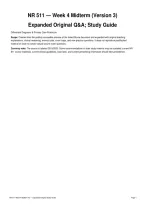
NR 511 — Week 4 Midterm (Version 3)
Expanded Original Q&A; Study Guide
Differential Diagnosis & Primary Care Practicum
Scope: Created from the publicly accessible preview of the linked Stuvia document and expanded with original teaching
explanations, clinical reasoning, memory aids, exam traps, and new practice questions. It does not reproduce paid/locked
material or claim to contain actual secure exam questions.
Currency note: The source is labeled 2019/2020. Some recommendations in older study material may be outdated; current NR
511 course materials, current clinical guidelines, local laws, and current prescribing information should take precedence.
NR 511 Week 4 Midterm V3 — Expanded Original Study Guide Page 1
, 1. Malpractice & Diagnostic Error
Q: What is a major cause of outpatient malpractice claims?
Diagnostic error—especially failure to diagnose or delayed/missed diagnosis—is a central risk. Good practice includes a complete
history, focused examination, appropriate differential, follow-up of abnormal results, and clear return precautions.
Exam trap
Do not reduce malpractice risk to prescribing errors alone. Communication, follow-up, documentation, and diagnostic reasoning
all matter.
2. Diabetes Foot Assessment
Q: How should diabetic foot risk be assessed?
Foot assessment should be performed regularly and individualized to risk. It includes skin inspection, deformity, pulses, footwear,
and neurologic testing such as protective sensation.
Q: Why is foot inspection important?
Neuropathy and peripheral arterial disease can reduce pain awareness and healing, allowing small injuries to progress to ulcers
or infection.
Exam update
Older questions may give a rigid interval such as 'every visit.' In practice, frequency depends on risk and current diabetes
guidance.
3. Alzheimer Disease
Q: Which medication class is commonly used for symptomatic treatment of mild-to-moderate
Alzheimer disease?
Cholinesterase inhibitors such as donepezil, rivastigmine, or galantamine may provide symptomatic cognitive benefit. Memantine
is generally used for moderate-to-severe disease and may be combined with a cholinesterase inhibitor.
Exam trap
These agents do not cure or reverse Alzheimer pathology; benefits are symptomatic and vary by patient.
4. Trichomoniasis
Q: What is first-line therapy for trichomoniasis?
A nitroimidazole such as metronidazole or tinidazole is used. Current recommendations favor appropriate systemic therapy and
treatment of sexual partners to reduce reinfection.
Exam trap
Do not confuse trichomoniasis with gonorrhea/chlamydia therapy; antibiotic selection depends on the pathogen.
5. Poisoning & Toxicology
Q: How should poisoning be approached initially?
Prioritize airway, breathing, circulation, mental status, glucose when indicated, exposure history, timing, dose, formulation, and
co-ingestants. Contact a poison center or emergency toxicology resource when appropriate.
Safety pearl
Do not induce vomiting routinely. Management depends on the specific toxin and clinical status.
6. Breast Mass Evaluation
NR 511 Week 4 Midterm V3 — Expanded Original Study Guide Page 2
Expanded Original Q&A; Study Guide
Differential Diagnosis & Primary Care Practicum
Scope: Created from the publicly accessible preview of the linked Stuvia document and expanded with original teaching
explanations, clinical reasoning, memory aids, exam traps, and new practice questions. It does not reproduce paid/locked
material or claim to contain actual secure exam questions.
Currency note: The source is labeled 2019/2020. Some recommendations in older study material may be outdated; current NR
511 course materials, current clinical guidelines, local laws, and current prescribing information should take precedence.
NR 511 Week 4 Midterm V3 — Expanded Original Study Guide Page 1
, 1. Malpractice & Diagnostic Error
Q: What is a major cause of outpatient malpractice claims?
Diagnostic error—especially failure to diagnose or delayed/missed diagnosis—is a central risk. Good practice includes a complete
history, focused examination, appropriate differential, follow-up of abnormal results, and clear return precautions.
Exam trap
Do not reduce malpractice risk to prescribing errors alone. Communication, follow-up, documentation, and diagnostic reasoning
all matter.
2. Diabetes Foot Assessment
Q: How should diabetic foot risk be assessed?
Foot assessment should be performed regularly and individualized to risk. It includes skin inspection, deformity, pulses, footwear,
and neurologic testing such as protective sensation.
Q: Why is foot inspection important?
Neuropathy and peripheral arterial disease can reduce pain awareness and healing, allowing small injuries to progress to ulcers
or infection.
Exam update
Older questions may give a rigid interval such as 'every visit.' In practice, frequency depends on risk and current diabetes
guidance.
3. Alzheimer Disease
Q: Which medication class is commonly used for symptomatic treatment of mild-to-moderate
Alzheimer disease?
Cholinesterase inhibitors such as donepezil, rivastigmine, or galantamine may provide symptomatic cognitive benefit. Memantine
is generally used for moderate-to-severe disease and may be combined with a cholinesterase inhibitor.
Exam trap
These agents do not cure or reverse Alzheimer pathology; benefits are symptomatic and vary by patient.
4. Trichomoniasis
Q: What is first-line therapy for trichomoniasis?
A nitroimidazole such as metronidazole or tinidazole is used. Current recommendations favor appropriate systemic therapy and
treatment of sexual partners to reduce reinfection.
Exam trap
Do not confuse trichomoniasis with gonorrhea/chlamydia therapy; antibiotic selection depends on the pathogen.
5. Poisoning & Toxicology
Q: How should poisoning be approached initially?
Prioritize airway, breathing, circulation, mental status, glucose when indicated, exposure history, timing, dose, formulation, and
co-ingestants. Contact a poison center or emergency toxicology resource when appropriate.
Safety pearl
Do not induce vomiting routinely. Management depends on the specific toxin and clinical status.
6. Breast Mass Evaluation
NR 511 Week 4 Midterm V3 — Expanded Original Study Guide Page 2


