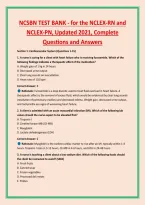
NCSBN TEST BANK - for the NCLEX-RN and
NCLEX-PN, Updated 2021, Complete
Questions and Answers
Section 1: Cardiovascular System (Questions 1-15)
1. A nurse is caring for a client with heart failure who is receiving furosemide. Which of the
following findings indicates a therapeutic effect of the medication?
A. Weight gain of 1 kg in 24 hours
B. Decreased urine output
C. Clear lung sounds on auscultation
D. Heart rate of 110 bpm
Correct Answer: C
Rationale: Furosemide is a loop diuretic used to treat fluid overload in heart failure. A
therapeutic effect is the removal of excess fluid, which would be evidenced by clear lung sounds
(resolution of pulmonary crackles) and decreased edema. Weight gain, decreased urine output,
and tachycardia are signs of worsening heart failure.
2. A client is admitted with an acute myocardial infarction (MI). Which of the following lab
values should the nurse expect to be elevated first?
A. Troponin I
B. Creatine kinase-MB (CK-MB)
C. Myoglobin
D. Lactate dehydrogenase (LDH)
Correct Answer: C
Rationale: Myoglobin is the earliest cardiac marker to rise after an MI, typically within 1-4
hours. Troponin I rises in 3-12 hours, CK-MB in 4-6 hours, and LDH in 24-48 hours.
3. A nurse is teaching a client about a low-sodium diet. Which of the following foods should
the client be instructed to avoid? (SATA)
A. Fresh fruits
B. Canned soup
C. Frozen vegetables
D. Processed deli meats
E. Pickles
,Correct Answers: B, D, E
Rationale: Canned soups, processed deli meats, and pickles are all high in sodium due to
preservation and processing. Fresh fruits and frozen vegetables (without added sauces) are
generally low in sodium.
4. A client with atrial fibrillation is prescribed warfarin. Which of the following statements by
the client indicates a need for further teaching?
A. "I will use a soft toothbrush."
B. "I will increase my intake of leafy green vegetables."
C. "I will wear a medical alert bracelet."
D. "I will have my blood drawn regularly to check my INR."
Correct Answer: B
Rationale: Leafy green vegetables are high in Vitamin K, which is the antidote to warfarin
and can decrease its effectiveness. The client should maintain a consistent intake of Vitamin K,
not increase it. The other statements are correct.
5. A nurse is assessing a client with peripheral artery disease (PAD). Which of the following
findings is expected?
A. Bounding pulses
B. Warm, reddened extremities
C. Dependent rubor
D. Pitting edema
Correct Answer: C
Rationale: Dependent rubor (a reddish-blue discoloration of the extremity when it is in a
dependent position) is a classic sign of PAD due to poor arterial circulation. PAD also causes
decreased pulses, cool extremities, and pallor on elevation. Edema and warm, reddened
extremities are signs of venous insufficiency.
6. A client is experiencing anaphylactic shock. What is the priority nursing action?
A. Administer diphenhydramine.
B. Establish an IV line.
C. Administer epinephrine.
D. Obtain a set of vital signs.
Correct Answer: C
Rationale: Epinephrine is the first-line medication for anaphylaxis. It reverses
bronchoconstriction and vasodilation. It should be administered immediately. Other actions like
establishing an IV and giving antihistamines are important but secondary to epinephrine.
,7. A nurse is reviewing the ECG strip of a client and notes a prolonged PR interval. This finding
is characteristic of which of the following?
A. First-degree heart block
B. Second-degree heart block, Type I
C. Second-degree heart block, Type II
D. Third-degree heart block
Correct Answer: A
Rationale: A prolonged PR interval (>0.20 seconds) that is consistent across all beats is the
defining characteristic of a first-degree heart block.
8. Which of the following are risk factors for developing hypertension? (SATA)
A. High dietary potassium intake
B. African American descent
C. Obesity
D. Sedentary lifestyle
E. Family history
Correct Answers: B, C, D, E
Rationale: Risk factors for hypertension include African American descent, obesity, a
sedentary lifestyle, family history, high sodium intake, and tobacco use. High potassium intake
can help lower blood pressure.
9. A client is scheduled for a cardiac catheterization. Which of the following pre-procedure
instructions is most important for the nurse to provide?
A. "You will need to be NPO for 8 hours before the procedure."
B. "You can take your metformin as usual."
C. "You will need to shave the insertion site."
D. "You will be able to drive yourself home."
Correct Answer: A
Rationale: The client must be NPO (nothing by mouth) for several hours before a cardiac
catheterization to prevent aspiration in case of an emergency. Metformin is often held due to
the risk of lactic acidosis with contrast dye. The client will be sedated and cannot drive
themselves home.
10. A nurse is caring for a client with a chest tube following a pneumothorax. The nurse
observes continuous bubbling in the water-seal chamber. This indicates:
A. A normal finding.
B. An air leak in the system.
, C. The lung has re-expanded.
D. The suction is set too high.
Correct Answer: B
Rationale: Continuous bubbling in the water-seal chamber indicates an air leak in the chest
tube system. Intermittent bubbling may be normal with coughing. The nurse should check all
connections and the insertion site.
11. A client with heart failure is prescribed digoxin. The nurse should withhold the medication
and notify the provider if the client's apical pulse is below:
A. 100 bpm
B. 90 bpm
C. 80 bpm
D. 60 bpm
Correct Answer: D
Rationale: Digoxin slows the heart rate. It should be withheld if the apical pulse is below 60
bpm in an adult, as this could indicate digoxin toxicity.
12. Which of the following assessments is a priority for a client immediately following a
percutaneous coronary intervention (PCI)?
A. Assessing the client's pain level.
B. Monitoring the insertion site for bleeding.
C. Checking the client's blood glucose.
D. Ambulating the client in the hallway.
Correct Answer: B
Rationale: The most immediate and life-threatening complication following a PCI is bleeding
or hematoma formation at the arterial insertion site. Therefore, monitoring the site is the
priority. Ambulation is not done immediately.
13. A nurse is teaching a client about lifestyle modifications to reduce blood pressure. Which
of the following should be included? (SATA)
A. Limit alcohol consumption.
B. Increase physical activity.
C. Maintain a high-sodium diet.
D. Stop smoking.
E. Manage stress.
Correct Answers: A, B, D, E
Rationale: Lifestyle modifications for hypertension include limiting alcohol, increasing
NCLEX-PN, Updated 2021, Complete
Questions and Answers
Section 1: Cardiovascular System (Questions 1-15)
1. A nurse is caring for a client with heart failure who is receiving furosemide. Which of the
following findings indicates a therapeutic effect of the medication?
A. Weight gain of 1 kg in 24 hours
B. Decreased urine output
C. Clear lung sounds on auscultation
D. Heart rate of 110 bpm
Correct Answer: C
Rationale: Furosemide is a loop diuretic used to treat fluid overload in heart failure. A
therapeutic effect is the removal of excess fluid, which would be evidenced by clear lung sounds
(resolution of pulmonary crackles) and decreased edema. Weight gain, decreased urine output,
and tachycardia are signs of worsening heart failure.
2. A client is admitted with an acute myocardial infarction (MI). Which of the following lab
values should the nurse expect to be elevated first?
A. Troponin I
B. Creatine kinase-MB (CK-MB)
C. Myoglobin
D. Lactate dehydrogenase (LDH)
Correct Answer: C
Rationale: Myoglobin is the earliest cardiac marker to rise after an MI, typically within 1-4
hours. Troponin I rises in 3-12 hours, CK-MB in 4-6 hours, and LDH in 24-48 hours.
3. A nurse is teaching a client about a low-sodium diet. Which of the following foods should
the client be instructed to avoid? (SATA)
A. Fresh fruits
B. Canned soup
C. Frozen vegetables
D. Processed deli meats
E. Pickles
,Correct Answers: B, D, E
Rationale: Canned soups, processed deli meats, and pickles are all high in sodium due to
preservation and processing. Fresh fruits and frozen vegetables (without added sauces) are
generally low in sodium.
4. A client with atrial fibrillation is prescribed warfarin. Which of the following statements by
the client indicates a need for further teaching?
A. "I will use a soft toothbrush."
B. "I will increase my intake of leafy green vegetables."
C. "I will wear a medical alert bracelet."
D. "I will have my blood drawn regularly to check my INR."
Correct Answer: B
Rationale: Leafy green vegetables are high in Vitamin K, which is the antidote to warfarin
and can decrease its effectiveness. The client should maintain a consistent intake of Vitamin K,
not increase it. The other statements are correct.
5. A nurse is assessing a client with peripheral artery disease (PAD). Which of the following
findings is expected?
A. Bounding pulses
B. Warm, reddened extremities
C. Dependent rubor
D. Pitting edema
Correct Answer: C
Rationale: Dependent rubor (a reddish-blue discoloration of the extremity when it is in a
dependent position) is a classic sign of PAD due to poor arterial circulation. PAD also causes
decreased pulses, cool extremities, and pallor on elevation. Edema and warm, reddened
extremities are signs of venous insufficiency.
6. A client is experiencing anaphylactic shock. What is the priority nursing action?
A. Administer diphenhydramine.
B. Establish an IV line.
C. Administer epinephrine.
D. Obtain a set of vital signs.
Correct Answer: C
Rationale: Epinephrine is the first-line medication for anaphylaxis. It reverses
bronchoconstriction and vasodilation. It should be administered immediately. Other actions like
establishing an IV and giving antihistamines are important but secondary to epinephrine.
,7. A nurse is reviewing the ECG strip of a client and notes a prolonged PR interval. This finding
is characteristic of which of the following?
A. First-degree heart block
B. Second-degree heart block, Type I
C. Second-degree heart block, Type II
D. Third-degree heart block
Correct Answer: A
Rationale: A prolonged PR interval (>0.20 seconds) that is consistent across all beats is the
defining characteristic of a first-degree heart block.
8. Which of the following are risk factors for developing hypertension? (SATA)
A. High dietary potassium intake
B. African American descent
C. Obesity
D. Sedentary lifestyle
E. Family history
Correct Answers: B, C, D, E
Rationale: Risk factors for hypertension include African American descent, obesity, a
sedentary lifestyle, family history, high sodium intake, and tobacco use. High potassium intake
can help lower blood pressure.
9. A client is scheduled for a cardiac catheterization. Which of the following pre-procedure
instructions is most important for the nurse to provide?
A. "You will need to be NPO for 8 hours before the procedure."
B. "You can take your metformin as usual."
C. "You will need to shave the insertion site."
D. "You will be able to drive yourself home."
Correct Answer: A
Rationale: The client must be NPO (nothing by mouth) for several hours before a cardiac
catheterization to prevent aspiration in case of an emergency. Metformin is often held due to
the risk of lactic acidosis with contrast dye. The client will be sedated and cannot drive
themselves home.
10. A nurse is caring for a client with a chest tube following a pneumothorax. The nurse
observes continuous bubbling in the water-seal chamber. This indicates:
A. A normal finding.
B. An air leak in the system.
, C. The lung has re-expanded.
D. The suction is set too high.
Correct Answer: B
Rationale: Continuous bubbling in the water-seal chamber indicates an air leak in the chest
tube system. Intermittent bubbling may be normal with coughing. The nurse should check all
connections and the insertion site.
11. A client with heart failure is prescribed digoxin. The nurse should withhold the medication
and notify the provider if the client's apical pulse is below:
A. 100 bpm
B. 90 bpm
C. 80 bpm
D. 60 bpm
Correct Answer: D
Rationale: Digoxin slows the heart rate. It should be withheld if the apical pulse is below 60
bpm in an adult, as this could indicate digoxin toxicity.
12. Which of the following assessments is a priority for a client immediately following a
percutaneous coronary intervention (PCI)?
A. Assessing the client's pain level.
B. Monitoring the insertion site for bleeding.
C. Checking the client's blood glucose.
D. Ambulating the client in the hallway.
Correct Answer: B
Rationale: The most immediate and life-threatening complication following a PCI is bleeding
or hematoma formation at the arterial insertion site. Therefore, monitoring the site is the
priority. Ambulation is not done immediately.
13. A nurse is teaching a client about lifestyle modifications to reduce blood pressure. Which
of the following should be included? (SATA)
A. Limit alcohol consumption.
B. Increase physical activity.
C. Maintain a high-sodium diet.
D. Stop smoking.
E. Manage stress.
Correct Answers: A, B, D, E
Rationale: Lifestyle modifications for hypertension include limiting alcohol, increasing