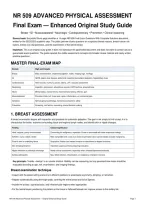
NR 509 ADVANCED PHYSICAL ASSESSMENT
Final Exam — Enhanced Original Study Guide
Breast • GI • Musculoskeletal • Neurologic • Cardiopulmonary • Prevention • Clinical reasoning
Source basis: the public Stuvia page identifies a 14-page NR 509 Final Exam Questions With Complete Solutions document,
written for the 2022/2023 academic year. The public preview shows questions on suspicious breast masses, breast-cancer risk
factors, breast cyst characteristics, and the examination of the lateral breast.
Important: This is an original study guide. It does not reproduce the paid/locked document and does not claim to contain actual or
guaranteed exam questions. The guide expands the visible assessment concepts into broader review material and newly written
practice questions.
MASTER FINAL-EXAM MAP
Domain High-yield targets
Breast Mass characteristics, inspection/palpation, nodes, imaging logic, red flags
GI GERD, peptic ulcer disease, abdominal inspection/auscultation/palpation, hepatobiliary clues
Cardiovascular Heart sounds, murmurs, pulses, edema, JVP, vascular assessment
Respiratory Inspection, percussion, adventitious sounds, COPD/asthma, pneumothorax
Neuro Mental status, cranial nerves, motor/sensory testing, reflexes, gait
Musculoskeletal Shoulder/rotator cuff, knee tests, spine, inflammatory vs mechanical pain
Geriatrics Normal aging vs pathology, functional assessment, safety
Prevention Screening, risk factors, counseling, shared decision-making
1. BREAST ASSESSMENT
A breast examination begins with inspection and proceeds to systematic palpation. The goal is not simply to find a lump; it is to
characterize the lesion, examine surrounding tissue and regional lymph nodes, and identify skin or nipple changes.
Finding Clinical significance
Hard, irregular, poorly circumscribed Concerning for malignancy, especially if fixed or associated with other suspicious findings.
Soft/firm, round, mobile, tender More compatible with a cyst, but clinical examination alone cannot reliably exclude malignancy.
Fixed to skin or underlying tissue Suspicious; fixation can indicate invasion or attachment to deeper structures.
Skin dimpling/retraction Important suspicious finding requiring evaluation.
Nipple retraction or pathologic discharge Needs clinical assessment, especially when unilateral/spontaneous/bloody.
Axillary adenopathy May reflect infection, inflammation, or malignancy; interpret in context.
Key principle: “mobile = benign” is an unsafe shortcut. Mobility can be reassuring, but any persistent/new mass should be
evaluated according to age, risk, examination, and imaging findings.
Breast examination technique
• Inspect with the patient sitting and arms in different positions to accentuate asymmetry, dimpling, or retraction.
• Palpate systematically using the finger pads, covering the entire breast and tail of Spence.
• Include the axillary, supraclavicular, and infraclavicular regions when appropriate.
• For the lateral breast, positioning the patient so the tissue is flattened/relaxed can improve access to the axillary tail.
NR 509 Advanced Physical Assessment — Original Enhanced Study Guide Page 1
, • Document quadrant/location, size, shape, consistency, mobility, tenderness, skin changes, nipple findings, and nodes.
A suspicious breast mass is evaluated with appropriate diagnostic imaging rather than relying on palpation alone. Imaging choice
depends on age, symptoms, pregnancy/lactation status, and clinical context.
2. BREAST CANCER RISK
Risk factor Why it matters
Increasing age Risk rises with age, making age a major epidemiologic factor.
Family history Can increase risk, especially with strong/early patterns.
Inherited pathogenic variants BRCA1/2 and other genes can substantially alter risk.
Personal breast cancer history Raises risk of additional breast malignancy.
Longer lifetime estrogen exposure Earlier menarche and later menopause can increase cumulative exposure.
High breast density Associated with increased risk and can reduce mammographic sensitivity.
Postmenopausal obesity Associated with increased breast cancer risk in many populations.
Alcohol use Dose-related association with breast cancer risk.
Risk-factor questions often test recognition rather than a single cause. Separate nonmodifiable factors such as age/genetics
from modifiable factors such as alcohol intake, physical inactivity, and weight after menopause.
3. GERD & UPPER GI
GERD commonly causes retrosternal burning or regurgitation. Symptoms may worsen after meals, when bending over, or when lying
down. Some patients have extraesophageal symptoms, but these are less specific.
Concept Exam anchor
GERD Reflux of gastric contents into the esophagus causing symptoms/complications.
Peptic ulcer disease Common major causes include H. pylori infection and NSAID exposure.
Gastric vs duodenal ulcer Pain patterns can differ, but symptom timing alone is not diagnostic.
Alarm features Dysphagia, bleeding, anemia, weight loss, persistent vomiting, or other concerning features change evaluation urgency.
H. pylori Associated with peptic ulcer disease and gastric malignancy risk.
4. ABDOMINAL EXAMINATION
The standard sequence is inspection → auscultation → percussion → palpation. Auscultation comes before percussion and
palpation because manipulation can alter bowel sounds.
• Inspection: contour, scars, distention, hernias, visible peristalsis or pulsations.
• Auscultation: bowel sounds and vascular bruits when indicated.
• Percussion: tympany/dullness and estimation of organ borders or fluid when appropriate.
• Palpation: begin gently and away from the most painful area; assess tenderness, guarding, rigidity, masses, and organomegaly.
• Rebound tenderness is a sign of peritoneal irritation, but deliberate repeated elicitation may be unnecessary when the clinical picture
is already concerning.
NR 509 Advanced Physical Assessment — Original Enhanced Study Guide Page 2
Final Exam — Enhanced Original Study Guide
Breast • GI • Musculoskeletal • Neurologic • Cardiopulmonary • Prevention • Clinical reasoning
Source basis: the public Stuvia page identifies a 14-page NR 509 Final Exam Questions With Complete Solutions document,
written for the 2022/2023 academic year. The public preview shows questions on suspicious breast masses, breast-cancer risk
factors, breast cyst characteristics, and the examination of the lateral breast.
Important: This is an original study guide. It does not reproduce the paid/locked document and does not claim to contain actual or
guaranteed exam questions. The guide expands the visible assessment concepts into broader review material and newly written
practice questions.
MASTER FINAL-EXAM MAP
Domain High-yield targets
Breast Mass characteristics, inspection/palpation, nodes, imaging logic, red flags
GI GERD, peptic ulcer disease, abdominal inspection/auscultation/palpation, hepatobiliary clues
Cardiovascular Heart sounds, murmurs, pulses, edema, JVP, vascular assessment
Respiratory Inspection, percussion, adventitious sounds, COPD/asthma, pneumothorax
Neuro Mental status, cranial nerves, motor/sensory testing, reflexes, gait
Musculoskeletal Shoulder/rotator cuff, knee tests, spine, inflammatory vs mechanical pain
Geriatrics Normal aging vs pathology, functional assessment, safety
Prevention Screening, risk factors, counseling, shared decision-making
1. BREAST ASSESSMENT
A breast examination begins with inspection and proceeds to systematic palpation. The goal is not simply to find a lump; it is to
characterize the lesion, examine surrounding tissue and regional lymph nodes, and identify skin or nipple changes.
Finding Clinical significance
Hard, irregular, poorly circumscribed Concerning for malignancy, especially if fixed or associated with other suspicious findings.
Soft/firm, round, mobile, tender More compatible with a cyst, but clinical examination alone cannot reliably exclude malignancy.
Fixed to skin or underlying tissue Suspicious; fixation can indicate invasion or attachment to deeper structures.
Skin dimpling/retraction Important suspicious finding requiring evaluation.
Nipple retraction or pathologic discharge Needs clinical assessment, especially when unilateral/spontaneous/bloody.
Axillary adenopathy May reflect infection, inflammation, or malignancy; interpret in context.
Key principle: “mobile = benign” is an unsafe shortcut. Mobility can be reassuring, but any persistent/new mass should be
evaluated according to age, risk, examination, and imaging findings.
Breast examination technique
• Inspect with the patient sitting and arms in different positions to accentuate asymmetry, dimpling, or retraction.
• Palpate systematically using the finger pads, covering the entire breast and tail of Spence.
• Include the axillary, supraclavicular, and infraclavicular regions when appropriate.
• For the lateral breast, positioning the patient so the tissue is flattened/relaxed can improve access to the axillary tail.
NR 509 Advanced Physical Assessment — Original Enhanced Study Guide Page 1
, • Document quadrant/location, size, shape, consistency, mobility, tenderness, skin changes, nipple findings, and nodes.
A suspicious breast mass is evaluated with appropriate diagnostic imaging rather than relying on palpation alone. Imaging choice
depends on age, symptoms, pregnancy/lactation status, and clinical context.
2. BREAST CANCER RISK
Risk factor Why it matters
Increasing age Risk rises with age, making age a major epidemiologic factor.
Family history Can increase risk, especially with strong/early patterns.
Inherited pathogenic variants BRCA1/2 and other genes can substantially alter risk.
Personal breast cancer history Raises risk of additional breast malignancy.
Longer lifetime estrogen exposure Earlier menarche and later menopause can increase cumulative exposure.
High breast density Associated with increased risk and can reduce mammographic sensitivity.
Postmenopausal obesity Associated with increased breast cancer risk in many populations.
Alcohol use Dose-related association with breast cancer risk.
Risk-factor questions often test recognition rather than a single cause. Separate nonmodifiable factors such as age/genetics
from modifiable factors such as alcohol intake, physical inactivity, and weight after menopause.
3. GERD & UPPER GI
GERD commonly causes retrosternal burning or regurgitation. Symptoms may worsen after meals, when bending over, or when lying
down. Some patients have extraesophageal symptoms, but these are less specific.
Concept Exam anchor
GERD Reflux of gastric contents into the esophagus causing symptoms/complications.
Peptic ulcer disease Common major causes include H. pylori infection and NSAID exposure.
Gastric vs duodenal ulcer Pain patterns can differ, but symptom timing alone is not diagnostic.
Alarm features Dysphagia, bleeding, anemia, weight loss, persistent vomiting, or other concerning features change evaluation urgency.
H. pylori Associated with peptic ulcer disease and gastric malignancy risk.
4. ABDOMINAL EXAMINATION
The standard sequence is inspection → auscultation → percussion → palpation. Auscultation comes before percussion and
palpation because manipulation can alter bowel sounds.
• Inspection: contour, scars, distention, hernias, visible peristalsis or pulsations.
• Auscultation: bowel sounds and vascular bruits when indicated.
• Percussion: tympany/dullness and estimation of organ borders or fluid when appropriate.
• Palpation: begin gently and away from the most painful area; assess tenderness, guarding, rigidity, masses, and organomegaly.
• Rebound tenderness is a sign of peritoneal irritation, but deliberate repeated elicitation may be unnecessary when the clinical picture
is already concerning.
NR 509 Advanced Physical Assessment — Original Enhanced Study Guide Page 2