
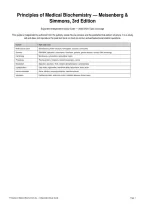
Principles of Medical Biochemistry — Meisenberg &
Simmons, 3rd Edition
Expanded Independent Study Guide — 2023/2024 Topic Coverage
This guide is independently authored from the publicly visible Stuvia preview and the published 3rd-edition structure. It is a study
aid and does not reproduce the paid test bank or claim to contain actual/leaked examination questions.
Domain High-yield areas
Molecular structure Biomolecules, protein structure, hemoglobin, enzymes, coenzymes
Genetics DNA/RNA, replication, transcription, translation, genome, genetic disease, viruses, DNA technology
Cell biology Membranes, cytoskeleton, extracellular matrix
Physiology Plasma proteins, receptors, second messengers, cancer
Metabolism Digestion, glycolysis, TCA, oxidative phosphorylation, carbohydrates
Lipids/proteins Fatty acids, triglycerides, membrane lipids, lipoproteins, amino acids
Heme/nucleotides Heme, bilirubin, purines/pyrimidines, vitamins/minerals
Integration Fed/fasting states, endocrine control, metabolic disease, clinical cases
Principles of Medical Biochemistry 3e — Independent Study Guide Page 1
, Part I — Molecular Structure & Function
Q1. What is a pKa?
Answer: The pH at which an ionizable group is 50% protonated and 50% deprotonated.
Rationale / exam cue: The Henderson-Hasselbalch relationship links pH, pKa, and the ratio of protonated to deprotonated forms.
Q2. Why does water dissolve many biological molecules?
Answer: Water is polar and can form hydrogen bonds and electrostatic interactions with charged or polar groups.
Rationale / exam cue: Hydrophobic substances behave differently because they interact poorly with water.
Q3. What is an epimer?
Answer: A stereoisomer that differs in configuration at one, but not all, chiral centers.
Rationale / exam cue: Glucose and galactose are C-4 epimers.
Q4. What is an anomer?
Answer: A cyclic sugar stereoisomer differing at its anomeric carbon.
Rationale / exam cue: Alpha and beta forms interconvert through the open-chain form in solution.
Q5. What is a peptide bond?
Answer: A covalent amide bond linking amino acids.
Rationale / exam cue: Peptide bonds have partial double-bond character and are relatively planar.
Q6. What stabilizes protein tertiary structure?
Answer: Hydrophobic interactions, hydrogen bonds, ionic interactions, van der Waals forces, and sometimes disulfide bonds.
Rationale / exam cue: The folded structure reflects many cooperative noncovalent interactions.
Q7. What is the isoelectric point?
Answer: The pH at which a molecule has zero net electrical charge.
Rationale / exam cue: Solubility and electrophoretic behavior often change near the isoelectric point.
Q8. Why are hydrophobic amino acids often buried in globular proteins?
Answer: Their nonpolar side chains are energetically favored away from the aqueous environment.
Rationale / exam cue: The hydrophobic effect is a major driver of protein folding.
Q9. What is denaturation?
Answer: Loss of higher-order protein structure without necessarily breaking the peptide backbone.
Rationale / exam cue: Denaturation commonly destroys biological activity.
Q10. What distinguishes hemoglobin from myoglobin?
Answer: Hemoglobin is a multimeric oxygen-transport protein in blood; myoglobin is a monomeric oxygen-binding protein in muscle.
Rationale / exam cue: Their different structures produce different oxygen-binding behavior.
Q11. What causes cooperative oxygen binding in hemoglobin?
Answer: Binding at one subunit influences the affinity of other subunits for oxygen.
Rationale / exam cue: This produces a sigmoidal oxygen-dissociation curve.
Q12. What is the Bohr effect?
Answer: Lower pH and increased CO2 decrease hemoglobin's oxygen affinity, promoting oxygen release in tissues.
Rationale / exam cue: It links metabolism with oxygen delivery.
Q13. What is an enzyme's active site?
Answer: The region where substrate binding and catalytic chemistry occur.
Rationale / exam cue: Specific interactions position substrates for reaction.
Q14. What is Km in Michaelis-Menten kinetics?
Answer: The substrate concentration at which velocity is half of Vmax under the model's assumptions.
Rationale / exam cue: Km is not universally identical to a dissociation constant.
Q15. What does a competitive inhibitor do?
Answer: It competes with substrate for the active site and can often be overcome by increasing substrate concentration.
Rationale / exam cue: In the classic model, apparent Km rises while Vmax is unchanged.
Q16. What is an allosteric enzyme?
Answer: An enzyme whose activity is regulated by binding at a site distinct from the catalytic site.
Principles of Medical Biochemistry 3e — Independent Study Guide Page 2
Simmons, 3rd Edition
Expanded Independent Study Guide — 2023/2024 Topic Coverage
This guide is independently authored from the publicly visible Stuvia preview and the published 3rd-edition structure. It is a study
aid and does not reproduce the paid test bank or claim to contain actual/leaked examination questions.
Domain High-yield areas
Molecular structure Biomolecules, protein structure, hemoglobin, enzymes, coenzymes
Genetics DNA/RNA, replication, transcription, translation, genome, genetic disease, viruses, DNA technology
Cell biology Membranes, cytoskeleton, extracellular matrix
Physiology Plasma proteins, receptors, second messengers, cancer
Metabolism Digestion, glycolysis, TCA, oxidative phosphorylation, carbohydrates
Lipids/proteins Fatty acids, triglycerides, membrane lipids, lipoproteins, amino acids
Heme/nucleotides Heme, bilirubin, purines/pyrimidines, vitamins/minerals
Integration Fed/fasting states, endocrine control, metabolic disease, clinical cases
Principles of Medical Biochemistry 3e — Independent Study Guide Page 1
, Part I — Molecular Structure & Function
Q1. What is a pKa?
Answer: The pH at which an ionizable group is 50% protonated and 50% deprotonated.
Rationale / exam cue: The Henderson-Hasselbalch relationship links pH, pKa, and the ratio of protonated to deprotonated forms.
Q2. Why does water dissolve many biological molecules?
Answer: Water is polar and can form hydrogen bonds and electrostatic interactions with charged or polar groups.
Rationale / exam cue: Hydrophobic substances behave differently because they interact poorly with water.
Q3. What is an epimer?
Answer: A stereoisomer that differs in configuration at one, but not all, chiral centers.
Rationale / exam cue: Glucose and galactose are C-4 epimers.
Q4. What is an anomer?
Answer: A cyclic sugar stereoisomer differing at its anomeric carbon.
Rationale / exam cue: Alpha and beta forms interconvert through the open-chain form in solution.
Q5. What is a peptide bond?
Answer: A covalent amide bond linking amino acids.
Rationale / exam cue: Peptide bonds have partial double-bond character and are relatively planar.
Q6. What stabilizes protein tertiary structure?
Answer: Hydrophobic interactions, hydrogen bonds, ionic interactions, van der Waals forces, and sometimes disulfide bonds.
Rationale / exam cue: The folded structure reflects many cooperative noncovalent interactions.
Q7. What is the isoelectric point?
Answer: The pH at which a molecule has zero net electrical charge.
Rationale / exam cue: Solubility and electrophoretic behavior often change near the isoelectric point.
Q8. Why are hydrophobic amino acids often buried in globular proteins?
Answer: Their nonpolar side chains are energetically favored away from the aqueous environment.
Rationale / exam cue: The hydrophobic effect is a major driver of protein folding.
Q9. What is denaturation?
Answer: Loss of higher-order protein structure without necessarily breaking the peptide backbone.
Rationale / exam cue: Denaturation commonly destroys biological activity.
Q10. What distinguishes hemoglobin from myoglobin?
Answer: Hemoglobin is a multimeric oxygen-transport protein in blood; myoglobin is a monomeric oxygen-binding protein in muscle.
Rationale / exam cue: Their different structures produce different oxygen-binding behavior.
Q11. What causes cooperative oxygen binding in hemoglobin?
Answer: Binding at one subunit influences the affinity of other subunits for oxygen.
Rationale / exam cue: This produces a sigmoidal oxygen-dissociation curve.
Q12. What is the Bohr effect?
Answer: Lower pH and increased CO2 decrease hemoglobin's oxygen affinity, promoting oxygen release in tissues.
Rationale / exam cue: It links metabolism with oxygen delivery.
Q13. What is an enzyme's active site?
Answer: The region where substrate binding and catalytic chemistry occur.
Rationale / exam cue: Specific interactions position substrates for reaction.
Q14. What is Km in Michaelis-Menten kinetics?
Answer: The substrate concentration at which velocity is half of Vmax under the model's assumptions.
Rationale / exam cue: Km is not universally identical to a dissociation constant.
Q15. What does a competitive inhibitor do?
Answer: It competes with substrate for the active site and can often be overcome by increasing substrate concentration.
Rationale / exam cue: In the classic model, apparent Km rises while Vmax is unchanged.
Q16. What is an allosteric enzyme?
Answer: An enzyme whose activity is regulated by binding at a site distinct from the catalytic site.
Principles of Medical Biochemistry 3e — Independent Study Guide Page 2


