
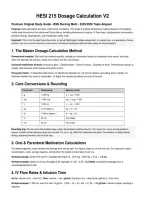
HESI 215 Dosage Calculation V2
Premium Original Study Guide • BSN Nursing Math • 2025/2026 Topic-Aligned
Purpose: Build calculation accuracy under exam conditions. This guide is original educational material based on the publicly
visible topic structure of the referenced Stuvia listing, including dimensional analysis, IV flow rates, oral/parenteral conversions,
pediatric dosing, reconstitution, and medication-safety math.
Important: This is not the paid Stuvia document, an actual Nightingale College assessment, an answer key, or a guarantee of exam
content. Use your course instructions and current institutional medication-administration policy for clinical practice.
1. The Master Dosage-Calculation Method
Dimensional analysis: Start with the ordered quantity, multiply by conversion factors so unwanted units cancel, and stop
when the desired unit remains. Keep units visible until the final answer.
Universal medication formula: Amount to give = (Desired dose ÷ Dose on hand) × Quantity on hand. Dimensional analysis is
usually safer because units expose conversion errors.
Five-point check: (1) Read the order twice. (2) Identify the desired unit. (3) Convert before calculating when needed. (4)
Estimate whether the result is reasonable. (5) Apply the required rounding rule only at the end.
2. Core Conversions & Rounding
Conversion Relationship Memory anchor
1g 1,000 mg g → mg: ×1,000
1 mg 1,000 mcg mg → mcg: ×1,000
1L 1,000 mL L → mL: ×1,000
1 kg 2.2 lb (approx.) kg → lb: ×2.2
1 lb 0.454 kg (approx.) lb → kg: ÷2.2
1 hr 60 min time bridge
1 min 60 sec time bridge
Rounding trap: Do not round intermediate steps unless the problem explicitly directs it. For drops/min, many nursing problems
require a whole number because drops are counted. For mL or kg, follow the stated decimal place. For pediatric or weight-based
dosing, preserve precision until the final step.
3. Oral & Parenteral Medication Calculations
For tablets/capsules, verify whether the dosage form can be split. For liquids, keep mL as the final unit. For injections, check
concentration, route, syringe capacity, and whether the stated concentration is per mL.
Worked example: Order 375 mg PO. Available 250 mg/5 mL. (375 mg ÷ 250 mg) × 5 mL = 7.5 mL.
Worked example: Order 0.125 mg. Available 0.25 mg/tablet. 0.125 ÷ 0.25 = 0.5 tablet, provided the dosage form is
scored/appropriate to split.
4. IV Flow Rates & Infusion Time
mL/hr: volume (mL) ÷ time (hr). Time: volume ÷ rate. gtt/min: [volume (mL) × drop factor (gtt/mL)] ÷ time (min).
Worked example: 1,000 mL over 8 hr with 15 gtt/mL: 1,000 × 15 ÷ (8 × 60) = 31.25 → 31 gtt/min if whole-number rounding is
required.
, Common trap: Never use hours in the denominator of a gtt/min calculation. Convert hours to minutes first.
5. Reconstitution & Concentration
Use the final concentration/yield printed on the medication label rather than assuming the amount of diluent equals the
final volume. Some products have displacement volume. If the label says a final concentration such as 200 mg/mL, use 200
mg/mL directly.
Worked example: Order 250 mg; reconstituted concentration 200 mg/mL. 250 ÷ 200 = 1.25 mL.
6. Weight-Based & Pediatric Dosing
kg-first rule: If an order is mg/kg, the patient's weight must be in kilograms. For lb → kg, divide by 2.2 unless the problem
specifies another conversion. Then multiply kg × ordered mg/kg.
Worked example: Child weighs 44 lb; order 0.5 mg/kg. 44 ÷ 2.2 = 20 kg. 20 × 0.5 = 10 mg.
Safe-dose-range logic: If a safe range is given in mg/kg/day, calculate the daily minimum and maximum, then compare the
ordered daily dose. If doses are divided q6h, q8h, etc., determine the number of doses per day before comparing per-dose
amounts.
7. IV Medication & Weight-Based Infusions
For mcg/kg/min or similar orders, convert the infusion to the same time and mass units requested. A reliable sequence is:
mL/hr → mg/hr (using concentration) → mcg/hr → mcg/min → mcg/kg/min.
Worked example: 800 mg in 500 mL at 5 mL/hr for a 70-kg patient: 5/500 × 800 = 8 mg/hr; 8,000 mcg/hr ÷ 60 = 133.3
mcg/min; 133.3 ÷ 70 = 1.9 mcg/kg/min.
Premium Original Study Guide • BSN Nursing Math • 2025/2026 Topic-Aligned
Purpose: Build calculation accuracy under exam conditions. This guide is original educational material based on the publicly
visible topic structure of the referenced Stuvia listing, including dimensional analysis, IV flow rates, oral/parenteral conversions,
pediatric dosing, reconstitution, and medication-safety math.
Important: This is not the paid Stuvia document, an actual Nightingale College assessment, an answer key, or a guarantee of exam
content. Use your course instructions and current institutional medication-administration policy for clinical practice.
1. The Master Dosage-Calculation Method
Dimensional analysis: Start with the ordered quantity, multiply by conversion factors so unwanted units cancel, and stop
when the desired unit remains. Keep units visible until the final answer.
Universal medication formula: Amount to give = (Desired dose ÷ Dose on hand) × Quantity on hand. Dimensional analysis is
usually safer because units expose conversion errors.
Five-point check: (1) Read the order twice. (2) Identify the desired unit. (3) Convert before calculating when needed. (4)
Estimate whether the result is reasonable. (5) Apply the required rounding rule only at the end.
2. Core Conversions & Rounding
Conversion Relationship Memory anchor
1g 1,000 mg g → mg: ×1,000
1 mg 1,000 mcg mg → mcg: ×1,000
1L 1,000 mL L → mL: ×1,000
1 kg 2.2 lb (approx.) kg → lb: ×2.2
1 lb 0.454 kg (approx.) lb → kg: ÷2.2
1 hr 60 min time bridge
1 min 60 sec time bridge
Rounding trap: Do not round intermediate steps unless the problem explicitly directs it. For drops/min, many nursing problems
require a whole number because drops are counted. For mL or kg, follow the stated decimal place. For pediatric or weight-based
dosing, preserve precision until the final step.
3. Oral & Parenteral Medication Calculations
For tablets/capsules, verify whether the dosage form can be split. For liquids, keep mL as the final unit. For injections, check
concentration, route, syringe capacity, and whether the stated concentration is per mL.
Worked example: Order 375 mg PO. Available 250 mg/5 mL. (375 mg ÷ 250 mg) × 5 mL = 7.5 mL.
Worked example: Order 0.125 mg. Available 0.25 mg/tablet. 0.125 ÷ 0.25 = 0.5 tablet, provided the dosage form is
scored/appropriate to split.
4. IV Flow Rates & Infusion Time
mL/hr: volume (mL) ÷ time (hr). Time: volume ÷ rate. gtt/min: [volume (mL) × drop factor (gtt/mL)] ÷ time (min).
Worked example: 1,000 mL over 8 hr with 15 gtt/mL: 1,000 × 15 ÷ (8 × 60) = 31.25 → 31 gtt/min if whole-number rounding is
required.
, Common trap: Never use hours in the denominator of a gtt/min calculation. Convert hours to minutes first.
5. Reconstitution & Concentration
Use the final concentration/yield printed on the medication label rather than assuming the amount of diluent equals the
final volume. Some products have displacement volume. If the label says a final concentration such as 200 mg/mL, use 200
mg/mL directly.
Worked example: Order 250 mg; reconstituted concentration 200 mg/mL. 250 ÷ 200 = 1.25 mL.
6. Weight-Based & Pediatric Dosing
kg-first rule: If an order is mg/kg, the patient's weight must be in kilograms. For lb → kg, divide by 2.2 unless the problem
specifies another conversion. Then multiply kg × ordered mg/kg.
Worked example: Child weighs 44 lb; order 0.5 mg/kg. 44 ÷ 2.2 = 20 kg. 20 × 0.5 = 10 mg.
Safe-dose-range logic: If a safe range is given in mg/kg/day, calculate the daily minimum and maximum, then compare the
ordered daily dose. If doses are divided q6h, q8h, etc., determine the number of doses per day before comparing per-dose
amounts.
7. IV Medication & Weight-Based Infusions
For mcg/kg/min or similar orders, convert the infusion to the same time and mass units requested. A reliable sequence is:
mL/hr → mg/hr (using concentration) → mcg/hr → mcg/min → mcg/kg/min.
Worked example: 800 mg in 500 mL at 5 mL/hr for a 70-kg patient: 5/500 × 800 = 8 mg/hr; 8,000 mcg/hr ÷ 60 = 133.3
mcg/min; 133.3 ÷ 70 = 1.9 mcg/kg/min.


