
Social Science Economics Finance
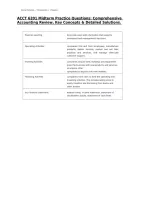
ACCT 6201 Midterm Practice Questions: Comprehensive
Accounting Review, Key Concepts & Detailed Solutions.
financial reporting to provide users with information that supports
investment and management decisions
Operating Activities companies hire and train employees, manufacture
products, deliver services, market and sell their
products and services, and manage after-sale
customer support.
Investing Activities companies acquire land, buildings and equipment,
grow the business with new products and services,
or acquire other
companies to expand into new markets.
Financing Activities companies raise cash to fund the operating and
investing activities. This includes selling stock to
equity investors and borrowing from banks and
other lenders
four financial statements balance sheet, income statement, statement of
stockholders equity, statement of cash flows
, Balance Sheet reports company's resources(assets) aka what the
company owns. reports sources of asset financing,
listed on balance sheet in order of nearness to cash
2 ways a company can finance its 1. raise money from stockholders - owner financing
assets 2.raise money from other
banks/creditors/suppliers - non owner financing
owner financing raise money from stockholders. their claims on assets
are referred to as equity. equity/total asset X 100
nonowner financing resources contributed by creditors (lenders). their
claims on assets are referred to as liabilities.
liability/total asset X 100
current assets Short-term assets, expected to be converted into cash
within 1 year or less. relates to a company's ability
to make short-term payments
Balance Sheet Order assets: short term, long term, total
liabilities: short term, long term, total
equity: contributed capital, retained earnings, other
equity, total
income statement equation net sales revenue - cogs = gross profit - other expenses
= net income
Contributed capital the stockholders' net contributions to the company.
epresents assets the company received from issuing
stock to
stockholders
(also called shareholders). net funding a company
received from issuing and reacquiring its shares; that
is, the funds
received from issuing shares less any funds paid to
repurchase such.
Retained earnings net income over the life of the company minus all
dividends ever paid. also earned capital. represent
the cumulative
total amount of income the company has earned and
that has been retained in the business; that
is, not distributed to stockholders in the form of
dividends. The change in retained earnings links
consecutive balance sheets via the income statement
Define Assets companies acquire assets to yield a return for their
shareholders. assets are expected to produce an
economic benefit in the form of revenue, either
directly like with
inventory or indirectly like with property that
produces the inventory for sale. To create stockholder
value, assets must
yield income that is in excess of the cost of the funds
used to acquire the assets. must have meet these 2:
1. asset must be owned (or controlled) by the company
ACCT 6201 Midterm Practice Questions: Comprehensive
Accounting Review, Key Concepts & Detailed Solutions.
financial reporting to provide users with information that supports
investment and management decisions
Operating Activities companies hire and train employees, manufacture
products, deliver services, market and sell their
products and services, and manage after-sale
customer support.
Investing Activities companies acquire land, buildings and equipment,
grow the business with new products and services,
or acquire other
companies to expand into new markets.
Financing Activities companies raise cash to fund the operating and
investing activities. This includes selling stock to
equity investors and borrowing from banks and
other lenders
four financial statements balance sheet, income statement, statement of
stockholders equity, statement of cash flows
, Balance Sheet reports company's resources(assets) aka what the
company owns. reports sources of asset financing,
listed on balance sheet in order of nearness to cash
2 ways a company can finance its 1. raise money from stockholders - owner financing
assets 2.raise money from other
banks/creditors/suppliers - non owner financing
owner financing raise money from stockholders. their claims on assets
are referred to as equity. equity/total asset X 100
nonowner financing resources contributed by creditors (lenders). their
claims on assets are referred to as liabilities.
liability/total asset X 100
current assets Short-term assets, expected to be converted into cash
within 1 year or less. relates to a company's ability
to make short-term payments
Balance Sheet Order assets: short term, long term, total
liabilities: short term, long term, total
equity: contributed capital, retained earnings, other
equity, total
income statement equation net sales revenue - cogs = gross profit - other expenses
= net income
Contributed capital the stockholders' net contributions to the company.
epresents assets the company received from issuing
stock to
stockholders
(also called shareholders). net funding a company
received from issuing and reacquiring its shares; that
is, the funds
received from issuing shares less any funds paid to
repurchase such.
Retained earnings net income over the life of the company minus all
dividends ever paid. also earned capital. represent
the cumulative
total amount of income the company has earned and
that has been retained in the business; that
is, not distributed to stockholders in the form of
dividends. The change in retained earnings links
consecutive balance sheets via the income statement
Define Assets companies acquire assets to yield a return for their
shareholders. assets are expected to produce an
economic benefit in the form of revenue, either
directly like with
inventory or indirectly like with property that
produces the inventory for sale. To create stockholder
value, assets must
yield income that is in excess of the cost of the funds
used to acquire the assets. must have meet these 2:
1. asset must be owned (or controlled) by the company


