
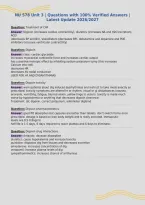
NU 578 Unit 3 | Questions with 100% Verified Answers |
Latest Update 2026/2027
Question: Treatment of CHF
Answer: Digoxin (increases cardiac contractility), diuretics (increases NA and H2O excretion),
ACEI
(decreases BP and BV), Vasodilators (decreases BP), dobutamine and dopamine and PDE
inhibitors (increase ventricular contractility)
Question: Digoxin
Answer: class: cardiac glycoside
increases myocardial contractile force and increases cardiac output
has a positive inotropic effect by inhibiting sodium potassium tump (this increases
Calcium into cell).
decreases HR
decreases AV nodal conduction
USED FOR HF AND DYSRHYTHMIAS
Question: Digoxin toxicity
Answer: warn patients about dig induced dysrhythmias and instruct to take meds exactly as
prescribed. toxicity symptoms are altered hr or rhythm, visual or gi disturbances (nausea,
anorexia, vomitting, fatigue, blurred vision, yellow tinge to vision). toxicity is made much
worse by hypokalemia or anything that decreases digoxin clearance.
Treatment: d/c digoxin, correct potassium, administer digibind
Question: Digoxin pharmacokinetics
Answer: good PO absorption but capsules are better than tablets. don't switch forms once
prescribed. dosage is based on lean body weight and is really excreted. therapeutic
levels are 0.5-0.8ng/ml.
half life is 1.5 days. 6 days required to reach plateau and 6 days to eliminate.
Question: Digoxin drug interactions
Answer: Antacids: decease absorption
diuretics: cause hypokalemia and increase toxicity
quinidine: displaces dig from tissues and decreases excretion
amiodarone: increases concentration of dig
verapamil: increase plasma levels of dig
sympathomimetics: increases chance of arrthymias
, Question: How do ACEI work in CHF?
Answer: inhibitor of ACE decreases angiotensin II, decreases total peripheral resistance, and
decreases blood volume. decreased aldosterone decreases TPR and BV.
Block the production of angiotensin II, decrease the release of aldosterone, and
suppress degradation of kinins. arteriolar dilation improves blood flow in kidneys, venous
dilation reduces venous pressure, edema, preload, and suppression of aldosterone
release enhances excretion of sodium and water . contribute to cardiac remodeling!!!
prolong life. not in acute decompensated HF. excreted by kidneys
FIRST LINE TREATMENT IN CHF!!!!
Question: ACEI side effects
Answer: cough, increased potassium, dizziness, angioedema, hypotension. can cause renal
failure
in patients with bilateral renal artery stenosis. use with caution in patients taking
potassium supplements or k sparing diuretics, neutropenia
DDI: diuretics can intensify hypotension, antihypertensive agents can increase powered
bp, risk of hyperkalemia with k sparing diuretics and k supplements, NSaids and Lithium
decrease effects of ACEI
BBW: can cause fetal injury in pregnancy.
Question: Lisinopril
Answer: ACE inhibitor that is given in active form
decreases TPR, Na and H2O load by inhibiting ACE.
block angiotensin II, decreases BO and salt and water retention.
longer 1/2 life. q day dosing. causes first dose syncope, dizziness, GI SE
approved for MI, HTN, heart failure.
Question: Angiotensin 2 receptor blockers
Answer: approved for hypertension, heart failure, diabetic nephropathhy, MI, prevention of MI
and stroke
They block the action of angiotensin 2. cause dilation of the arterioles, prevent cardiac
structure change, increase renal excretion of sodium and water. DO NOT INHIBIT
KINASE II and do not increase levels of bradykinin in the lungs. have lower risk for cough.
Used for HF, HTN, diabetic neuropathy, MI, stroke prevention, prevention of MI, diabetic
retinopathy
Question: ARBS AE
Answer: angioedema, renal failure.
BBW for fetal harm
Question: Calcium Channel Blockers
Answer: print calcium ions from entering cells. used for dysrhythmias, htn, angina pectoris.
Reduces force of contraction, slow heart rate, and suppress conduction through the AV
node.
Latest Update 2026/2027
Question: Treatment of CHF
Answer: Digoxin (increases cardiac contractility), diuretics (increases NA and H2O excretion),
ACEI
(decreases BP and BV), Vasodilators (decreases BP), dobutamine and dopamine and PDE
inhibitors (increase ventricular contractility)
Question: Digoxin
Answer: class: cardiac glycoside
increases myocardial contractile force and increases cardiac output
has a positive inotropic effect by inhibiting sodium potassium tump (this increases
Calcium into cell).
decreases HR
decreases AV nodal conduction
USED FOR HF AND DYSRHYTHMIAS
Question: Digoxin toxicity
Answer: warn patients about dig induced dysrhythmias and instruct to take meds exactly as
prescribed. toxicity symptoms are altered hr or rhythm, visual or gi disturbances (nausea,
anorexia, vomitting, fatigue, blurred vision, yellow tinge to vision). toxicity is made much
worse by hypokalemia or anything that decreases digoxin clearance.
Treatment: d/c digoxin, correct potassium, administer digibind
Question: Digoxin pharmacokinetics
Answer: good PO absorption but capsules are better than tablets. don't switch forms once
prescribed. dosage is based on lean body weight and is really excreted. therapeutic
levels are 0.5-0.8ng/ml.
half life is 1.5 days. 6 days required to reach plateau and 6 days to eliminate.
Question: Digoxin drug interactions
Answer: Antacids: decease absorption
diuretics: cause hypokalemia and increase toxicity
quinidine: displaces dig from tissues and decreases excretion
amiodarone: increases concentration of dig
verapamil: increase plasma levels of dig
sympathomimetics: increases chance of arrthymias
, Question: How do ACEI work in CHF?
Answer: inhibitor of ACE decreases angiotensin II, decreases total peripheral resistance, and
decreases blood volume. decreased aldosterone decreases TPR and BV.
Block the production of angiotensin II, decrease the release of aldosterone, and
suppress degradation of kinins. arteriolar dilation improves blood flow in kidneys, venous
dilation reduces venous pressure, edema, preload, and suppression of aldosterone
release enhances excretion of sodium and water . contribute to cardiac remodeling!!!
prolong life. not in acute decompensated HF. excreted by kidneys
FIRST LINE TREATMENT IN CHF!!!!
Question: ACEI side effects
Answer: cough, increased potassium, dizziness, angioedema, hypotension. can cause renal
failure
in patients with bilateral renal artery stenosis. use with caution in patients taking
potassium supplements or k sparing diuretics, neutropenia
DDI: diuretics can intensify hypotension, antihypertensive agents can increase powered
bp, risk of hyperkalemia with k sparing diuretics and k supplements, NSaids and Lithium
decrease effects of ACEI
BBW: can cause fetal injury in pregnancy.
Question: Lisinopril
Answer: ACE inhibitor that is given in active form
decreases TPR, Na and H2O load by inhibiting ACE.
block angiotensin II, decreases BO and salt and water retention.
longer 1/2 life. q day dosing. causes first dose syncope, dizziness, GI SE
approved for MI, HTN, heart failure.
Question: Angiotensin 2 receptor blockers
Answer: approved for hypertension, heart failure, diabetic nephropathhy, MI, prevention of MI
and stroke
They block the action of angiotensin 2. cause dilation of the arterioles, prevent cardiac
structure change, increase renal excretion of sodium and water. DO NOT INHIBIT
KINASE II and do not increase levels of bradykinin in the lungs. have lower risk for cough.
Used for HF, HTN, diabetic neuropathy, MI, stroke prevention, prevention of MI, diabetic
retinopathy
Question: ARBS AE
Answer: angioedema, renal failure.
BBW for fetal harm
Question: Calcium Channel Blockers
Answer: print calcium ions from entering cells. used for dysrhythmias, htn, angina pectoris.
Reduces force of contraction, slow heart rate, and suppress conduction through the AV
node.


