
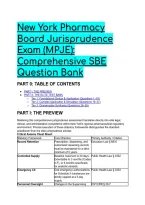
New York Pharmacy
Board Jurisprudence
Exam (MPJE):
Comprehensive SBE
Question Bank
PART 0: TABLE OF CONTENTS
● PART I: THE PREVIEW
● PART II: THE ELITE TEST BANK
○ Tier 1: Foundational Syntax & Application (Questions 1–18)
○ Tier 2: Complex Application & Simulation (Questions 19–37)
○ Tier 3: Grandmaster Synthesis (Questions 38–55)
PART I: THE PREVIEW
Mastering this comprehensive jurisprudence assessment translates directly into elite legal,
clinical, and administrative competence within New York's rigorous pharmaceutical regulatory
environment. Precise execution of these statutory frameworks distinguishes the standard
practitioner from the elite jurisprudence scholar.
Critical Axioms Cheat Sheet:
Statutory Framework Core Directive Primary Authority / Citation
Record Retention Prescription, dispensing, and Education Law § 6810
customized repacking records
must be maintained for a strict
minimum of 5 years.
Controlled Supply Baseline maximum is 30 days. Public Health Law § 3332
Extendable to 3 months (Codes
A-F), or 6 months specifically
for anabolic steroids.
Emergency CII Oral emergency authorizations Public Health Law § 3334
for Schedule II substances are
strictly capped at a 5-day
supply.
Personnel Oversight Changes in the Supervising 8 NYCRR § 29.7
,Statutory Framework Core Directive Primary Authority / Citation
Pharmacist designation require
formal notification to the Board
within exactly 7 days.
PBM Audits Capped at 100 randomly Public Health Law § 280-c
selected prescriptions annually;
requires 15 days' notice;
prohibited during the first 3
days of the month.
Non-Controlled Transfers Under 2026 mandates, 8 NYCRR § 63.6
non-controlled transfers must
move the entire prescription,
including all remaining
authorized refills.
PART II: THE ELITE TEST BANK
Tier 1: Foundational Syntax & Application (Questions 1–18)
Q1: A practitioner contacts the pharmacy to issue an emergency oral prescription for
oxycodone. Based on the principles of New York Public Health Law Article 33, what is the
MAXIMUM days' supply that may be dispensed? A) A 48-hour supply B) A 72-hour supply C) A
5-day supply D) A 7-day supply
● Answer: C (A 5-day supply)
● Distractor Analysis:
○ A is incorrect: A 48-hour limit applies to legacy institutional parameters, not
outpatient emergency Schedule II prescriptions in New York.
○ B is incorrect: 72 hours is the timeframe required for the prescriber to deliver the
official follow-up prescription, not the limit on the medication dispensed.
○ D is incorrect: A 7-day supply is the maximum limit for an initial opioid prescription
for acute pain, not an emergency oral authorization.
The Mentor's Analysis: When facing an emergency oral prescription for a Schedule II controlled
substance, the immediate priority is capping the dispensation at a five-day supply. By utilizing
this strict state limitation, you bypass the common trap of defaulting to the federal "amount
needed to treat the emergency" standard. Professional Intuition: Always isolate New York's
five-day Schedule II emergency maximum from federal ambiguities.
Q2: A pharmacy undergoes a change in its management structure. Based on the principles of
the New York State Education Law, which timeframe is REQUIRED for notifying the Board of
Pharmacy regarding a change in the Supervising Pharmacist? A) Within 48 hours B) Within 7
days C) Within 15 days D) Within 30 days
● Answer: B (Within 7 days)
● Distractor Analysis:
○ A is incorrect: 48 hours is the notification timeframe required when a registered
establishment is damaged by fire, flood, or disaster.
○ C is incorrect: 15 days is the advance notice a Pharmacy Benefit Manager (PBM)
must give before an on-site audit.
○ D is incorrect: 30 days is the notification requirement for a change in corporate
officers or primary stockholders.
, The Mentor's Analysis: When facing administrative personnel shifts, the immediate priority is
securing the pharmacy's operational license by maintaining authorized oversight. By utilizing the
7-day notification rule, you bypass the common trap of conflating personnel changes with
corporate structural changes. Professional Intuition: Supervising Pharmacist changes
mandate a rigid seven-day regulatory alert.
Q3: A pharmacy's archiving system is being updated. Based on the principles of New York State
Record Retention laws, what is the MINIMUM duration that prescription records must be
maintained on-site or readily retrievable? A) 2 years B) 5 years C) 7 years D) 10 years
● Answer: B (5 years)
● Distractor Analysis:
○ A is incorrect: Two years is the federal DEA requirement for controlled substance
records, but New York law is strictly more stringent.
○ C is incorrect: Seven years is often tied to Medicare Part D or specific commercial
payer contracts, not the baseline state pharmacy law.
○ D is incorrect: Ten years applies to certain pediatric records or specific Medicaid
stipulations, not general prescription retention.
The Mentor's Analysis: When facing record destruction protocols, the immediate priority is
adhering to the strictest jurisdictional mandate. By utilizing the New York 5-year rule for
prescription records, you bypass the common trap of relying solely on the 2-year federal DEA
minimum. Professional Intuition: State law supersedes federal law when state retention
requirements (5 years) are more stringent.
Q4: A licensed pharmacist is overseeing technicians during a busy shift. Based on the principles
of Article 137-A, what is the MAXIMUM ratio of registered pharmacy technicians to pharmacists
for licensed tasks? A) 1 pharmacist to 1 registered technician B) 1 pharmacist to 2 registered
technicians C) 1 pharmacist to 3 registered technicians D) 1 pharmacist to 4 registered
technicians
● Answer: B (1 pharmacist to 2 registered technicians)
● Distractor Analysis:
○ A is incorrect: This ratio is overly restrictive and does not reflect current New York
legislation.
○ C is incorrect: While some states allow a 1:3 ratio, New York caps registered
technicians at two per pharmacist.
○ D is incorrect: Four is the maximum total number of unlicensed persons assisting,
not registered technicians performing licensed tasks.
The Mentor's Analysis: When facing workflow optimization, the immediate priority is maintaining
lawful direct personal supervision. By utilizing the 1:2 registered technician ratio, you bypass the
common trap of confusing registered technician ratios with the maximum total allowance of
unlicensed personnel. Professional Intuition: A single pharmacist may supervise exactly two
registered technicians performing licensed tasks.
Q5: A physician writes a prescription for a Schedule II controlled substance intended to treat
attention deficit disorder (ADD). Based on the principles of Condition Codes, which code is the
MOST APPROPRIATE to authorize a three-month supply? A) Code A B) Code B C) Code C D)
Code E
● Answer: B (Code B)
● Distractor Analysis:
○ A is incorrect: Code A is exclusively designated for panic disorders.
○ C is incorrect: Code C is designated for chronic debilitating neurological conditions.
○ D is incorrect: Code E is designated specifically for narcolepsy.
Board Jurisprudence
Exam (MPJE):
Comprehensive SBE
Question Bank
PART 0: TABLE OF CONTENTS
● PART I: THE PREVIEW
● PART II: THE ELITE TEST BANK
○ Tier 1: Foundational Syntax & Application (Questions 1–18)
○ Tier 2: Complex Application & Simulation (Questions 19–37)
○ Tier 3: Grandmaster Synthesis (Questions 38–55)
PART I: THE PREVIEW
Mastering this comprehensive jurisprudence assessment translates directly into elite legal,
clinical, and administrative competence within New York's rigorous pharmaceutical regulatory
environment. Precise execution of these statutory frameworks distinguishes the standard
practitioner from the elite jurisprudence scholar.
Critical Axioms Cheat Sheet:
Statutory Framework Core Directive Primary Authority / Citation
Record Retention Prescription, dispensing, and Education Law § 6810
customized repacking records
must be maintained for a strict
minimum of 5 years.
Controlled Supply Baseline maximum is 30 days. Public Health Law § 3332
Extendable to 3 months (Codes
A-F), or 6 months specifically
for anabolic steroids.
Emergency CII Oral emergency authorizations Public Health Law § 3334
for Schedule II substances are
strictly capped at a 5-day
supply.
Personnel Oversight Changes in the Supervising 8 NYCRR § 29.7
,Statutory Framework Core Directive Primary Authority / Citation
Pharmacist designation require
formal notification to the Board
within exactly 7 days.
PBM Audits Capped at 100 randomly Public Health Law § 280-c
selected prescriptions annually;
requires 15 days' notice;
prohibited during the first 3
days of the month.
Non-Controlled Transfers Under 2026 mandates, 8 NYCRR § 63.6
non-controlled transfers must
move the entire prescription,
including all remaining
authorized refills.
PART II: THE ELITE TEST BANK
Tier 1: Foundational Syntax & Application (Questions 1–18)
Q1: A practitioner contacts the pharmacy to issue an emergency oral prescription for
oxycodone. Based on the principles of New York Public Health Law Article 33, what is the
MAXIMUM days' supply that may be dispensed? A) A 48-hour supply B) A 72-hour supply C) A
5-day supply D) A 7-day supply
● Answer: C (A 5-day supply)
● Distractor Analysis:
○ A is incorrect: A 48-hour limit applies to legacy institutional parameters, not
outpatient emergency Schedule II prescriptions in New York.
○ B is incorrect: 72 hours is the timeframe required for the prescriber to deliver the
official follow-up prescription, not the limit on the medication dispensed.
○ D is incorrect: A 7-day supply is the maximum limit for an initial opioid prescription
for acute pain, not an emergency oral authorization.
The Mentor's Analysis: When facing an emergency oral prescription for a Schedule II controlled
substance, the immediate priority is capping the dispensation at a five-day supply. By utilizing
this strict state limitation, you bypass the common trap of defaulting to the federal "amount
needed to treat the emergency" standard. Professional Intuition: Always isolate New York's
five-day Schedule II emergency maximum from federal ambiguities.
Q2: A pharmacy undergoes a change in its management structure. Based on the principles of
the New York State Education Law, which timeframe is REQUIRED for notifying the Board of
Pharmacy regarding a change in the Supervising Pharmacist? A) Within 48 hours B) Within 7
days C) Within 15 days D) Within 30 days
● Answer: B (Within 7 days)
● Distractor Analysis:
○ A is incorrect: 48 hours is the notification timeframe required when a registered
establishment is damaged by fire, flood, or disaster.
○ C is incorrect: 15 days is the advance notice a Pharmacy Benefit Manager (PBM)
must give before an on-site audit.
○ D is incorrect: 30 days is the notification requirement for a change in corporate
officers or primary stockholders.
, The Mentor's Analysis: When facing administrative personnel shifts, the immediate priority is
securing the pharmacy's operational license by maintaining authorized oversight. By utilizing the
7-day notification rule, you bypass the common trap of conflating personnel changes with
corporate structural changes. Professional Intuition: Supervising Pharmacist changes
mandate a rigid seven-day regulatory alert.
Q3: A pharmacy's archiving system is being updated. Based on the principles of New York State
Record Retention laws, what is the MINIMUM duration that prescription records must be
maintained on-site or readily retrievable? A) 2 years B) 5 years C) 7 years D) 10 years
● Answer: B (5 years)
● Distractor Analysis:
○ A is incorrect: Two years is the federal DEA requirement for controlled substance
records, but New York law is strictly more stringent.
○ C is incorrect: Seven years is often tied to Medicare Part D or specific commercial
payer contracts, not the baseline state pharmacy law.
○ D is incorrect: Ten years applies to certain pediatric records or specific Medicaid
stipulations, not general prescription retention.
The Mentor's Analysis: When facing record destruction protocols, the immediate priority is
adhering to the strictest jurisdictional mandate. By utilizing the New York 5-year rule for
prescription records, you bypass the common trap of relying solely on the 2-year federal DEA
minimum. Professional Intuition: State law supersedes federal law when state retention
requirements (5 years) are more stringent.
Q4: A licensed pharmacist is overseeing technicians during a busy shift. Based on the principles
of Article 137-A, what is the MAXIMUM ratio of registered pharmacy technicians to pharmacists
for licensed tasks? A) 1 pharmacist to 1 registered technician B) 1 pharmacist to 2 registered
technicians C) 1 pharmacist to 3 registered technicians D) 1 pharmacist to 4 registered
technicians
● Answer: B (1 pharmacist to 2 registered technicians)
● Distractor Analysis:
○ A is incorrect: This ratio is overly restrictive and does not reflect current New York
legislation.
○ C is incorrect: While some states allow a 1:3 ratio, New York caps registered
technicians at two per pharmacist.
○ D is incorrect: Four is the maximum total number of unlicensed persons assisting,
not registered technicians performing licensed tasks.
The Mentor's Analysis: When facing workflow optimization, the immediate priority is maintaining
lawful direct personal supervision. By utilizing the 1:2 registered technician ratio, you bypass the
common trap of confusing registered technician ratios with the maximum total allowance of
unlicensed personnel. Professional Intuition: A single pharmacist may supervise exactly two
registered technicians performing licensed tasks.
Q5: A physician writes a prescription for a Schedule II controlled substance intended to treat
attention deficit disorder (ADD). Based on the principles of Condition Codes, which code is the
MOST APPROPRIATE to authorize a three-month supply? A) Code A B) Code B C) Code C D)
Code E
● Answer: B (Code B)
● Distractor Analysis:
○ A is incorrect: Code A is exclusively designated for panic disorders.
○ C is incorrect: Code C is designated for chronic debilitating neurological conditions.
○ D is incorrect: Code E is designated specifically for narcolepsy.


