
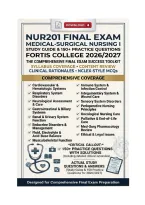
,NUR201 Medical-Surgical Nursing I Final Exam
Study Guide & 150 Practice Questions Fortis
College 2026/2027
1. A 68-year-old male patient is admitted with crushing chest pain radiating to his left arm,
diaphoresis, and nausea. His vital signs show BP 88/52 mmHg, HR 110 bpm, and RR 24/min. The
12-lead ECG reveals ST-segment elevation in leads V1–V4. The nurse recognizes these findings
as indicative of an anterior wall myocardial infarction. Which medication should the nurse
administer first to reduce cardiac workload and myocardial oxygen demand?
A. Aspirin 325 mg chewable, because antiplatelet therapy prevents further thrombus formation
in the coronary artery.
B. Metoprolol 5 mg IV, because beta-blockers decrease heart rate and contractility, reducing
myocardial oxygen consumption.
C. Nitroglycerin 0.4 mg sublingual, because vasodilation reduces preload and afterload,
decreasing cardiac workload.
D. Morphine sulfate 2–4 mg IV, because pain relief reduces catecholamine release and
decreases myocardial oxygen demand.
Correct Answer: C. Nitroglycerin 0.4 mg sublingual, because vasodilation reduces preload and
afterload, decreasing cardiac workload.
Rationale: Nitroglycerin is the priority medication for an acute anterior STEMI because it
reduces preload and afterload through venous and arterial dilation, directly decreasing
myocardial oxygen demand. While aspirin (A) is critical for antiplatelet effects, nitroglycerin
addresses the immediate ischemia. Morphine (D) is used for refractory pain but is not first-line.
,2. A 72-year-old female patient with a history of chronic heart failure presents with increasing
dyspnea, orthopnea, and bilateral crackles on auscultation. Her weight has increased by 4
pounds over the past 3 days, and she reports sleeping on three pillows. The nurse notes jugular
venous distension and 2+ pitting edema in both lower extremities. Based on these findings,
which nursing intervention is the highest priority?
A. Administer furosemide 40 mg IV as prescribed to promote diuresis and reduce fluid overload.
B. Place the patient in a high-Fowler's position to decrease venous return and improve
respiratory effort.
C. Apply supplemental oxygen at 2 L/min via nasal cannula to improve oxygenation and reduce
dyspnea.
D. Monitor daily weights and intake/output to assess fluid balance and guide diuretic therapy.
Correct Answer: B. Place the patient in a high-Fowler's position to decrease venous return and
improve respiratory effort.
Rationale: In acute decompensated heart failure with respiratory distress, positioning the
patient in high-Fowler's position is the immediate priority to reduce preload and improve
ventilation. While furosemide (A) and oxygen (C) are essential interventions, positioning is the
first action to address life-threatening respiratory compromise.
3. A patient newly prescribed lisinopril calls the clinic reporting a dry, nonproductive cough.
Which response by the nurse is most appropriate?
, A. "This is a common side effect of ACE inhibitors caused by bradykinin accumulation; I will
notify your provider to discuss an alternative."
B. "This cough indicates an allergic reaction; stop the medication immediately and go to the
emergency department."
C. "This is expected and will resolve within 48 hours; continue taking the medication."
D. "This means the medication is working too well; I will ask the provider to decrease your
dose."
Correct Answer: A. "This is a common side effect of ACE inhibitors caused by bradykinin
accumulation; I will notify your provider to discuss an alternative."
Rationale: A dry, persistent cough is a well-documented adverse effect of ACE inhibitors due to
bradykinin accumulation (not an allergy), occurring in 5–20% of patients and often necessitating
switching to an ARB. It is not a transient effect that resolves in 48 hours, nor does it indicate
excessive therapeutic effect.
4. A nurse is reviewing the mechanism of action of furosemide (Lasix). Which statement best
describes how this medication works?
A. It inhibits aldosterone in the distal tubule.
B. It inhibits sodium and chloride reabsorption in the ascending loop of Henle.
Study Guide & 150 Practice Questions Fortis
College 2026/2027
1. A 68-year-old male patient is admitted with crushing chest pain radiating to his left arm,
diaphoresis, and nausea. His vital signs show BP 88/52 mmHg, HR 110 bpm, and RR 24/min. The
12-lead ECG reveals ST-segment elevation in leads V1–V4. The nurse recognizes these findings
as indicative of an anterior wall myocardial infarction. Which medication should the nurse
administer first to reduce cardiac workload and myocardial oxygen demand?
A. Aspirin 325 mg chewable, because antiplatelet therapy prevents further thrombus formation
in the coronary artery.
B. Metoprolol 5 mg IV, because beta-blockers decrease heart rate and contractility, reducing
myocardial oxygen consumption.
C. Nitroglycerin 0.4 mg sublingual, because vasodilation reduces preload and afterload,
decreasing cardiac workload.
D. Morphine sulfate 2–4 mg IV, because pain relief reduces catecholamine release and
decreases myocardial oxygen demand.
Correct Answer: C. Nitroglycerin 0.4 mg sublingual, because vasodilation reduces preload and
afterload, decreasing cardiac workload.
Rationale: Nitroglycerin is the priority medication for an acute anterior STEMI because it
reduces preload and afterload through venous and arterial dilation, directly decreasing
myocardial oxygen demand. While aspirin (A) is critical for antiplatelet effects, nitroglycerin
addresses the immediate ischemia. Morphine (D) is used for refractory pain but is not first-line.
,2. A 72-year-old female patient with a history of chronic heart failure presents with increasing
dyspnea, orthopnea, and bilateral crackles on auscultation. Her weight has increased by 4
pounds over the past 3 days, and she reports sleeping on three pillows. The nurse notes jugular
venous distension and 2+ pitting edema in both lower extremities. Based on these findings,
which nursing intervention is the highest priority?
A. Administer furosemide 40 mg IV as prescribed to promote diuresis and reduce fluid overload.
B. Place the patient in a high-Fowler's position to decrease venous return and improve
respiratory effort.
C. Apply supplemental oxygen at 2 L/min via nasal cannula to improve oxygenation and reduce
dyspnea.
D. Monitor daily weights and intake/output to assess fluid balance and guide diuretic therapy.
Correct Answer: B. Place the patient in a high-Fowler's position to decrease venous return and
improve respiratory effort.
Rationale: In acute decompensated heart failure with respiratory distress, positioning the
patient in high-Fowler's position is the immediate priority to reduce preload and improve
ventilation. While furosemide (A) and oxygen (C) are essential interventions, positioning is the
first action to address life-threatening respiratory compromise.
3. A patient newly prescribed lisinopril calls the clinic reporting a dry, nonproductive cough.
Which response by the nurse is most appropriate?
, A. "This is a common side effect of ACE inhibitors caused by bradykinin accumulation; I will
notify your provider to discuss an alternative."
B. "This cough indicates an allergic reaction; stop the medication immediately and go to the
emergency department."
C. "This is expected and will resolve within 48 hours; continue taking the medication."
D. "This means the medication is working too well; I will ask the provider to decrease your
dose."
Correct Answer: A. "This is a common side effect of ACE inhibitors caused by bradykinin
accumulation; I will notify your provider to discuss an alternative."
Rationale: A dry, persistent cough is a well-documented adverse effect of ACE inhibitors due to
bradykinin accumulation (not an allergy), occurring in 5–20% of patients and often necessitating
switching to an ARB. It is not a transient effect that resolves in 48 hours, nor does it indicate
excessive therapeutic effect.
4. A nurse is reviewing the mechanism of action of furosemide (Lasix). Which statement best
describes how this medication works?
A. It inhibits aldosterone in the distal tubule.
B. It inhibits sodium and chloride reabsorption in the ascending loop of Henle.


