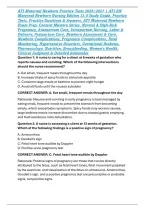
ATI Maternal Newborn Practice Tests 2026/2027 | ATI RN
Maternal Newborn Nursing Edition 13.0 Study Guide, Practice
Tests, Practice Questions & Answers, ATI Maternal Newborn
Exam Prep, Content Mastery Series, Normal & High-Risk
Pregnancy, Antepartum Care, Intrapartum Nursing, Labor &
Delivery, Postpartum Care, Newborn Assessment & Care,
Newborn Complications, Pregnancy Complications, Fetal
Monitoring, Hypertensive Disorders, Gestational Diabetes,
Pharmacology, Nutrition, Breastfeeding, Women's Health,
Clinical Judgment & Detailed Rationales
Question 1: A nurse is caring for a client at 8 weeks of gestation who
reports nausea and vomiting. Which of the following interventions
should the nurse recommend?
A. Eat small, frequent meals throughout the day
B. Increase intake of spicy foods to stimulate appetite
C. Consume large meals at bedtime to prevent night hunger
D. Avoid all fluids until the nausea subsides
CORRECT ANSWER: A. Eat small, frequent meals throughout the day
Rationale: Nausea and vomiting in early pregnancy is best managed by
eating small, frequent meals to prevent the stomach from becoming
empty, which exacerbates symptoms. Spicy foods may worsen nausea,
large bedtime meals increase discomfort due to slowed gastric emptying,
and fluid avoidance risks dehydration.
Question 2: A nurse is assessing a client at 12 weeks of gestation.
Which of the following findings is a positive sign of pregnancy?
A. Amenorrhea
B. Goodell's sign
C. Fetal heart tone audible by Doppler
D. Positive urine pregnancy test
CORRECT ANSWER: C. Fetal heart tone audible by Doppler
Rationale: Positive signs of pregnancy are those that can be directly
attributed to the fetus, such as fetal heart tones, fetal movement palpated
by the examiner, and visualization of the fetus on ultrasound. Amenorrhea,
Goodell's sign, and a positive pregnancy test are presumptive or probable
signs, not positive signs.
,Question 3: A nurse is providing teaching to a client at 10 weeks of
gestation who has iron deficiency anemia. Which of the following
dietary recommendations should the nurse include?
A. Increase intake of dairy products with meals
B. Eat more citrus fruits with iron-rich foods
C. Avoid eating green leafy vegetables
D. Take iron supplements with milk
CORRECT ANSWER: B. Eat more citrus fruits with iron-rich foods
Rationale: Vitamin C enhances the absorption of iron. Citrus fruits should
be consumed with iron-rich foods or supplements. Dairy products and milk
can inhibit iron absorption and should be taken at separate times. Green
leafy vegetables are good sources of iron and should be encouraged.
Question 4: A nurse is assessing a client at 32 weeks of gestation who is
experiencing preterm labor. Which medication should the nurse
anticipate administering to promote fetal lung maturity?
A. Misoprostol
B. Betamethasone
C. Poractant alfa
D. Methylergonovine
CORRECT ANSWER: B. Betamethasone
Rationale: Betamethasone is an antenatal corticosteroid administered to
clients at risk for preterm birth to accelerate fetal lung maturation and
reduce the incidence and severity of neonatal respiratory distress
syndrome. Misoprostol is used for cervical ripening, poractant alfa is a
neonatal surfactant, and methylergonovine is used for postpartum
hemorrhage.
Question 5: A nurse is assessing a client at 34 weeks of gestation who
has a cardiac disorder. Which of the following findings should the nurse
report to the provider?
A. Heart rate increase of 10 beats per minute from baseline
B. Respiratory rate of 18 breaths per minute
C. Presence of a systolic murmur
D. Oxygen saturation of 94% on room air
,CORRECT ANSWER: D. Oxygen saturation of 94% on room air
Rationale: An oxygen saturation below 95% in a pregnant client with a
cardiac disorder may indicate inadequate oxygenation and cardiac
decompensation, requiring immediate provider notification. Mild
tachycardia and a systolic murmur are common during pregnancy due to
increased blood volume. A respiratory rate of 18 is within normal limits.
Question 6: A nurse is calculating the estimated date of birth using
Naegele's rule for a client whose last menstrual period began on June
21. Which of the following is the estimated date of delivery?
A. March 14
B. March 28
C. April 14
D. April 28
CORRECT ANSWER: B. March 28
Rationale: Naegele's rule is calculated by subtracting 3 months from the
first day of the last menstrual period and adding 7 days. June 21 minus 3
months equals March 21; March 21 plus 7 days equals March 28 of the
following year.
Question 7: A nurse is assessing a client at 32 weeks of gestation who
reports occasional mild contractions. Which finding indicates possible
preterm labor requiring further evaluation?
A. Contractions that subside with rest and hydration
B. Cervical dilation of 2 cm with 50% effacement
C. Fetal heart rate of 140 per minute with moderate variability
D. Urinary frequency without dysuria
CORRECT ANSWER: B. Cervical dilation of 2 cm with 50% effacement
Rationale: Cervical changes before 37 weeks are key indicators of preterm
labor and require immediate evaluation. Irregular contractions that subside
with rest are typically Braxton Hicks. A fetal heart rate of 140 with moderate
variability is reassuring. Urinary frequency is a common discomfort of
pregnancy and not indicative of preterm labor.
, Question 8: A nurse is caring for a client who has hyperemesis
gravidarum and is receiving IV fluid replacement. Which laboratory
finding indicates inadequate fluid replacement?
A. Serum creatinine of 0.8 mg/dL
B. Urine output of 280 mL within 8 hours
C. BUN of 25 mg/dL
D. Urine negative for ketones
CORRECT ANSWER: C. BUN of 25 mg/dL
Rationale: An elevated BUN indicates dehydration and inadequate fluid
replacement in a client with hyperemesis gravidarum. A serum creatinine
of 0.8 mg/dL, urine output of 280 mL within 8 hours, and urine negative for
ketones are expected findings.
Question 9: A nurse is assessing a pregnant client at 28 weeks of
gestation. Which of the following blood pressure readings should the
nurse report as concerning for gestational hypertension?
A. 110/70 mm Hg
B. 118/76 mm Hg
C. 138/88 mm Hg on two separate occasions
D. 126/82 mm Hg on one occasion
CORRECT ANSWER: C. 138/88 mm Hg on two separate occasions
Rationale: A blood pressure reading of 138/88 mm Hg on two separate
occasions during pregnancy is concerning for gestational hypertension or
preeclampsia, especially when sustained. Normal blood pressure in
pregnancy is generally less than 120/80 mm Hg.
Question 10: A client at 33 weeks of gestation presents with sudden
onset of severe, constant abdominal pain and dark vaginal bleeding.
The uterus is firm and tender to palpation. Which condition should the
nurse suspect?
A. Placenta previa
B. Placental abruption
C. Uterine rupture
D. Vasa previa
CORRECT ANSWER: B. Placental abruption
Maternal Newborn Nursing Edition 13.0 Study Guide, Practice
Tests, Practice Questions & Answers, ATI Maternal Newborn
Exam Prep, Content Mastery Series, Normal & High-Risk
Pregnancy, Antepartum Care, Intrapartum Nursing, Labor &
Delivery, Postpartum Care, Newborn Assessment & Care,
Newborn Complications, Pregnancy Complications, Fetal
Monitoring, Hypertensive Disorders, Gestational Diabetes,
Pharmacology, Nutrition, Breastfeeding, Women's Health,
Clinical Judgment & Detailed Rationales
Question 1: A nurse is caring for a client at 8 weeks of gestation who
reports nausea and vomiting. Which of the following interventions
should the nurse recommend?
A. Eat small, frequent meals throughout the day
B. Increase intake of spicy foods to stimulate appetite
C. Consume large meals at bedtime to prevent night hunger
D. Avoid all fluids until the nausea subsides
CORRECT ANSWER: A. Eat small, frequent meals throughout the day
Rationale: Nausea and vomiting in early pregnancy is best managed by
eating small, frequent meals to prevent the stomach from becoming
empty, which exacerbates symptoms. Spicy foods may worsen nausea,
large bedtime meals increase discomfort due to slowed gastric emptying,
and fluid avoidance risks dehydration.
Question 2: A nurse is assessing a client at 12 weeks of gestation.
Which of the following findings is a positive sign of pregnancy?
A. Amenorrhea
B. Goodell's sign
C. Fetal heart tone audible by Doppler
D. Positive urine pregnancy test
CORRECT ANSWER: C. Fetal heart tone audible by Doppler
Rationale: Positive signs of pregnancy are those that can be directly
attributed to the fetus, such as fetal heart tones, fetal movement palpated
by the examiner, and visualization of the fetus on ultrasound. Amenorrhea,
Goodell's sign, and a positive pregnancy test are presumptive or probable
signs, not positive signs.
,Question 3: A nurse is providing teaching to a client at 10 weeks of
gestation who has iron deficiency anemia. Which of the following
dietary recommendations should the nurse include?
A. Increase intake of dairy products with meals
B. Eat more citrus fruits with iron-rich foods
C. Avoid eating green leafy vegetables
D. Take iron supplements with milk
CORRECT ANSWER: B. Eat more citrus fruits with iron-rich foods
Rationale: Vitamin C enhances the absorption of iron. Citrus fruits should
be consumed with iron-rich foods or supplements. Dairy products and milk
can inhibit iron absorption and should be taken at separate times. Green
leafy vegetables are good sources of iron and should be encouraged.
Question 4: A nurse is assessing a client at 32 weeks of gestation who is
experiencing preterm labor. Which medication should the nurse
anticipate administering to promote fetal lung maturity?
A. Misoprostol
B. Betamethasone
C. Poractant alfa
D. Methylergonovine
CORRECT ANSWER: B. Betamethasone
Rationale: Betamethasone is an antenatal corticosteroid administered to
clients at risk for preterm birth to accelerate fetal lung maturation and
reduce the incidence and severity of neonatal respiratory distress
syndrome. Misoprostol is used for cervical ripening, poractant alfa is a
neonatal surfactant, and methylergonovine is used for postpartum
hemorrhage.
Question 5: A nurse is assessing a client at 34 weeks of gestation who
has a cardiac disorder. Which of the following findings should the nurse
report to the provider?
A. Heart rate increase of 10 beats per minute from baseline
B. Respiratory rate of 18 breaths per minute
C. Presence of a systolic murmur
D. Oxygen saturation of 94% on room air
,CORRECT ANSWER: D. Oxygen saturation of 94% on room air
Rationale: An oxygen saturation below 95% in a pregnant client with a
cardiac disorder may indicate inadequate oxygenation and cardiac
decompensation, requiring immediate provider notification. Mild
tachycardia and a systolic murmur are common during pregnancy due to
increased blood volume. A respiratory rate of 18 is within normal limits.
Question 6: A nurse is calculating the estimated date of birth using
Naegele's rule for a client whose last menstrual period began on June
21. Which of the following is the estimated date of delivery?
A. March 14
B. March 28
C. April 14
D. April 28
CORRECT ANSWER: B. March 28
Rationale: Naegele's rule is calculated by subtracting 3 months from the
first day of the last menstrual period and adding 7 days. June 21 minus 3
months equals March 21; March 21 plus 7 days equals March 28 of the
following year.
Question 7: A nurse is assessing a client at 32 weeks of gestation who
reports occasional mild contractions. Which finding indicates possible
preterm labor requiring further evaluation?
A. Contractions that subside with rest and hydration
B. Cervical dilation of 2 cm with 50% effacement
C. Fetal heart rate of 140 per minute with moderate variability
D. Urinary frequency without dysuria
CORRECT ANSWER: B. Cervical dilation of 2 cm with 50% effacement
Rationale: Cervical changes before 37 weeks are key indicators of preterm
labor and require immediate evaluation. Irregular contractions that subside
with rest are typically Braxton Hicks. A fetal heart rate of 140 with moderate
variability is reassuring. Urinary frequency is a common discomfort of
pregnancy and not indicative of preterm labor.
, Question 8: A nurse is caring for a client who has hyperemesis
gravidarum and is receiving IV fluid replacement. Which laboratory
finding indicates inadequate fluid replacement?
A. Serum creatinine of 0.8 mg/dL
B. Urine output of 280 mL within 8 hours
C. BUN of 25 mg/dL
D. Urine negative for ketones
CORRECT ANSWER: C. BUN of 25 mg/dL
Rationale: An elevated BUN indicates dehydration and inadequate fluid
replacement in a client with hyperemesis gravidarum. A serum creatinine
of 0.8 mg/dL, urine output of 280 mL within 8 hours, and urine negative for
ketones are expected findings.
Question 9: A nurse is assessing a pregnant client at 28 weeks of
gestation. Which of the following blood pressure readings should the
nurse report as concerning for gestational hypertension?
A. 110/70 mm Hg
B. 118/76 mm Hg
C. 138/88 mm Hg on two separate occasions
D. 126/82 mm Hg on one occasion
CORRECT ANSWER: C. 138/88 mm Hg on two separate occasions
Rationale: A blood pressure reading of 138/88 mm Hg on two separate
occasions during pregnancy is concerning for gestational hypertension or
preeclampsia, especially when sustained. Normal blood pressure in
pregnancy is generally less than 120/80 mm Hg.
Question 10: A client at 33 weeks of gestation presents with sudden
onset of severe, constant abdominal pain and dark vaginal bleeding.
The uterus is firm and tender to palpation. Which condition should the
nurse suspect?
A. Placenta previa
B. Placental abruption
C. Uterine rupture
D. Vasa previa
CORRECT ANSWER: B. Placental abruption