
Financial Accounting I | Comprehensive Year 1 Review
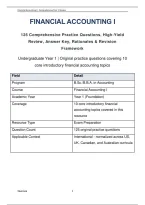
FINANCIAL ACCOUNTING I
125 Comprehensive Practice Questions, High-Yield
Review, Answer Key, Rationales & Revision
Framework
Undergraduate Year 1 | Original practice questions covering 10
core introductory financial accounting topics
Field Detail
Program B.Sc./B.B.A. in Accounting
Course Financial Accounting I
Academic Year Year 1 (Foundation)
Coverage 10 core introductory financial
accounting topics covered in this
resource
Resource Type Exam Preparation
Question Count 125 original practice questions
Applicable Context International - normalized across US,
UK, Canadian, and Australian curricula
Quesvia 1
,Financial Accounting I | Comprehensive Year 1 Review
Learning Objectives
By the end of this resource, you should be able to:
Explain the purpose of accounting, identify forms of business
organization, and apply the accounting equation.
Analyze and record business transactions using the double-entry
system, and prepare a trial balance.
Distinguish accrual from cash-basis accounting and record all four
standard categories of adjusting entries.
Prepare closing entries, a post-closing trial balance, and a classified
balance sheet.
Record merchandising transactions under the perpetual system and
prepare a multi-step income statement.
Apply FIFO, LIFO, and weighted-average inventory costing and explain
their effect on reported income.
Explain internal control principles and prepare a bank reconciliation.
Account for uncollectible receivables using the allowance method and
compute interest on notes receivable.
Calculate depreciation under straight-line, units-of-production, and
declining-balance methods, and account for asset disposals.
Record current liabilities, including notes payable, payroll obligations,
and contingent liabilities.
Quesvia 2
,Financial Accounting I | Comprehensive Year 1 Review
How to Use This Resource
This resource covers 10 core introductory financial accounting topics -
work through it topic by topic rather than all at once.
Use the High-Yield Concept Review for each topic before attempting
that topic's questions.
Attempt every question yourself before checking the answer key.
Read the detailed rationale for every question, not only the ones you
got wrong.
Pay particular attention to calculation questions in inventory,
depreciation, and receivables because these are central quantitative
skills in introductory financial accounting.
Use the Final Revision Checklist a few days before your assessment
as a topic-by-topic self-check.
Quesvia 3
, Financial Accounting I | Comprehensive Year 1 Review
Key Terms
Term Definition
Accounting Equation The relationship Assets = Liabilities +
Equity, which must remain in balance
after every transaction.
Double-Entry System A recording system in which every
transaction affects at least two accounts,
with total debits always equal to total
credits.
Journal and Ledger The journal is the chronological record
of transactions; the ledger organizes
those entries by individual account.
Trial Balance A listing of all ledger account balances
used to confirm that total debits equal
total credits.
Adjusting Entry A journal entry made at period end to
update account balances before
financial statements are prepared.
Accrual Basis of Accounting Recording revenues when earned and
expenses when incurred, regardless of
when cash changes hands.
Quesvia 4
FINANCIAL ACCOUNTING I
125 Comprehensive Practice Questions, High-Yield
Review, Answer Key, Rationales & Revision
Framework
Undergraduate Year 1 | Original practice questions covering 10
core introductory financial accounting topics
Field Detail
Program B.Sc./B.B.A. in Accounting
Course Financial Accounting I
Academic Year Year 1 (Foundation)
Coverage 10 core introductory financial
accounting topics covered in this
resource
Resource Type Exam Preparation
Question Count 125 original practice questions
Applicable Context International - normalized across US,
UK, Canadian, and Australian curricula
Quesvia 1
,Financial Accounting I | Comprehensive Year 1 Review
Learning Objectives
By the end of this resource, you should be able to:
Explain the purpose of accounting, identify forms of business
organization, and apply the accounting equation.
Analyze and record business transactions using the double-entry
system, and prepare a trial balance.
Distinguish accrual from cash-basis accounting and record all four
standard categories of adjusting entries.
Prepare closing entries, a post-closing trial balance, and a classified
balance sheet.
Record merchandising transactions under the perpetual system and
prepare a multi-step income statement.
Apply FIFO, LIFO, and weighted-average inventory costing and explain
their effect on reported income.
Explain internal control principles and prepare a bank reconciliation.
Account for uncollectible receivables using the allowance method and
compute interest on notes receivable.
Calculate depreciation under straight-line, units-of-production, and
declining-balance methods, and account for asset disposals.
Record current liabilities, including notes payable, payroll obligations,
and contingent liabilities.
Quesvia 2
,Financial Accounting I | Comprehensive Year 1 Review
How to Use This Resource
This resource covers 10 core introductory financial accounting topics -
work through it topic by topic rather than all at once.
Use the High-Yield Concept Review for each topic before attempting
that topic's questions.
Attempt every question yourself before checking the answer key.
Read the detailed rationale for every question, not only the ones you
got wrong.
Pay particular attention to calculation questions in inventory,
depreciation, and receivables because these are central quantitative
skills in introductory financial accounting.
Use the Final Revision Checklist a few days before your assessment
as a topic-by-topic self-check.
Quesvia 3
, Financial Accounting I | Comprehensive Year 1 Review
Key Terms
Term Definition
Accounting Equation The relationship Assets = Liabilities +
Equity, which must remain in balance
after every transaction.
Double-Entry System A recording system in which every
transaction affects at least two accounts,
with total debits always equal to total
credits.
Journal and Ledger The journal is the chronological record
of transactions; the ledger organizes
those entries by individual account.
Trial Balance A listing of all ledger account balances
used to confirm that total debits equal
total credits.
Adjusting Entry A journal entry made at period end to
update account balances before
financial statements are prepared.
Accrual Basis of Accounting Recording revenues when earned and
expenses when incurred, regardless of
when cash changes hands.
Quesvia 4


