[STUDY GUIDE] • HIGH-YIELD PRACTICE & REVIEW EDITION
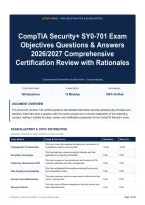
CompTIA Security+ SY0-701 Exam
Objectives Questions & Answers
2026/2027 Comprehensive
Certification Review with Rationales
Comprehensive Examination Question Bank • Concept Mapping
TOTAL QUESTIONS EXAM TOPICS RATIONALES
100 Questions 12 Modules 100% Verified
DOCUMENT OVERVIEW
This document contains 100 verified questions with detailed rationales covering cybersecurity principles and
practices. Each item pairs a question with the correct answer and a concise explanation of the underlying
concept, making it suitable for study, review, and certification preparation for the CompTIA Security+ exam.
EXAM BLUEPRINT & TOPIC DISTRIBUTION
Systematic breakdown of subject domains and exam coverage.
Topic Module Scope & Core Focus Questions Share (%)
This topic covers the essential concepts and mechanisms of
Cryptographic Fundamentals cryptography used for securing data. 10 Qs 10.0%
This topic explores various encryption methods and their
Encryption Techniques applications in protecting information. 9 Qs 9.0%
This topic focuses on the components and functions of PKI,
Public Key Infrastructure (PKI) including certificates and their management. 9 Qs 9.0%
This topic emphasizes the principles ensuring the accuracy
Data Integrity and Availability and accessibility of data. 8 Qs 8.0%
This topic examines various access control methods and their
Access Control Mechanisms roles in cybersecurity. 8 Qs 8.0%
This topic covers different categories of security controls and
Security Controls their implementations. 8 Qs 8.0%
Confidential • Student Study Edition • Practice & Review Guide Page 1 of 30
,STUDENT STUDY & MASTERY EDITION PRACTICE & REVIEW GUIDE
This topic addresses strategies and technologies used to
Threat Mitigation Strategies reduce and manage security threats. 8 Qs 8.0%
This topic focuses on physical barriers and techniques to
Physical Security Measures protect facilities and assets. 8 Qs 8.0%
Incident Response and This topic highlights processes and plans for responding to
Recovery and recovering from security incidents. 8 Qs 8.0%
Technical and Managerial This topic reviews the interplay between technical and
Controls managerial controls in cybersecurity practices. 8 Qs 8.0%
This topic involves techniques for monitoring systems and
Monitoring and Testing evaluating their security posture. 8 Qs 8.0%
This topic delves into the processes involved in managing
Certificate Management digital certificates effectively. 8 Qs 8.0%
Total Exam Coverage 12 Integrated Topic Modules 100 Qs 100.0%
Confidential • Student Study Edition • Practice & Review Guide Page 2 of 30
, STUDENT STUDY & MASTERY EDITION PRACTICE & REVIEW GUIDE
TOPIC 1: CRYPTOGRAPHIC FUNDAMENTALS
10 Questions • 10.0% of Exam • This topic covers the essential concepts and mechanisms of cryptography used for securing data.
QUESTION 1
Public key infrastructure (PKI)
Answer: A system that manages the creation, distribution, and revocation of digital certificates.
Rationale: PKI provides the framework for verifying identities and securing communications through the lifecycle
management of digital certificates, encompassing their issuance, distribution, and revocation. This infrastructure underpins
trust in digital interactions by ensuring the authenticity and integrity of cryptographic keys.
QUESTION 2
Public key
Answer: A cryptographic key that is used for encryption and verifying digital signatures in asymmetric
encryption.
Rationale: A public key is part of an asymmetric cryptographic system, enabling anyone to encrypt messages or verify
signatures, but only the corresponding private key can decrypt or create signatures. This asymmetry ensures secure
communication and authentication without needing to share a secret key.
QUESTION 3
Private key
Answer: A cryptographic key that is used for decryption and creating digital signatures in asymmetric
encryption.
Rationale: The private key is uniquely paired with a public key in asymmetric cryptography and is kept secret by its owner to
decrypt messages encrypted with the corresponding public key and to generate digital signatures verifying authenticity. This
principle underscores asymmetric encryption's core function of secure communication and authentication through key pair
management.
Confidential • Student Study Edition • Practice & Review Guide Page 3 of 30