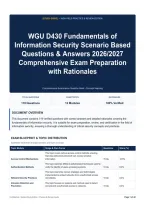
[STUDY GUIDE] • HIGH-YIELD PRACTICE & REVIEW EDITION
WGU D430 Fundamentals of
Information Security Scenario Based
Questions & Answers 2026/2027
Comprehensive Exam Preparation
with Rationales
Comprehensive Examination Question Bank • Concept Mapping
TOTAL QUESTIONS EXAM TOPICS RATIONALES
119 Questions 12 Modules 100% Verified
DOCUMENT OVERVIEW
This document contains 119 verified questions with correct answers and detailed rationales covering the
fundamentals of information security. It is suitable for exam preparation, review, and certification in the field of
information security, ensuring a thorough understanding of critical security concepts and practices.
EXAM BLUEPRINT & TOPIC DISTRIBUTION
Systematic breakdown of subject domains and exam coverage.
Topic Module Scope & Core Focus Questions Share (%)
This topic covers various access control methods ensuring
that only authorized personnel can access sensitive
Access Control Mechanisms information. 15 Qs 12.6%
This topic explores different authentication techniques used to
Authentication Methods verify the identity of users accessing systems. 10 Qs 8.4%
This topic examines various strategies and technologies
implemented to protect networks from unauthorized access
Network Security Practices and attacks. 10 Qs 8.4%
Intrusion Detection and This topic focuses on systems and methods used to detect
Prevention and prevent unauthorized access to networks. 10 Qs 8.4%
Confidential • Student Study Edition • Practice & Review Guide Page 1 of 42
,STUDENT STUDY & MASTERY EDITION PRACTICE & REVIEW GUIDE
Security Policies and This topic addresses organizational policies aimed at
Procedures maintaining security and compliance in information systems. 10 Qs 8.4%
This topic identifies various types of cyber attacks and
Malware and Attack Types malware, including methods of exploitation. 10 Qs 8.4%
This topic covers encryption technologies and techniques
used to safeguard sensitive data during transmission and
Data Encryption and Protection storage. 9 Qs 7.6%
This topic discusses the importance of auditing and
Auditing and Monitoring monitoring user activities to ensure compliance and security. 9 Qs 7.6%
This topic focuses on physical security strategies that protect
Physical Security Measures sensitive areas and information from unauthorized access. 9 Qs 7.6%
This topic explores firewall technologies and packet filtering
Firewalls and Filtering methods used to control incoming and outgoing network
Technologies traffic. 9 Qs 7.6%
This topic examines technologies that enable secure remote
Remote Access Security access to internal organizational resources. 9 Qs 7.6%
Incident Response and This topic looks at the strategies and measures taken to
Recovery respond to and recover from security incidents. 9 Qs 7.6%
Total Exam Coverage 12 Integrated Topic Modules 119 Qs 100.0%
Confidential • Student Study Edition • Practice & Review Guide Page 2 of 42
,STUDENT STUDY & MASTERY EDITION PRACTICE & REVIEW GUIDE
TOPIC 1: ACCESS CONTROL MECHANISMS
15 Questions • 12.6% of Exam • This topic covers various access control methods ensuring that only authorized personnel can access
sensitive information.
QUESTION 1
An organization wants to ensure that only authorized personnel can access sensitive
data stored in a database. What security measure should be implemented for protecting
data at rest?
Answer: Access controls.
Rationale: Access controls enforce authentication and authorization, ensuring that only verified and permitted users can
interact with sensitive data, thereby protecting it while it is stored. This principle of least privilege limits data exposure by
restricting access to authorized personnel only.
QUESTION 2
A company wants to ensure that only authorized devices can connect to its wireless
network. What security measure should be implemented?
Answer: Access Controls.
Rationale: Access controls restrict network entry to authenticated and authorized devices, preventing unauthorized
connections. This principle of least privilege ensures that only approved hardware can obtain network resources.
QUESTION 3
An organization wants to ensure that employees only have access to specific areas of a
building based on their job responsibilities. What practice should be implemented?
Answer: Role-Based Access Control (RBAC)
Rationale: Role-Based Access Control (RBAC) is the practice that grants permissions based on an employee's assigned
role within the organization, ensuring access is limited to only what is necessary for their job responsibilities. This principle of
least privilege minimizes security risks by restricting user access to resources only as required by their job function.
Confidential • Student Study Edition • Practice & Review Guide Page 3 of 42
, STUDENT STUDY & MASTERY EDITION PRACTICE & REVIEW GUIDE
QUESTION 4
A security administrator is implementing a method to verify the identity of individuals
accessing a system by using a combination of username and a one-time code sent to
their mobile device. What method is being implemented?
Answer: Multi-Factor Authentication (MFA)
Rationale: This scenario describes Multi-Factor Authentication (MFA), which requires at least two distinct forms of
identification, combining something the user knows (username) with something the user has (mobile device for a one-time
code). The core principle tested is the layered security approach of MFA to prevent unauthorized access.
QUESTION 5
A company wants to implement a method where access permissions are automatically
granted or revoked based on predefined rules and policies. What method is being
described?
Answer: Attribute-Based Access Control (ABAC)
Rationale: Attribute-Based Access Control (ABAC) centrally manages access by evaluating policies that consider user
attributes, resource attributes, and environmental conditions to dynamically grant or deny permissions. This policy-driven
approach allows for granular and context-aware access decisions based on predefined rules.
QUESTION 6
An organization is implementing a policy to ensure that employees are only granted
access to specific systems necessary for their job roles. What is this policy called?
Answer: Least Privilege Policy.
Rationale: This policy enforces the principle of least privilege, granting users only the minimum access required to perform
their job functions, thereby minimizing potential security risks from unauthorized actions or data breaches. The core concept
tested is the security principle of restricting access to only what is absolutely necessary.
Confidential • Student Study Edition • Practice & Review Guide Page 4 of 42
WGU D430 Fundamentals of
Information Security Scenario Based
Questions & Answers 2026/2027
Comprehensive Exam Preparation
with Rationales
Comprehensive Examination Question Bank • Concept Mapping
TOTAL QUESTIONS EXAM TOPICS RATIONALES
119 Questions 12 Modules 100% Verified
DOCUMENT OVERVIEW
This document contains 119 verified questions with correct answers and detailed rationales covering the
fundamentals of information security. It is suitable for exam preparation, review, and certification in the field of
information security, ensuring a thorough understanding of critical security concepts and practices.
EXAM BLUEPRINT & TOPIC DISTRIBUTION
Systematic breakdown of subject domains and exam coverage.
Topic Module Scope & Core Focus Questions Share (%)
This topic covers various access control methods ensuring
that only authorized personnel can access sensitive
Access Control Mechanisms information. 15 Qs 12.6%
This topic explores different authentication techniques used to
Authentication Methods verify the identity of users accessing systems. 10 Qs 8.4%
This topic examines various strategies and technologies
implemented to protect networks from unauthorized access
Network Security Practices and attacks. 10 Qs 8.4%
Intrusion Detection and This topic focuses on systems and methods used to detect
Prevention and prevent unauthorized access to networks. 10 Qs 8.4%
Confidential • Student Study Edition • Practice & Review Guide Page 1 of 42
,STUDENT STUDY & MASTERY EDITION PRACTICE & REVIEW GUIDE
Security Policies and This topic addresses organizational policies aimed at
Procedures maintaining security and compliance in information systems. 10 Qs 8.4%
This topic identifies various types of cyber attacks and
Malware and Attack Types malware, including methods of exploitation. 10 Qs 8.4%
This topic covers encryption technologies and techniques
used to safeguard sensitive data during transmission and
Data Encryption and Protection storage. 9 Qs 7.6%
This topic discusses the importance of auditing and
Auditing and Monitoring monitoring user activities to ensure compliance and security. 9 Qs 7.6%
This topic focuses on physical security strategies that protect
Physical Security Measures sensitive areas and information from unauthorized access. 9 Qs 7.6%
This topic explores firewall technologies and packet filtering
Firewalls and Filtering methods used to control incoming and outgoing network
Technologies traffic. 9 Qs 7.6%
This topic examines technologies that enable secure remote
Remote Access Security access to internal organizational resources. 9 Qs 7.6%
Incident Response and This topic looks at the strategies and measures taken to
Recovery respond to and recover from security incidents. 9 Qs 7.6%
Total Exam Coverage 12 Integrated Topic Modules 119 Qs 100.0%
Confidential • Student Study Edition • Practice & Review Guide Page 2 of 42
,STUDENT STUDY & MASTERY EDITION PRACTICE & REVIEW GUIDE
TOPIC 1: ACCESS CONTROL MECHANISMS
15 Questions • 12.6% of Exam • This topic covers various access control methods ensuring that only authorized personnel can access
sensitive information.
QUESTION 1
An organization wants to ensure that only authorized personnel can access sensitive
data stored in a database. What security measure should be implemented for protecting
data at rest?
Answer: Access controls.
Rationale: Access controls enforce authentication and authorization, ensuring that only verified and permitted users can
interact with sensitive data, thereby protecting it while it is stored. This principle of least privilege limits data exposure by
restricting access to authorized personnel only.
QUESTION 2
A company wants to ensure that only authorized devices can connect to its wireless
network. What security measure should be implemented?
Answer: Access Controls.
Rationale: Access controls restrict network entry to authenticated and authorized devices, preventing unauthorized
connections. This principle of least privilege ensures that only approved hardware can obtain network resources.
QUESTION 3
An organization wants to ensure that employees only have access to specific areas of a
building based on their job responsibilities. What practice should be implemented?
Answer: Role-Based Access Control (RBAC)
Rationale: Role-Based Access Control (RBAC) is the practice that grants permissions based on an employee's assigned
role within the organization, ensuring access is limited to only what is necessary for their job responsibilities. This principle of
least privilege minimizes security risks by restricting user access to resources only as required by their job function.
Confidential • Student Study Edition • Practice & Review Guide Page 3 of 42
, STUDENT STUDY & MASTERY EDITION PRACTICE & REVIEW GUIDE
QUESTION 4
A security administrator is implementing a method to verify the identity of individuals
accessing a system by using a combination of username and a one-time code sent to
their mobile device. What method is being implemented?
Answer: Multi-Factor Authentication (MFA)
Rationale: This scenario describes Multi-Factor Authentication (MFA), which requires at least two distinct forms of
identification, combining something the user knows (username) with something the user has (mobile device for a one-time
code). The core principle tested is the layered security approach of MFA to prevent unauthorized access.
QUESTION 5
A company wants to implement a method where access permissions are automatically
granted or revoked based on predefined rules and policies. What method is being
described?
Answer: Attribute-Based Access Control (ABAC)
Rationale: Attribute-Based Access Control (ABAC) centrally manages access by evaluating policies that consider user
attributes, resource attributes, and environmental conditions to dynamically grant or deny permissions. This policy-driven
approach allows for granular and context-aware access decisions based on predefined rules.
QUESTION 6
An organization is implementing a policy to ensure that employees are only granted
access to specific systems necessary for their job roles. What is this policy called?
Answer: Least Privilege Policy.
Rationale: This policy enforces the principle of least privilege, granting users only the minimum access required to perform
their job functions, thereby minimizing potential security risks from unauthorized actions or data breaches. The core concept
tested is the security principle of restricting access to only what is absolutely necessary.
Confidential • Student Study Edition • Practice & Review Guide Page 4 of 42