
1|Page
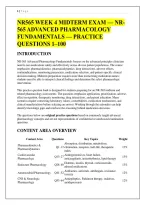
NR565 WEEK 4 MIDTERM EXAM — NR-
565 ADVANCED PHARMACOLOGY
FUNDAMENTALS — PRACTICE
QUESTIONS 1–100
INTRODUCTION
NR-565 Advanced Pharmacology Fundamentals focuses on the advanced principles clinicians
need to use medications safely and effectively across diverse patient populations. The course
emphasizes pharmacokinetics, pharmacodynamics, drug interactions, adverse effects,
contraindications, monitoring parameters, medication selection, and patient-specific clinical
decision-making. Midterm preparation requires more than memorizing medication names;
students must be able to interpret clinical findings and determine the safest pharmacologic
intervention.
This practice question bank is designed for students preparing for an NR-565 midterm and
related pharmacology assessments. The questions emphasize application, prioritization, adverse-
effect recognition, therapeutic monitoring, drug interactions, and patient education. Many
scenarios require connecting laboratory values, comorbidities, medication mechanisms, and
clinical manifestations before selecting an answer. Working through the rationales can help
identify knowledge gaps and reinforce the reasoning behind medication decisions.
The questions below are original practice questions based on commonly taught advanced
pharmacology concepts and are not representations of confidential or unreleased examination
questions.
CONTENT AREA OVERVIEW
Content Area Questions Key Topics Weight
Absorption, distribution, metabolism,
Pharmacokinetics &
Q1–12 elimination, receptors, half-life, therapeutic 12%
Pharmacodynamics
index
Cardiovascular Antihypertensives, heart failure,
Q13–27 15%
Pharmacology anticoagulants, antiarrhythmics, lipid therapy
Diabetes, insulin, thyroid, corticosteroids,
Endocrine Pharmacology Q28–40 13%
adrenal medications
Antibiotics, antivirals, antifungals, resistance,
Antimicrobial Pharmacology Q41–52 12%
toxicity
CNS & Neurologic Antiepileptics, Parkinson therapy, sedatives,
Q53–64 12%
Pharmacology antidepressants
,2|Page
Content Area Questions Key Topics Weight
Asthma, COPD, bronchodilators, inhaled
Respiratory Pharmacology Q65–72 8%
corticosteroids
Gastrointestinal Acid suppression, antiemetics, laxatives,
Q73–80 8%
Pharmacology hepatic encephalopathy
Pain & Inflammatory Opioids, NSAIDs, acetaminophen,
Q81–87 7%
Pharmacology corticosteroids
Antidepressants, antipsychotics, anxiolytics,
Psychopharmacology Q88–94 7%
mood stabilizers
Medication Safety & Interactions, reconciliation, monitoring, high-
Q95–100 6%
Clinical Judgment alert medications
QUESTIONS 1–100
PHARMACOKINETICS & PHARMACODYNAMICS
Q1:
A 72-year-old patient with severe hypoalbuminemia is prescribed a highly protein-bound
medication. Shortly after initiation, the patient develops manifestations consistent with drug
toxicity despite receiving the usual therapeutic dose. Which pharmacokinetic change best
explains this finding?
A) Increased renal excretion of the unbound medication
B) Increased free drug concentration resulting from reduced protein binding
C) Decreased gastrointestinal absorption caused by hypoalbuminemia
D) Increased hepatic metabolism caused by increased albumin clearance
Rationale: The correct answer is B because decreased albumin increases the fraction of highly
protein-bound medication that remains pharmacologically active in the circulation, potentially
increasing toxicity. A is incorrect because hypoalbuminemia does not directly increase renal
excretion. C is incorrect because albumin concentration does not primarily determine
gastrointestinal absorption. D is incorrect because reduced albumin does not inherently increase
hepatic metabolism.
Q2:
A patient receiving a medication eliminated primarily through the kidneys develops acute kidney
injury. The medication has a narrow therapeutic index. Which action is most appropriate?
A) Automatically double the dose to compensate for reduced absorption
B) Evaluate renal function and consider dose or dosing-interval adjustment
,3|Page
C) Continue the same regimen because the therapeutic index is narrow
D) Discontinue all medications until renal function normalizes
Rationale: The correct answer is B because impaired renal clearance can increase drug
accumulation and toxicity, particularly with narrow-therapeutic-index medications. A is unsafe
because kidney injury does not justify increasing the dose. C ignores the increased risk of
accumulation. D is inappropriate because medications should be individually evaluated rather
than universally discontinued.
Q3:
A patient taking a medication with a half-life of 24 hours asks why several days may be needed
before the medication reaches a relatively stable concentration. Which explanation is most
accurate?
A) The medication is absorbed only once every 24 hours
B) Several half-lives are generally required to approach steady-state concentration
C) The liver cannot metabolize the medication until the fifth dose
D) The medication becomes active only after complete renal elimination
Rationale: The correct answer is B because steady state is typically approached after
approximately four to five half-lives for many drugs. A confuses absorption with elimination. C is
incorrect because hepatic metabolism begins according to the drug's pharmacokinetic
properties, not after a fixed number of doses. D is incorrect because elimination removes drug
rather than activating it in most cases.
Q4:
A patient taking a medication extensively metabolized by CYP3A4 begins therapy with a potent
CYP3A4 inhibitor. What clinical consequence should the clinician anticipate?
A) Decreased medication concentration and therapeutic failure
B) Increased medication concentration and potential toxicity
C) Increased renal clearance of the medication
D) Complete prevention of medication absorption
Rationale: The correct answer is B because CYP inhibition can reduce hepatic metabolism and
increase systemic drug exposure. A describes the opposite effect. C is incorrect because CYP3A4
primarily affects metabolism rather than directly increasing renal clearance. D is incorrect
because CYP inhibition does not prevent gastrointestinal absorption.
Q5:
A patient taking a medication metabolized by CYP enzymes begins a strong enzyme inducer.
Which outcome is most likely?
, 4|Page
A) Increased serum concentration and toxicity
B) Reduced serum concentration and possible therapeutic failure
C) Immediate renal failure
D) Increased protein binding
Rationale: The correct answer is B because enzyme induction increases metabolism of
susceptible drugs, lowering their plasma concentrations. A is the typical consequence of enzyme
inhibition, not induction. C is unrelated to CYP induction. D is incorrect because enzyme
induction does not directly increase plasma protein binding.
Q6:
A medication produces its therapeutic effect by binding to a receptor and preventing an
endogenous agonist from activating it. How should this medication be classified?
A) Full agonist
B) Partial agonist
C) Competitive antagonist
D) Enzyme inducer
Rationale: The correct answer is C because a competitive antagonist occupies a receptor and
prevents an agonist from producing its effect. A activates the receptor fully. B activates the
receptor but produces a lower maximal response. D describes altered enzyme activity rather
than receptor blockade.
Q7:
A patient has received a sedative medication regularly for several months and now requires a
higher dose to achieve the same clinical response. Which pharmacodynamic phenomenon is
occurring?
A) Idiosyncratic reaction
B) Tolerance
C) First-pass metabolism
D) Bioavailability
Rationale: The correct answer is B because tolerance occurs when repeated exposure reduces
the response to a medication, requiring higher doses for the same effect. A refers to an unusual
unpredictable reaction. C concerns metabolism before systemic circulation. D refers to the
fraction of a drug reaching systemic circulation.
Q8:
A clinician combines two medications whose pharmacologic effects together are greater than the
effect expected from simply adding their individual effects. Which interaction is being
demonstrated?
NR565 WEEK 4 MIDTERM EXAM — NR-
565 ADVANCED PHARMACOLOGY
FUNDAMENTALS — PRACTICE
QUESTIONS 1–100
INTRODUCTION
NR-565 Advanced Pharmacology Fundamentals focuses on the advanced principles clinicians
need to use medications safely and effectively across diverse patient populations. The course
emphasizes pharmacokinetics, pharmacodynamics, drug interactions, adverse effects,
contraindications, monitoring parameters, medication selection, and patient-specific clinical
decision-making. Midterm preparation requires more than memorizing medication names;
students must be able to interpret clinical findings and determine the safest pharmacologic
intervention.
This practice question bank is designed for students preparing for an NR-565 midterm and
related pharmacology assessments. The questions emphasize application, prioritization, adverse-
effect recognition, therapeutic monitoring, drug interactions, and patient education. Many
scenarios require connecting laboratory values, comorbidities, medication mechanisms, and
clinical manifestations before selecting an answer. Working through the rationales can help
identify knowledge gaps and reinforce the reasoning behind medication decisions.
The questions below are original practice questions based on commonly taught advanced
pharmacology concepts and are not representations of confidential or unreleased examination
questions.
CONTENT AREA OVERVIEW
Content Area Questions Key Topics Weight
Absorption, distribution, metabolism,
Pharmacokinetics &
Q1–12 elimination, receptors, half-life, therapeutic 12%
Pharmacodynamics
index
Cardiovascular Antihypertensives, heart failure,
Q13–27 15%
Pharmacology anticoagulants, antiarrhythmics, lipid therapy
Diabetes, insulin, thyroid, corticosteroids,
Endocrine Pharmacology Q28–40 13%
adrenal medications
Antibiotics, antivirals, antifungals, resistance,
Antimicrobial Pharmacology Q41–52 12%
toxicity
CNS & Neurologic Antiepileptics, Parkinson therapy, sedatives,
Q53–64 12%
Pharmacology antidepressants
,2|Page
Content Area Questions Key Topics Weight
Asthma, COPD, bronchodilators, inhaled
Respiratory Pharmacology Q65–72 8%
corticosteroids
Gastrointestinal Acid suppression, antiemetics, laxatives,
Q73–80 8%
Pharmacology hepatic encephalopathy
Pain & Inflammatory Opioids, NSAIDs, acetaminophen,
Q81–87 7%
Pharmacology corticosteroids
Antidepressants, antipsychotics, anxiolytics,
Psychopharmacology Q88–94 7%
mood stabilizers
Medication Safety & Interactions, reconciliation, monitoring, high-
Q95–100 6%
Clinical Judgment alert medications
QUESTIONS 1–100
PHARMACOKINETICS & PHARMACODYNAMICS
Q1:
A 72-year-old patient with severe hypoalbuminemia is prescribed a highly protein-bound
medication. Shortly after initiation, the patient develops manifestations consistent with drug
toxicity despite receiving the usual therapeutic dose. Which pharmacokinetic change best
explains this finding?
A) Increased renal excretion of the unbound medication
B) Increased free drug concentration resulting from reduced protein binding
C) Decreased gastrointestinal absorption caused by hypoalbuminemia
D) Increased hepatic metabolism caused by increased albumin clearance
Rationale: The correct answer is B because decreased albumin increases the fraction of highly
protein-bound medication that remains pharmacologically active in the circulation, potentially
increasing toxicity. A is incorrect because hypoalbuminemia does not directly increase renal
excretion. C is incorrect because albumin concentration does not primarily determine
gastrointestinal absorption. D is incorrect because reduced albumin does not inherently increase
hepatic metabolism.
Q2:
A patient receiving a medication eliminated primarily through the kidneys develops acute kidney
injury. The medication has a narrow therapeutic index. Which action is most appropriate?
A) Automatically double the dose to compensate for reduced absorption
B) Evaluate renal function and consider dose or dosing-interval adjustment
,3|Page
C) Continue the same regimen because the therapeutic index is narrow
D) Discontinue all medications until renal function normalizes
Rationale: The correct answer is B because impaired renal clearance can increase drug
accumulation and toxicity, particularly with narrow-therapeutic-index medications. A is unsafe
because kidney injury does not justify increasing the dose. C ignores the increased risk of
accumulation. D is inappropriate because medications should be individually evaluated rather
than universally discontinued.
Q3:
A patient taking a medication with a half-life of 24 hours asks why several days may be needed
before the medication reaches a relatively stable concentration. Which explanation is most
accurate?
A) The medication is absorbed only once every 24 hours
B) Several half-lives are generally required to approach steady-state concentration
C) The liver cannot metabolize the medication until the fifth dose
D) The medication becomes active only after complete renal elimination
Rationale: The correct answer is B because steady state is typically approached after
approximately four to five half-lives for many drugs. A confuses absorption with elimination. C is
incorrect because hepatic metabolism begins according to the drug's pharmacokinetic
properties, not after a fixed number of doses. D is incorrect because elimination removes drug
rather than activating it in most cases.
Q4:
A patient taking a medication extensively metabolized by CYP3A4 begins therapy with a potent
CYP3A4 inhibitor. What clinical consequence should the clinician anticipate?
A) Decreased medication concentration and therapeutic failure
B) Increased medication concentration and potential toxicity
C) Increased renal clearance of the medication
D) Complete prevention of medication absorption
Rationale: The correct answer is B because CYP inhibition can reduce hepatic metabolism and
increase systemic drug exposure. A describes the opposite effect. C is incorrect because CYP3A4
primarily affects metabolism rather than directly increasing renal clearance. D is incorrect
because CYP inhibition does not prevent gastrointestinal absorption.
Q5:
A patient taking a medication metabolized by CYP enzymes begins a strong enzyme inducer.
Which outcome is most likely?
, 4|Page
A) Increased serum concentration and toxicity
B) Reduced serum concentration and possible therapeutic failure
C) Immediate renal failure
D) Increased protein binding
Rationale: The correct answer is B because enzyme induction increases metabolism of
susceptible drugs, lowering their plasma concentrations. A is the typical consequence of enzyme
inhibition, not induction. C is unrelated to CYP induction. D is incorrect because enzyme
induction does not directly increase plasma protein binding.
Q6:
A medication produces its therapeutic effect by binding to a receptor and preventing an
endogenous agonist from activating it. How should this medication be classified?
A) Full agonist
B) Partial agonist
C) Competitive antagonist
D) Enzyme inducer
Rationale: The correct answer is C because a competitive antagonist occupies a receptor and
prevents an agonist from producing its effect. A activates the receptor fully. B activates the
receptor but produces a lower maximal response. D describes altered enzyme activity rather
than receptor blockade.
Q7:
A patient has received a sedative medication regularly for several months and now requires a
higher dose to achieve the same clinical response. Which pharmacodynamic phenomenon is
occurring?
A) Idiosyncratic reaction
B) Tolerance
C) First-pass metabolism
D) Bioavailability
Rationale: The correct answer is B because tolerance occurs when repeated exposure reduces
the response to a medication, requiring higher doses for the same effect. A refers to an unusual
unpredictable reaction. C concerns metabolism before systemic circulation. D refers to the
fraction of a drug reaching systemic circulation.
Q8:
A clinician combines two medications whose pharmacologic effects together are greater than the
effect expected from simply adding their individual effects. Which interaction is being
demonstrated?


