
1|Page
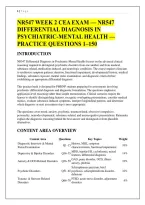
NR547 WEEK 2 CEA EXAM — NR547
DIFFERENTIAL DIAGNOSIS IN
PSYCHIATRIC-MENTAL HEALTH —
PRACTICE QUESTIONS 1–150
INTRODUCTION
NR547 Differential Diagnosis in Psychiatric-Mental Health focuses on the advanced clinical
reasoning required to distinguish psychiatric disorders from one another and from medical,
substance-related, medication-induced, and neurologic conditions. The course requires clinicians
to synthesize symptom patterns, duration, functional impairment, developmental history, medical
findings, substance exposure, mental status examination, and diagnostic criteria before
establishing an appropriate differential diagnosis.
This practice bank is designed for PMHNP students preparing for assessments involving
psychiatric differential diagnosis and diagnostic formulation. The questions emphasize
application-level reasoning rather than simple memorization. Clinical scenarios require the
learner to identify distinguishing features, recognize overlapping presentations, consider medical
mimics, evaluate substance-induced symptoms, interpret longitudinal patterns, and determine
which diagnosis or next assessment step is most appropriate.
The questions cover mood, anxiety, psychotic, trauma-related, obsessive-compulsive,
personality, neurodevelopmental, substance-related, and neurocognitive presentations. Rationales
explain the diagnostic reasoning behind the best answer and distinguish it from plausible
alternatives.
CONTENT AREA OVERVIEW
Content Area Questions Key Topics Weight
Diagnostic Interview & Mental History, MSE, symptom
Q1–15 10%
Status Examination characterization, functional impairment
MDD, bipolar I/II, cyclothymia, mixed
Depressive & Bipolar Disorders Q16–35 14%
features, differential diagnosis
GAD, panic disorder, OCD, illness
Anxiety & OCD-Related Disorders Q36–50 10%
anxiety, phobias
Schizophrenia spectrum, brief
Psychotic Disorders Q51–65 psychosis, schizophreniform disorder, 10%
delusions
Trauma- & Stressor-Related PTSD, acute stress disorder, adjustment
Q66–78 9%
Disorders disorders
,2|Page
Content Area Questions Key Topics Weight
Substance/Medication-Induced Intoxication, withdrawal, substance-
Q79–92 10%
Conditions induced psychiatric syndromes
Cluster A, B, C presentations and
Personality Disorders Q93–107 10%
differential diagnosis
ADHD, autism spectrum disorder,
Neurodevelopmental Disorders Q108–118 8%
developmental differentials
Delirium, dementia, neurologic and
Neurocognitive & Medical Mimics Q119–135 9%
endocrine mimics
Special Populations & Integrated Older adults, adolescents, pregnancy,
Q136–150 10%
Differential Diagnosis medical complexity
QUESTIONS 1–150
DIAGNOSTIC INTERVIEW & MENTAL STATUS
EXAMINATION
Q1:
A 29-year-old patient reports "anxiety" during the initial psychiatric evaluation. On further
questioning, the patient describes episodes lasting approximately 10 minutes in which there is
sudden chest tightness, palpitations, trembling, fear of dying, and a sense of losing control.
Between episodes, the patient worries extensively about having another attack. Which additional
finding would most strongly support panic disorder rather than generalized anxiety disorder?
A) Worry occurring on most days about several life domains
B) Recurrent unexpected episodes followed by persistent concern or behavioral change
C) Muscle tension occurring throughout the day
D) Difficulty controlling worry about finances and employment
Rationale: The correct answer is B because panic disorder involves recurrent unexpected panic
attacks followed by persistent concern or maladaptive behavioral changes. A, C, and D are more
characteristic of generalized anxiety disorder, which involves excessive worry across multiple
domains.
Q2:
During an interview, a patient answers questions appropriately but repeatedly returns to the same
unrelated topic despite redirection. Which aspect of the mental status examination is most
directly affected?
A) Affect
B) Thought process
,3|Page
C) Insight
D) Sensorium
Rationale: The correct answer is B because the organization and progression of ideas are
evaluated under thought process. Affect describes observable emotional expression, insight
concerns awareness of illness, and sensorium refers to consciousness and orientation.
Q3:
A patient reports hearing a voice commenting on actions when no external stimulus is present.
The patient recognizes that others cannot hear the voice. Which finding is most accurately
documented?
A) Illusion
B) Auditory hallucination with preserved insight
C) Obsession
D) Delusion
Rationale: The correct answer is B because a hallucination is a perception without an external
stimulus. Preserved insight is suggested by the patient's recognition that others do not perceive
the voice. An illusion involves misinterpretation of a real stimulus, an obsession is an intrusive
thought, and a delusion is a fixed false belief.
Q4:
A patient reports a belief that coworkers are secretly monitoring every conversation despite
repeated evidence that this is not occurring. The patient is completely convinced and cannot
consider alternative explanations. Which symptom is most consistent with this presentation?
A) Overvalued idea
B) Persecutory delusion
C) Obsession
D) Derealization
Rationale: The correct answer is B because a fixed, false belief involving being monitored or
harmed by others is characteristic of a persecutory delusion. An obsession is recognized as
intrusive by the patient, an overvalued idea is less rigid, and derealization involves altered
perception of the environment.
Q5:
A patient reports feeling detached from their own body, as though observing themselves from
outside. The patient understands that the experience is unusual. Which phenomenon is most
likely?
, 4|Page
A) Derealization
B) Depersonalization
C) Thought insertion
D) Delirium
Rationale: The correct answer is B because depersonalization involves an altered sense of one's
own self or body. Derealization concerns the environment feeling unreal. Thought insertion
involves the belief that thoughts have been placed into one's mind. Delirium involves impaired
attention and fluctuating consciousness.
Q6:
A patient presents with depressed mood but also reports decreased need for sleep, racing
thoughts, increased goal-directed activity, and impulsive spending occurring during distinct
periods. Which historical information is most important before diagnosing unipolar depression?
A) Whether the patient has experienced occasional sadness
B) Whether there have been distinct periods of abnormally elevated, expansive, or irritable
mood with increased energy
C) Whether the patient has experienced normal grief
D) Whether the patient dislikes their workplace
Rationale: The correct answer is B because identifying past manic or hypomanic episodes is
essential when differentiating depressive disorders from bipolar spectrum disorders. A, C, and D
do not establish bipolarity.
Q7:
A patient reports "hearing voices," but the clinician discovers that the experiences occur
exclusively while the patient is falling asleep and disappear once fully awake. What is the most
appropriate interpretation?
A) Definitive schizophrenia
B) Possible hypnagogic perceptual phenomena requiring clinical context
C) Persistent psychotic disorder
D) Delusional disorder
Rationale: The correct answer is B because perceptual experiences around sleep transitions can
occur without indicating a primary psychotic disorder. A, C, and D require broader evidence of
persistent psychosis and functional disturbance.
Q8:
A patient presents with severe anxiety and repeatedly checks whether the doors are locked. The
patient recognizes that the behavior is excessive but feels unable to resist the urge. Which feature
most strongly supports obsessive-compulsive disorder?
NR547 WEEK 2 CEA EXAM — NR547
DIFFERENTIAL DIAGNOSIS IN
PSYCHIATRIC-MENTAL HEALTH —
PRACTICE QUESTIONS 1–150
INTRODUCTION
NR547 Differential Diagnosis in Psychiatric-Mental Health focuses on the advanced clinical
reasoning required to distinguish psychiatric disorders from one another and from medical,
substance-related, medication-induced, and neurologic conditions. The course requires clinicians
to synthesize symptom patterns, duration, functional impairment, developmental history, medical
findings, substance exposure, mental status examination, and diagnostic criteria before
establishing an appropriate differential diagnosis.
This practice bank is designed for PMHNP students preparing for assessments involving
psychiatric differential diagnosis and diagnostic formulation. The questions emphasize
application-level reasoning rather than simple memorization. Clinical scenarios require the
learner to identify distinguishing features, recognize overlapping presentations, consider medical
mimics, evaluate substance-induced symptoms, interpret longitudinal patterns, and determine
which diagnosis or next assessment step is most appropriate.
The questions cover mood, anxiety, psychotic, trauma-related, obsessive-compulsive,
personality, neurodevelopmental, substance-related, and neurocognitive presentations. Rationales
explain the diagnostic reasoning behind the best answer and distinguish it from plausible
alternatives.
CONTENT AREA OVERVIEW
Content Area Questions Key Topics Weight
Diagnostic Interview & Mental History, MSE, symptom
Q1–15 10%
Status Examination characterization, functional impairment
MDD, bipolar I/II, cyclothymia, mixed
Depressive & Bipolar Disorders Q16–35 14%
features, differential diagnosis
GAD, panic disorder, OCD, illness
Anxiety & OCD-Related Disorders Q36–50 10%
anxiety, phobias
Schizophrenia spectrum, brief
Psychotic Disorders Q51–65 psychosis, schizophreniform disorder, 10%
delusions
Trauma- & Stressor-Related PTSD, acute stress disorder, adjustment
Q66–78 9%
Disorders disorders
,2|Page
Content Area Questions Key Topics Weight
Substance/Medication-Induced Intoxication, withdrawal, substance-
Q79–92 10%
Conditions induced psychiatric syndromes
Cluster A, B, C presentations and
Personality Disorders Q93–107 10%
differential diagnosis
ADHD, autism spectrum disorder,
Neurodevelopmental Disorders Q108–118 8%
developmental differentials
Delirium, dementia, neurologic and
Neurocognitive & Medical Mimics Q119–135 9%
endocrine mimics
Special Populations & Integrated Older adults, adolescents, pregnancy,
Q136–150 10%
Differential Diagnosis medical complexity
QUESTIONS 1–150
DIAGNOSTIC INTERVIEW & MENTAL STATUS
EXAMINATION
Q1:
A 29-year-old patient reports "anxiety" during the initial psychiatric evaluation. On further
questioning, the patient describes episodes lasting approximately 10 minutes in which there is
sudden chest tightness, palpitations, trembling, fear of dying, and a sense of losing control.
Between episodes, the patient worries extensively about having another attack. Which additional
finding would most strongly support panic disorder rather than generalized anxiety disorder?
A) Worry occurring on most days about several life domains
B) Recurrent unexpected episodes followed by persistent concern or behavioral change
C) Muscle tension occurring throughout the day
D) Difficulty controlling worry about finances and employment
Rationale: The correct answer is B because panic disorder involves recurrent unexpected panic
attacks followed by persistent concern or maladaptive behavioral changes. A, C, and D are more
characteristic of generalized anxiety disorder, which involves excessive worry across multiple
domains.
Q2:
During an interview, a patient answers questions appropriately but repeatedly returns to the same
unrelated topic despite redirection. Which aspect of the mental status examination is most
directly affected?
A) Affect
B) Thought process
,3|Page
C) Insight
D) Sensorium
Rationale: The correct answer is B because the organization and progression of ideas are
evaluated under thought process. Affect describes observable emotional expression, insight
concerns awareness of illness, and sensorium refers to consciousness and orientation.
Q3:
A patient reports hearing a voice commenting on actions when no external stimulus is present.
The patient recognizes that others cannot hear the voice. Which finding is most accurately
documented?
A) Illusion
B) Auditory hallucination with preserved insight
C) Obsession
D) Delusion
Rationale: The correct answer is B because a hallucination is a perception without an external
stimulus. Preserved insight is suggested by the patient's recognition that others do not perceive
the voice. An illusion involves misinterpretation of a real stimulus, an obsession is an intrusive
thought, and a delusion is a fixed false belief.
Q4:
A patient reports a belief that coworkers are secretly monitoring every conversation despite
repeated evidence that this is not occurring. The patient is completely convinced and cannot
consider alternative explanations. Which symptom is most consistent with this presentation?
A) Overvalued idea
B) Persecutory delusion
C) Obsession
D) Derealization
Rationale: The correct answer is B because a fixed, false belief involving being monitored or
harmed by others is characteristic of a persecutory delusion. An obsession is recognized as
intrusive by the patient, an overvalued idea is less rigid, and derealization involves altered
perception of the environment.
Q5:
A patient reports feeling detached from their own body, as though observing themselves from
outside. The patient understands that the experience is unusual. Which phenomenon is most
likely?
, 4|Page
A) Derealization
B) Depersonalization
C) Thought insertion
D) Delirium
Rationale: The correct answer is B because depersonalization involves an altered sense of one's
own self or body. Derealization concerns the environment feeling unreal. Thought insertion
involves the belief that thoughts have been placed into one's mind. Delirium involves impaired
attention and fluctuating consciousness.
Q6:
A patient presents with depressed mood but also reports decreased need for sleep, racing
thoughts, increased goal-directed activity, and impulsive spending occurring during distinct
periods. Which historical information is most important before diagnosing unipolar depression?
A) Whether the patient has experienced occasional sadness
B) Whether there have been distinct periods of abnormally elevated, expansive, or irritable
mood with increased energy
C) Whether the patient has experienced normal grief
D) Whether the patient dislikes their workplace
Rationale: The correct answer is B because identifying past manic or hypomanic episodes is
essential when differentiating depressive disorders from bipolar spectrum disorders. A, C, and D
do not establish bipolarity.
Q7:
A patient reports "hearing voices," but the clinician discovers that the experiences occur
exclusively while the patient is falling asleep and disappear once fully awake. What is the most
appropriate interpretation?
A) Definitive schizophrenia
B) Possible hypnagogic perceptual phenomena requiring clinical context
C) Persistent psychotic disorder
D) Delusional disorder
Rationale: The correct answer is B because perceptual experiences around sleep transitions can
occur without indicating a primary psychotic disorder. A, C, and D require broader evidence of
persistent psychosis and functional disturbance.
Q8:
A patient presents with severe anxiety and repeatedly checks whether the doors are locked. The
patient recognizes that the behavior is excessive but feels unable to resist the urge. Which feature
most strongly supports obsessive-compulsive disorder?


