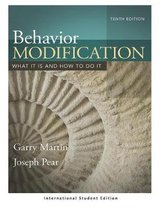
TEST BANK FOR BEHAVIOR MODIFICATION
WHAT IT IS AND HOW TO DO IT 12TH EDITION
BY GARRY MARTIN, JOSEPH J. PEAR: ISBN-10;
1032233141 / ISBN 13; 978-1032233147
# TEST BANK FOR BEHAVIOR MODIFICATION: WHAT IT IS AND HOW TO DO IT (12th Edition)
## By Garry Martin & Joseph J. Pear
---
## CHAPTER 1: INTRODUCTION
---
**1. A behavioral deficit is:**
a) too little of a particular type of behavior
b) too much of a particular type of behavior
c) an appropriate behavior occurring to the wrong stimulus
d) an appropriate behavior occurring at the wrong time or place
**Correct Answer: a) too little of a particular type of behavior**
**Rationale:** A behavioral deficit refers to an insufficient frequency or intensity of a desirable
behavior. It is defined as "too little of a particular type of behavior." This is a foundational concept in
behavior modification where the goal is often to increase deficient behaviors.
,---
**2. A behavioral excess is:**
a) too much of a particular type of behavior
b) too little of a particular type of behavior
c) an appropriate behavior occurring to the wrong stimulus
d) an appropriate behavior occurring at the wrong time or place
**Correct Answer: a) too much of a particular type of behavior**
**Rationale:** A behavioral excess refers to an excessive frequency or intensity of an undesirable
behavior. It is defined as "too much of a particular type of behavior." Behavior modifiers often work to
decrease behavioral excesses.
---
**3. Which of the following is an example of behavior?**
a) hair color
b) the color of someone's eyes
c) the clothes someone is wearing
*d) dressing in the morning
**Correct Answer: d) dressing in the morning**
**Rationale:** Behavior is defined as anything a person does or says. Dressing in the morning is an
action that a person performs. Hair color, eye color, and clothes are not behaviors—they are physical
characteristics or products of behavior, not the behavior itself.
,---
**4. In behavior modification, motivation and intelligence refer to:**
a) inner mental processes
*b) ways of behaving
c) causes of behavior
d) major sources of abnormality
**Correct Answer: b) ways of behaving**
**Rationale:** In behavior modification, motivation and intelligence are viewed as ways of behaving
rather than as inner mental processes or causes of behavior. This reflects the behavioral perspective
that focuses on observable and measurable behaviors rather than hypothetical internal constructs.
---
**5. In behavior modification, the term "environment" refers to:**
a) the neighborhood in which a person is raised
b) the natural habitat of an organism
*c) the specific physical variables in one's immediate surroundings
d) the general situation where one happens to be
**Correct Answer: c) the specific physical variables in one's immediate surroundings**
**Rationale:** In behavior modification, "environment" refers to the specific physical variables in one's
immediate surroundings that can affect behavior. This is a more precise and operational definition than
broad terms like neighborhood or general situation.
, ---
**6. A child does not pronounce words clearly and does not interact with other children. These are
examples of:**
a) behavioral excesses
b) behavioral abnormalities
*c) behavioral deficits
d) behavioral characteristics
**Correct Answer: c) behavioral deficits**
**Rationale:** Both not pronouncing words clearly and not interacting with other children represent
too little of desirable behaviors. These are behavioral deficits—behaviors that are insufficient in
frequency or quality.
---
**7. Behavior modifiers stress the importance of defining problems in terms of specific behavioral
deficits or behavioral excesses because:**
a) therapists can then focus on the individual's problem behaviors rather than on his or her strengths
*b) it is behavior that causes concern, and there are specific procedures now available to change
behavior
**Correct Answer: b) it is behavior that causes concern, and there are specific procedures now available
to change behavior**
**Rationale:** Defining problems in behavioral terms allows for the application of specific, evidence-
based procedures to change behavior. This is a core principle of behavior modification—focusing on
what can be observed, measured, and changed.
WHAT IT IS AND HOW TO DO IT 12TH EDITION
BY GARRY MARTIN, JOSEPH J. PEAR: ISBN-10;
1032233141 / ISBN 13; 978-1032233147
# TEST BANK FOR BEHAVIOR MODIFICATION: WHAT IT IS AND HOW TO DO IT (12th Edition)
## By Garry Martin & Joseph J. Pear
---
## CHAPTER 1: INTRODUCTION
---
**1. A behavioral deficit is:**
a) too little of a particular type of behavior
b) too much of a particular type of behavior
c) an appropriate behavior occurring to the wrong stimulus
d) an appropriate behavior occurring at the wrong time or place
**Correct Answer: a) too little of a particular type of behavior**
**Rationale:** A behavioral deficit refers to an insufficient frequency or intensity of a desirable
behavior. It is defined as "too little of a particular type of behavior." This is a foundational concept in
behavior modification where the goal is often to increase deficient behaviors.
,---
**2. A behavioral excess is:**
a) too much of a particular type of behavior
b) too little of a particular type of behavior
c) an appropriate behavior occurring to the wrong stimulus
d) an appropriate behavior occurring at the wrong time or place
**Correct Answer: a) too much of a particular type of behavior**
**Rationale:** A behavioral excess refers to an excessive frequency or intensity of an undesirable
behavior. It is defined as "too much of a particular type of behavior." Behavior modifiers often work to
decrease behavioral excesses.
---
**3. Which of the following is an example of behavior?**
a) hair color
b) the color of someone's eyes
c) the clothes someone is wearing
*d) dressing in the morning
**Correct Answer: d) dressing in the morning**
**Rationale:** Behavior is defined as anything a person does or says. Dressing in the morning is an
action that a person performs. Hair color, eye color, and clothes are not behaviors—they are physical
characteristics or products of behavior, not the behavior itself.
,---
**4. In behavior modification, motivation and intelligence refer to:**
a) inner mental processes
*b) ways of behaving
c) causes of behavior
d) major sources of abnormality
**Correct Answer: b) ways of behaving**
**Rationale:** In behavior modification, motivation and intelligence are viewed as ways of behaving
rather than as inner mental processes or causes of behavior. This reflects the behavioral perspective
that focuses on observable and measurable behaviors rather than hypothetical internal constructs.
---
**5. In behavior modification, the term "environment" refers to:**
a) the neighborhood in which a person is raised
b) the natural habitat of an organism
*c) the specific physical variables in one's immediate surroundings
d) the general situation where one happens to be
**Correct Answer: c) the specific physical variables in one's immediate surroundings**
**Rationale:** In behavior modification, "environment" refers to the specific physical variables in one's
immediate surroundings that can affect behavior. This is a more precise and operational definition than
broad terms like neighborhood or general situation.
, ---
**6. A child does not pronounce words clearly and does not interact with other children. These are
examples of:**
a) behavioral excesses
b) behavioral abnormalities
*c) behavioral deficits
d) behavioral characteristics
**Correct Answer: c) behavioral deficits**
**Rationale:** Both not pronouncing words clearly and not interacting with other children represent
too little of desirable behaviors. These are behavioral deficits—behaviors that are insufficient in
frequency or quality.
---
**7. Behavior modifiers stress the importance of defining problems in terms of specific behavioral
deficits or behavioral excesses because:**
a) therapists can then focus on the individual's problem behaviors rather than on his or her strengths
*b) it is behavior that causes concern, and there are specific procedures now available to change
behavior
**Correct Answer: b) it is behavior that causes concern, and there are specific procedures now available
to change behavior**
**Rationale:** Defining problems in behavioral terms allows for the application of specific, evidence-
based procedures to change behavior. This is a core principle of behavior modification—focusing on
what can be observed, measured, and changed.