
STUDY AID
P S Y C H I AT R I C - M E N TA L H E A LT H N U R S I N G · E X A M R E V I E W & S T U D Y B A N K
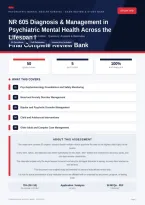
NR 605 Diagnosis & Management in
Psychiatric Mental Health Across the
Lifespan I
Exam Review Edition · Questions, Answers & Rationales
50 Questions Full Rationales Answer Key Included
Final Complete Review Bank
50 5 100%
QUESTIONS SECTIONS R AT I O N A L E S
WHAT THIS COVERS
01 Psychopharmacology Foundations and Safety Monitoring
02 Mood and Anxiety Disorder Management
03 Bipolar and Psychotic Disorder Management
04 Child and Adolescent Interventions
05 Older Adult and Complex Case Management
ABOUT THIS ASSESSMENT
This study bank contains 50 original, scenario-based multiple-choice questions focused on the highest-yield topics of the
course.
Every stem, option, and rationale was written specifically for this edition and reviewed for accuracy, clarity, and
one-best-answer construction.
The rationales explain why the keyed answer is correct and why the strongest distractor is wrong, so every item teaches as
well as tests.
This document is an original study aid intended for personal educational review only.
It is not the actual examination of any institution and is not affiliated with or endorsed by any school, program, or testing
body.
75% () Application / Analysis 50 MCQs · PDF
PA S S I N G S C O R E LEVEL F O R M AT
EXAM REVIEW & STUDY BANK · 2026/2027 Page 1
,NR 605 Diagnosis & Management Across the Lifespan I · Final Review Bank Edition
SECTION 1 · PSYCHOPHARMACOLOGY FOUNDATIONS AND SAFETY MONITORING
Q1. A 34-year-old woman with moderate depression is started on sertraline 50 mg daily. At the two-week
check she feels slightly improved but impatient for results. What is the most appropriate counseling
and monitoring plan?
A. Double the dose now because response should appear within days
B. Discontinue the trial at two weeks and switch agents immediately
C. Extend the interval between visits to six months without measurement
D. Explain the four-to-six-week onset expectation and reassess with the PHQ-9 at that interval
Correct Answer: D
Rationale: Antidepressant benefit typically emerges over four to six weeks, and guideline-based care re-measures
symptoms at that interval before switching or augmenting. Early dose doubling increases side effects without
accelerating onset, and abandoning a too-young trial or extending follow-up inappropriately both violate
measurement-based care.
Q2. Three days after an SSRI dose increase, a 29-year-old develops agitation, diaphoresis, tremor,
hyperreflexia, inducible ankle clonus, and temperature of 38.9 C after adding an OTC cough remedy.
What is the correct recognition and immediate management?
A. Serotonin syndrome from a serotonergic interaction; stop serotonergic agents and provide
supportive care
B. Neuroleptic malignant syndrome treated with dantrolene
C. Simple SSRI side effect managed by taking the drug with food
D. Anticholinergic toxicity treated with physostigmine
Correct Answer: A
Rationale: Clonus, hyperreflexia, hyperthermia, and autonomic instability after serotonergic stacking define
serotonin syndrome, managed by stopping the agents and supportive measures. NMS involves antipsychotics with
leaden rigidity and elevated creatine kinase, and the other options misread the toxidrome.
EXAM REVIEW & STUDY BANK · 2026/2027 Page 2
, NR 605 Diagnosis & Management Across the Lifespan I · Final Review Bank Edition
Q3. A 78-year-old on escitalopram for eight weeks reports new fatigue, lightheadedness on standing, and
two recent falls. Sodium returns at 126 mEq/L. What is the correct management step?
A. Recognize SSRI-associated hyponatremia and hold or reduce the SSRI with sodium monitoring
B. Increase the SSRI to consolidate the antidepressant effect
C. Add a salt supplement and continue the same dose unchanged
D. Attribute the falls to normal aging and continue all medications
Correct Answer: A
Rationale: SSRIs can cause SIADH-mediated hyponatremia, especially in older adults, producing fatigue,
lightheadedness, and falls. The correct response is dose reduction or discontinuation with monitored recovery, while
dose escalation or dismissing geriatric falls worsens the danger.
Q4. A 19-year-old starting fluoxetine asks why the pharmacist warned about suicidal thoughts in young
patients. What is the most accurate explanation and plan?
A. The warning applies only to patients older than 65
B. The warning concerns dependence and requires tapering forever
C. Antidepressants carry a boxed warning for suicidality under age 25, so schedule close early
monitoring
D. The label warning means fluoxetine is contraindicated in this age group
Correct Answer: C
Rationale: The boxed warning covers antidepressant-emergent suicidality in patients under 25, reflecting early
activation before mood improves, which is addressed by frequent early contact rather than avoidance. Fluoxetine is
not contraindicated in adolescents, and the warning addresses neither geriatrics nor dependence.
Q5. A 46-year-old with depression plans a trip abroad and buys St. John's wort from an online shop while
continuing prescribed sertraline. What is the most important counseling point?
A. The combination is a recommended strategy to speed response
B. Herbal products never interact with prescription antidepressants
C. Only concern involves mild stomach upset from the herb
D. Combining the two can precipitate serotonin syndrome and St. John's wort also induces
drug-metabolizing enzymes
Correct Answer: D
Rationale: St. John's wort is serotonergic and a potent CYP3A4 inducer, creating serotonin-syndrome risk with
SSRIs and reducing levels of many co-prescribed drugs. Combining serotonergic agents is never a strategy to
accelerate response.
EXAM REVIEW & STUDY BANK · 2026/2027 Page 3
P S Y C H I AT R I C - M E N TA L H E A LT H N U R S I N G · E X A M R E V I E W & S T U D Y B A N K
NR 605 Diagnosis & Management in
Psychiatric Mental Health Across the
Lifespan I
Exam Review Edition · Questions, Answers & Rationales
50 Questions Full Rationales Answer Key Included
Final Complete Review Bank
50 5 100%
QUESTIONS SECTIONS R AT I O N A L E S
WHAT THIS COVERS
01 Psychopharmacology Foundations and Safety Monitoring
02 Mood and Anxiety Disorder Management
03 Bipolar and Psychotic Disorder Management
04 Child and Adolescent Interventions
05 Older Adult and Complex Case Management
ABOUT THIS ASSESSMENT
This study bank contains 50 original, scenario-based multiple-choice questions focused on the highest-yield topics of the
course.
Every stem, option, and rationale was written specifically for this edition and reviewed for accuracy, clarity, and
one-best-answer construction.
The rationales explain why the keyed answer is correct and why the strongest distractor is wrong, so every item teaches as
well as tests.
This document is an original study aid intended for personal educational review only.
It is not the actual examination of any institution and is not affiliated with or endorsed by any school, program, or testing
body.
75% () Application / Analysis 50 MCQs · PDF
PA S S I N G S C O R E LEVEL F O R M AT
EXAM REVIEW & STUDY BANK · 2026/2027 Page 1
,NR 605 Diagnosis & Management Across the Lifespan I · Final Review Bank Edition
SECTION 1 · PSYCHOPHARMACOLOGY FOUNDATIONS AND SAFETY MONITORING
Q1. A 34-year-old woman with moderate depression is started on sertraline 50 mg daily. At the two-week
check she feels slightly improved but impatient for results. What is the most appropriate counseling
and monitoring plan?
A. Double the dose now because response should appear within days
B. Discontinue the trial at two weeks and switch agents immediately
C. Extend the interval between visits to six months without measurement
D. Explain the four-to-six-week onset expectation and reassess with the PHQ-9 at that interval
Correct Answer: D
Rationale: Antidepressant benefit typically emerges over four to six weeks, and guideline-based care re-measures
symptoms at that interval before switching or augmenting. Early dose doubling increases side effects without
accelerating onset, and abandoning a too-young trial or extending follow-up inappropriately both violate
measurement-based care.
Q2. Three days after an SSRI dose increase, a 29-year-old develops agitation, diaphoresis, tremor,
hyperreflexia, inducible ankle clonus, and temperature of 38.9 C after adding an OTC cough remedy.
What is the correct recognition and immediate management?
A. Serotonin syndrome from a serotonergic interaction; stop serotonergic agents and provide
supportive care
B. Neuroleptic malignant syndrome treated with dantrolene
C. Simple SSRI side effect managed by taking the drug with food
D. Anticholinergic toxicity treated with physostigmine
Correct Answer: A
Rationale: Clonus, hyperreflexia, hyperthermia, and autonomic instability after serotonergic stacking define
serotonin syndrome, managed by stopping the agents and supportive measures. NMS involves antipsychotics with
leaden rigidity and elevated creatine kinase, and the other options misread the toxidrome.
EXAM REVIEW & STUDY BANK · 2026/2027 Page 2
, NR 605 Diagnosis & Management Across the Lifespan I · Final Review Bank Edition
Q3. A 78-year-old on escitalopram for eight weeks reports new fatigue, lightheadedness on standing, and
two recent falls. Sodium returns at 126 mEq/L. What is the correct management step?
A. Recognize SSRI-associated hyponatremia and hold or reduce the SSRI with sodium monitoring
B. Increase the SSRI to consolidate the antidepressant effect
C. Add a salt supplement and continue the same dose unchanged
D. Attribute the falls to normal aging and continue all medications
Correct Answer: A
Rationale: SSRIs can cause SIADH-mediated hyponatremia, especially in older adults, producing fatigue,
lightheadedness, and falls. The correct response is dose reduction or discontinuation with monitored recovery, while
dose escalation or dismissing geriatric falls worsens the danger.
Q4. A 19-year-old starting fluoxetine asks why the pharmacist warned about suicidal thoughts in young
patients. What is the most accurate explanation and plan?
A. The warning applies only to patients older than 65
B. The warning concerns dependence and requires tapering forever
C. Antidepressants carry a boxed warning for suicidality under age 25, so schedule close early
monitoring
D. The label warning means fluoxetine is contraindicated in this age group
Correct Answer: C
Rationale: The boxed warning covers antidepressant-emergent suicidality in patients under 25, reflecting early
activation before mood improves, which is addressed by frequent early contact rather than avoidance. Fluoxetine is
not contraindicated in adolescents, and the warning addresses neither geriatrics nor dependence.
Q5. A 46-year-old with depression plans a trip abroad and buys St. John's wort from an online shop while
continuing prescribed sertraline. What is the most important counseling point?
A. The combination is a recommended strategy to speed response
B. Herbal products never interact with prescription antidepressants
C. Only concern involves mild stomach upset from the herb
D. Combining the two can precipitate serotonin syndrome and St. John's wort also induces
drug-metabolizing enzymes
Correct Answer: D
Rationale: St. John's wort is serotonergic and a potent CYP3A4 inducer, creating serotonin-syndrome risk with
SSRIs and reducing levels of many co-prescribed drugs. Combining serotonergic agents is never a strategy to
accelerate response.
EXAM REVIEW & STUDY BANK · 2026/2027 Page 3


