
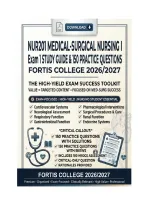
,NUR201 Medical-Surgical Nursing I Exam 1
Study Guide & 150 Practice Questions Fortis
College 2026/2027
1. A nurse is providing preoperative teaching to a client scheduled for surgery. The client asks
why they must remain NPO after midnight. Which response by the nurse is most appropriate?
A. "To reduce the risk of developing a postoperative wound infection."
B. "To ensure the stomach is empty for a clearer surgical view."
C. "To prevent postoperative constipation and abdominal distension."
D. "To prevent the risk of aspiration during anesthesia administration."
Correct Answer: D. "To prevent the risk of aspiration during anesthesia administration."
Rationale: The primary reason for NPO status prior to surgery is to prevent the aspiration of
gastric contents into the lungs while the client is under anesthesia, which suppresses protective
airway reflexes. Aspiration can lead to severe pneumonia or respiratory failure. The nurse must
emphasize that even small amounts of liquid can pose a significant risk.
2. When assessing a postoperative client, the nurse notes that the surgical dressing is saturated
with bright red blood. Which action should the nurse take first?
,A. Reinforce the dressing with additional sterile gauze pads.
B. Remove the old dressing to inspect the incision site.
C. Notify the surgeon immediately about the active bleeding.
D. Document the finding and reassess the client in one hour.
Correct Answer: A. Reinforce the dressing with additional sterile gauze pads.
Rationale: The initial nursing action for a saturated dressing is to reinforce it with additional
sterile gauze pads to prevent contamination and monitor the amount of bleeding. The nurse
should then notify the surgeon and monitor the client for signs of hypovolemic shock. Removing
the old dressing can disrupt clot formation and increase bleeding.
3. A nurse is preparing a 72-year-old patient for an elective total knee replacement scheduled
for tomorrow morning. Which action by the nurse demonstrates proper understanding of the
informed consent process?
A. The nurse witnesses the patient's signature after the surgeon explains the procedure, risks,
and alternatives.
B. The nurse obtains the informed consent from the patient after explaining the surgical
procedure.
C. The nurse asks the patient to sign the consent form without the surgeon present.
, D. The nurse explains the risks and benefits of anesthesia to the patient.
Correct Answer: A. The nurse witnesses the patient's signature after the surgeon explains the
procedure, risks, and alternatives.
Rationale: Informed consent is a legally required process that must be obtained by the physician
(surgeon), and the nurse's role is to witness the patient's signature and verify the patient's
understanding through teach-back methods. The nurse ensures there is no coercion and that
the patient has had adequate opportunity to ask questions before signing. It is outside the
nurse's scope of practice to obtain informed consent for surgical procedures, as this
responsibility belongs to the operating surgeon who will perform the procedure.
4. A patient arrives at the outpatient surgical center for a scheduled laparoscopy under general
anesthesia. Which information requires the nurse's intervention to maintain patient safety?
A. The patient has never had general anesthesia.
B. The patient is planning to drive home after surgery.
C. The patient drank a sip of water 4 hours before arriving.
D. The patient's insurance does not cover outpatient surgery.
Correct Answer: B. The patient is planning to drive home after surgery.
Study Guide & 150 Practice Questions Fortis
College 2026/2027
1. A nurse is providing preoperative teaching to a client scheduled for surgery. The client asks
why they must remain NPO after midnight. Which response by the nurse is most appropriate?
A. "To reduce the risk of developing a postoperative wound infection."
B. "To ensure the stomach is empty for a clearer surgical view."
C. "To prevent postoperative constipation and abdominal distension."
D. "To prevent the risk of aspiration during anesthesia administration."
Correct Answer: D. "To prevent the risk of aspiration during anesthesia administration."
Rationale: The primary reason for NPO status prior to surgery is to prevent the aspiration of
gastric contents into the lungs while the client is under anesthesia, which suppresses protective
airway reflexes. Aspiration can lead to severe pneumonia or respiratory failure. The nurse must
emphasize that even small amounts of liquid can pose a significant risk.
2. When assessing a postoperative client, the nurse notes that the surgical dressing is saturated
with bright red blood. Which action should the nurse take first?
,A. Reinforce the dressing with additional sterile gauze pads.
B. Remove the old dressing to inspect the incision site.
C. Notify the surgeon immediately about the active bleeding.
D. Document the finding and reassess the client in one hour.
Correct Answer: A. Reinforce the dressing with additional sterile gauze pads.
Rationale: The initial nursing action for a saturated dressing is to reinforce it with additional
sterile gauze pads to prevent contamination and monitor the amount of bleeding. The nurse
should then notify the surgeon and monitor the client for signs of hypovolemic shock. Removing
the old dressing can disrupt clot formation and increase bleeding.
3. A nurse is preparing a 72-year-old patient for an elective total knee replacement scheduled
for tomorrow morning. Which action by the nurse demonstrates proper understanding of the
informed consent process?
A. The nurse witnesses the patient's signature after the surgeon explains the procedure, risks,
and alternatives.
B. The nurse obtains the informed consent from the patient after explaining the surgical
procedure.
C. The nurse asks the patient to sign the consent form without the surgeon present.
, D. The nurse explains the risks and benefits of anesthesia to the patient.
Correct Answer: A. The nurse witnesses the patient's signature after the surgeon explains the
procedure, risks, and alternatives.
Rationale: Informed consent is a legally required process that must be obtained by the physician
(surgeon), and the nurse's role is to witness the patient's signature and verify the patient's
understanding through teach-back methods. The nurse ensures there is no coercion and that
the patient has had adequate opportunity to ask questions before signing. It is outside the
nurse's scope of practice to obtain informed consent for surgical procedures, as this
responsibility belongs to the operating surgeon who will perform the procedure.
4. A patient arrives at the outpatient surgical center for a scheduled laparoscopy under general
anesthesia. Which information requires the nurse's intervention to maintain patient safety?
A. The patient has never had general anesthesia.
B. The patient is planning to drive home after surgery.
C. The patient drank a sip of water 4 hours before arriving.
D. The patient's insurance does not cover outpatient surgery.
Correct Answer: B. The patient is planning to drive home after surgery.


